Tips
ByCLYDE BRION DAVIS
WHEN I was a boy my father expressly forbade me to accept gratuities from anyone. He said, “You can do any kind of honest work for a stipulated wage and look your employer in the eye. You’re as good as he is. But the minute you permit him to make you a gift of money, you’ve demeaned yourself and lost self-respect because you’ve made him your superior. No man tips his equal.”
That advice took. I have done a good deal of menial work, but I never accepted a gratuity. Even though an offer may have been made with the kindest intentions, I inwardly resented it as an attempt to parade a superiority of caste or position which I was not ready to recognize.
Was that a silly piece of snobbery? Was it actuated by an innate sense of inferiority? Perhaps. But I don’t think so. I think it is fundamental democracy straight down from Thomas Jefferson .
No man tips his equal. You don’t tip your physician. You’d insult your neighbor if you offered him a cash gratuity for some friendly service. When you, an American citizen, present a tip to another American citizen, you are tacitly proclaiming, “I am a noble lord generously scattering largess to subhuman serfs.”The American citizen who accepts your gratuity is your political and legal equal and perhaps your moral and intellectual superior. But in accepting, he (tacitly at least) is pulling his forelock, fawning, and murmuring gratitude.
The tipping system is a relic of parasites in satin pants and servitors sleeping with the dogs on the rush-strewn kitchen floor. It’s a relic of days when only royalty and nobility had actual full-feathered souls; when the gentry, by courtesy of a kindly ruler, sometimes were allowed to develop rudimentary nubbins of immortality in return for extraordinary service to their liege lord; when the great mass of cloddish people slaved, hungered, shivered, and fought — so they were led to believe — only under sufferance and the munificence of the haughty.
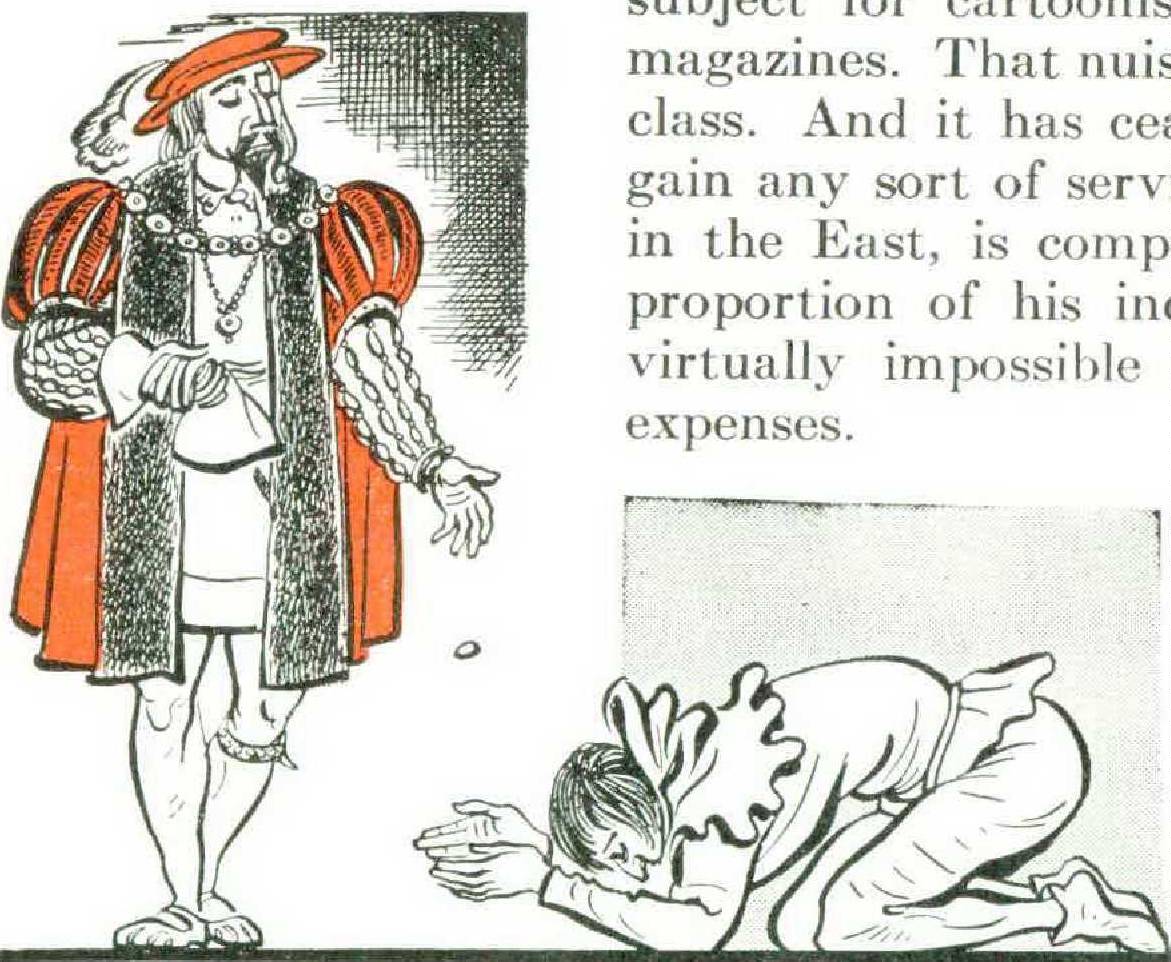
That such nonsense should have survived in modern Europe, even, is surprising. That it should have been imported to America and allowed to flourish to its present proportions is practically a national disgrace.
A generation ago the “tipping nuisance” was a subject for cartoonists and wits in the humorous magazines. That nuisance now is out of the nuisance class. And it has ceased being funny. In order to gain any sort of service, the city dweller, especially in the East, is compelled to put out an increasing proportion of his income in tips. It. is becoming virtually impossible for one to budget his living expenses.
One signs an apartment lease; and if he is sufficiently naïve, he might write down his rent as the cost of housing. But rent isn’t quite all the cost of housing. If the tenant really wants decorating done, as provided in the lease, he’ll slip the agent a substantial gratuity. He’ll also, as a matter of course, make presents to the apartment superintendent and the engineer and the house mechanic to establish his family as worth-while people.
He’ll tip and continue to tip at fairly regular intervals the person who carries away the garbage and trash. He’ll hand a dollar or so to the elevator operators every time their servility shows signs of turning to surliness. That will mount in the course of a year because, if there are a dozen elevator operators in the building, they rotate so that he’ll encounter all twelve. It’s to their advantage to play musical chairs with the various lifts, getting acquainted with every resident of the house.
If the tenant lives, for instance, on the tenth floor and the resident of the eighth floor has been more liberal with the particular operator who happens to be on duty, the tenth-floor tenant will wait before the door while the elevator rises to the eighth floor, stops, takes on the generous lord, and descends leisurely to the ground floor amid the exchange of patronizing pleasantries for obsequious platitudes. By the time the elevator reluctantly climbs back to the tenth floor the waiting tenant remembers that it has been several weeks since he handed a bank note to this house servant.
The city dweller travels constantly through a forest of outstretched palms. The waiter, the cab driver, the delivery man from the store which advertises free deliveries, the checkroom girls, the butcher’s clerk (if you want specialties), the grocer’s clerk (if you want service), the barber — virtually everyone who serves the city dweller expects not only the stipulated pay for the service but a gratuity.
My point is not, however, the expense and inconvenience to the donor. More often than not he gives either to gain special privileges or because he fears he will lose caste or be insulted if he does not. My point is the ridiculousness and the shame of obliging American citizens, working on full-time jobs, to adopt the degrading tactics of a mendicant in order to live.
The truth is, of course, that these people must have your tips to support themselves and their families. The truth is that their employers subtract a very optimistic estimate of an employee’s annual tips from his annual wage. This practice, I submit, is preposterous, undemocratic, dishonest, destructive of human dignity, and thoroughly vicious.
I am not greatly concerned with the fortunes made in tips at night clubs and similar excrescences on the body of our civilization. I am concerned primarily with the tipping evil as it touches ordinary life.
Why do you tip your barber but not your dentist? The answer is plain.
Why do you tip the taxicab driver and not the bus operator?
Why, after a particularly good meal, do you tip the waiter liberally but not the chef, who, after all, is responsible for the meal’s excellence?
When the jolly-good-fellowship of certain Sir Bountifuls began to be copied by patronizing showoffs who hoped they might be mistaken for Sir Bountifuls themselves, the practice of presenting lagniappe to waiters and cab drivers became too common for the owners of cafés and cabs to overlook. They began to compute probable tips into minimum wages. Thus every taxi meter in America is a liar. A 75-cent fare means a dollar.
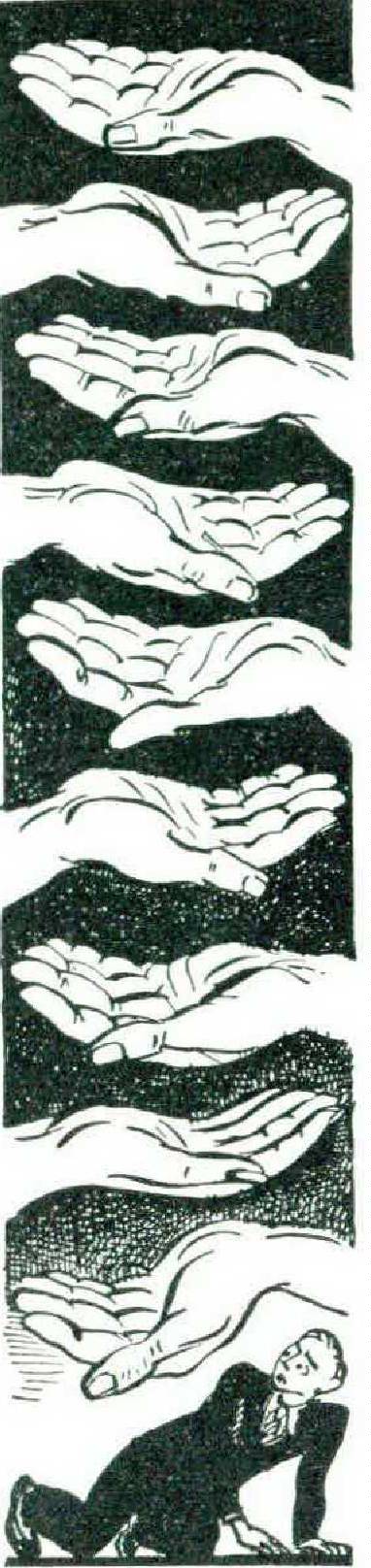
Who benefits? Probably nobody, and certainly not the driver. Competition between cab companies in major cities is so high that fares no doubt are as low as they could profitably be. But it is an unlovely system which requires a highly skilled, hard-working citizen to live on the usually grudgingly given charity of his customers. A gratuity, no matter how much it is expected, no matter how commonly given, in the last analysis is charity.
These conditions now hold in virtually every service trade. Except in some of the better clubs, waiters and waitresses practically live on alms.
The service charge seems to be one solution. If apartment house owners, under the present schedule of rents, are unable (which I do not believe for one moment) to pay their employees enough to take them out of the mendicant class, they should be straightforward and tack a service charge on their tenants’ rent, distribute this money equitably among the employees, and definitely forbid these employees to accept gratuities from any of those ego-bloated residents who might seek to bribe their way to special privileges. If the laborer is worthy of his hire, why not pay him his due instead of issuing him a semiofficial begging concession?
No one likes the tipping system except a few perfumed headwaiters and alcoholic climbers in café society. Why do not the unions, especially in the service trades, make a stand to retrieve the human dignity of their members? This is definitely a job for organized labor. And I believe that a concerted drive to wipe out the tipping evil, even by making taxi meters, menus, and other price schedules honest, would meet no public opposition.