Bats in the Bomb Bay
By LOUIS N. RIDENOUR
DURING World War I, the Allies spent some of their anti-submarine effort training sea lions to track down U-boats. The war ended before this measure could be used in combat.
World War II, as everybody knows, was an air war to an overwhelming extent. It began and ended with air bombardment of cities, and the Navy was frank to say that its most important class of ship was the aircraft carrier. Accordingly, the animals looked to for assistance were predominantly birds.
One scheme involved bats. I learned of this when I was having luncheon at the Cosmos Club in Washington with a general officer in the Army Air Forces and a distinguished civilian employee of the War Department. The General turned to my companion and said, “By the way, they tried three hundred bats out at Sunnyvale the other day, with full load. Only two crashed.”
Naturally enough, I waited for the laugh. But my friend — let us call him Wilson — turned to the General with considerable interest. About this time they noticed my surprise, and told me the following story.
A professor in a well-known Ivy League Uiversity had made the observation that bats, when the sun is about to rise, roost — if that is what bats do when they hang by their claws — in the most unlikely and hard-to-reach places. He reasoned that if the bats could be caused to set fires in such places, the fires would probably go unnoticed for some time, and then be very hard to put out. And, since Japan is notoriously made of paper —
The professor was so taken with the idea that he spent quite a lot of his own time and money backing it. He looked into the bat supply available in the caves of the West and found that, like the Chinese people who would never finish marching four abreast past a given place, certain types would never finish flying out of caves at a certain rate, even if they never came back.
He studied the handling of bats and found that they could be caused to hibernate by lowering their temperature, and to wake up by raising it. He worked out a means of attaching a tiny incendiary capsule to each bat, by means of a surgical clip fastened to the loose skin over the chest.
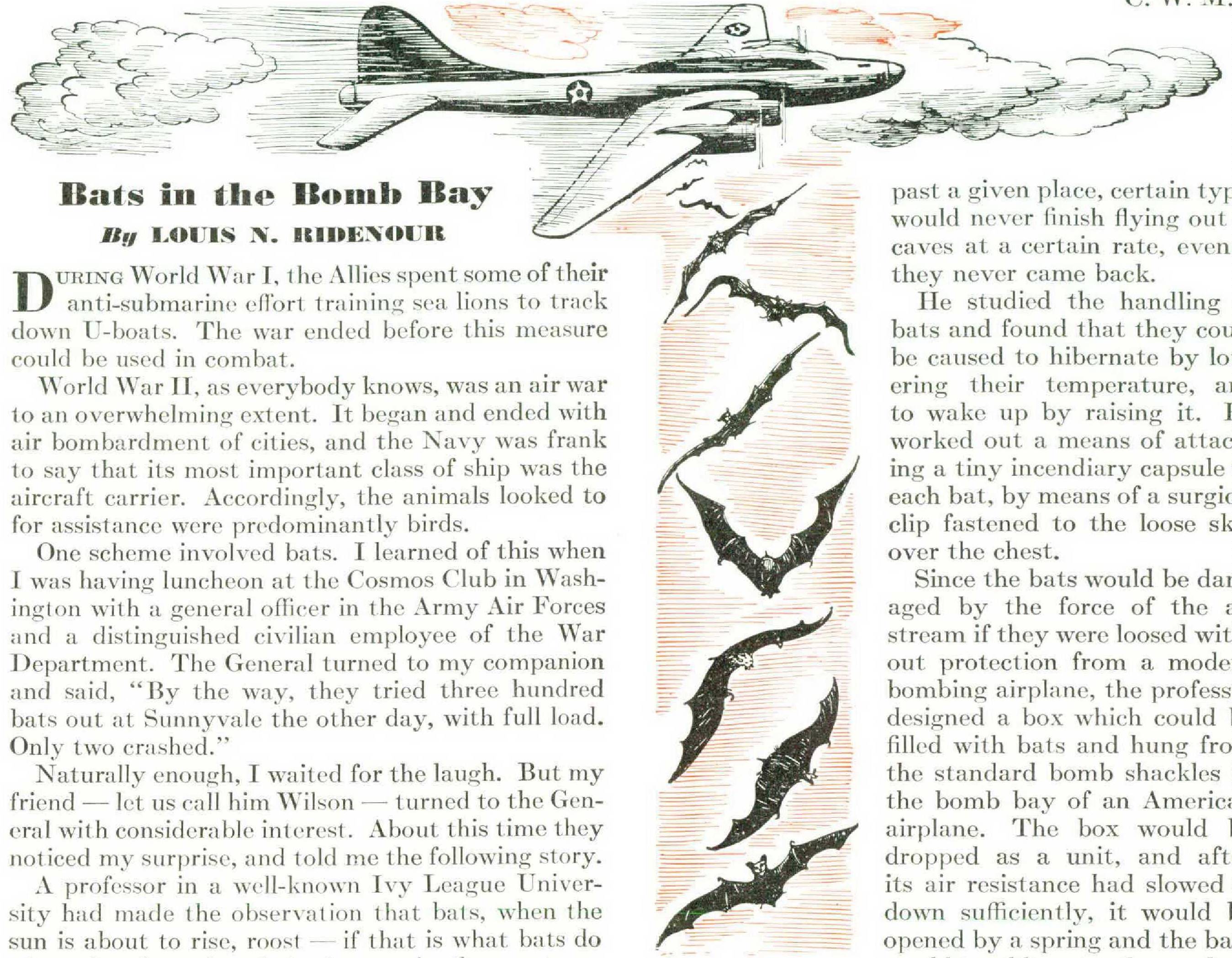
Since the bats would be damaged by the force of the air stream if they were loosed without protection from a modern bombing airplane, the professor designed a box which could be filled with bats and hung from the standard bomb shackles in the bomb bay of an American airplane. The box would be dropped as a unit, and after its air resistance had slowed it down sufficiently, it would be opened by a spring and the bats would tumble out unharmed.
At one stage of the project he explored the possibilities of a rocket with bats in the war head and a time-delay mechanism which would release the bats at the top of the rocket’s flight. This device was intended to permit the bombardment of the enemy shore with bats fired from the deck of a submarine.
The professor studied the load-carrying capacity of various species of bat, and when he had found the type that could handle the biggest payload, he made statistical investigations to determine what proportion of these bats would stall and spin in under full load. It was such a test that the General was reporting to Wilson. It seems that they took the bats up onto the rafters of the airship hangar at Sunnyvale and pushed them off.
Well, this particular secret weapon was never used. I saw a very brief story in the newspaper that said the reason was that bats are notorious carriers of disease. It was feared that the Japanese might think we were engaging in biological warfare if we dropped bats — even incendiary bats — on them.
In a way, I’m sorry that the bats weren’t dropped in anger, because I like to think how dramatic the scene would be. Imagine a giant four-engined bomber droning through the night, just before the dawn. The navigation is by radar in the darkness, and muttered course corrections come from radarman to pilot on the interphone. Enemy searchlights reach out like probing fingers for the bomber, and from time to time flak bursts near-by with the hollow sound that means it is too close.
At last it is time to start the bomb run. The pilot throws the controls to automatic, so that the bombardier can steer the airplane. The bombardier is bent over his radar bombsight, concentrating on the run. Flak bursts appear unheeded at nine o’clock, a little low. Finally, when the tension of the crew has become unbearable, there is an abrupt lightening of the plane. The bombardier straightens up and breathes a sigh. Pushing his interphone button, he says the two words the crew has been waiting for: “Bats away!”