Sea Food
By CROSBY GAIGE
SOME years ago I had the privilege of editing the American edition of Mme. Prunier’s Fish Cookery Book. Prunier’s in the Rue Duphot in Paris was at that time the world’s most famous restaurant specializing in fish. Alfred Prunier, his heirs, successors, and assigns, were artists in the same sense of the word as the tapestry weavers of Belgium or the diamond cutters of Holland. Fish was their medium of creative expression. As a matter of comparison, Mme. Prunier’s book describes one hundred and fifty different ways of cooking sole, whereas the most popular American cook book presents but five methods of dealing with this fine fish.
To return to the range side, here is the method of preparing the Goujonettes of Sole served recently at a luncheon that I enjoyed with Jeanne Owen and André Simon. The recipe can be successfully used for English sole, lemon sole, or flounder. The boned fillets of fish are cut on the bias into fingerlike strips. These are dipped in salted milk and lightly floured. Fry them in deep fat for five to seven minutes. The fat should be very hot, slightly smoking, so that the fish is seared or “sized” at once.
The delicately browned julienne strips of fish should be served from a napkin. They may be taken in the fingers and dipped in the Perfect Mustard Sauce. The recipe for this sauce was given me by the late Charles Scotto, Escoffier’s favorite pupil, when he was chef at the Hotel Pierre. Of such sauces the French say with profound aptness, C’est la sauce qui fait manger le poisson. It is the supreme blessing with grilled pompano, poached lake trout, or poached turbot. Here is the way to prepare it, and the cook must figure out for herself the quantity of sauce to satisfy generously the number of guests to be fed. This sauce is slightly expensive and is appropriate for a party or for the family when they are on their best behavior.
On the fire, in a sauté pan, one ounce of butter is melted and one ounce of flour is stirred in briskly for about two minutes without browning. Add to this one-half pint of slightly salted consommé. Stir well with a fork or metal whip. Blend two egg yolks with two tablespoons of heavy cream and whip into the mixture. Remove from the fire and add a teaspoon of lemon juice; strain through a fine cheesecloth. Over low heat add one-quarter pound of sweet butter and one tablespoon of powdered English mustard that has been made into a smooth paste with a little water. Blend the whole mixture thoroughly and serve in a hot sauceboat.
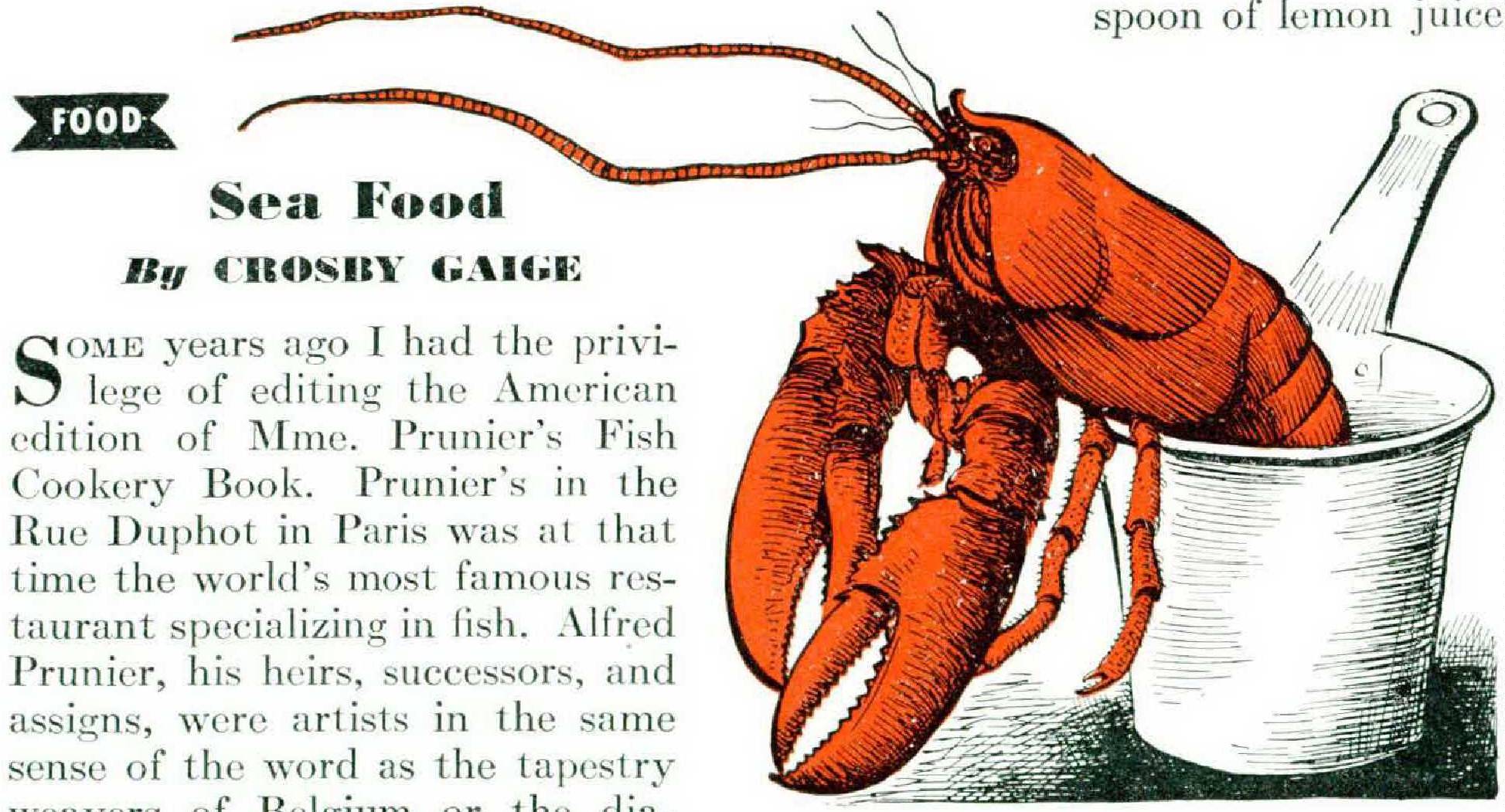
There are many distinguished members of the Crustacean family. They are all fairly well-to-do and I have met them on friendly terms in most of the swankier eating places of Europe and America. Whether they go under the name of Homard, Langouste, Crawfish, Rock Crab, or Lobster, they are all interesting fellows and worthy of cultivation. Chefs of high and low degree are forever practicing their art upon these creatures. We have Homard Américain, Homard Amóricain, Lobster Newburg, and Homard rôti au Whiskey.
The best lobster I ever ate, however, was cooked in a tin wash boiler over a fire of driftwood at a beach party held in a rocky cove on the Maine coast. The lobsters were the smallest that the law would allow and there were plenty of them, at least two per person and a few spares for the greedy. There was an ample supply of melted butter enhanced with finely chopped parsley. The picnickers, freed from the conventions of the dining room, were joyously at liberty to crack their lobster claws at will and to scatter the shells without damage to napery or carpets. Each guest had a little dish of melted butter in which to dunk his lobster. From recent experience I hesitate to confess that my own dish of butter had been blessed by just one fragrant tear that brimmed from the eye of Little Eva, my personal clove of garlic who has been with me for years and who always accompanies me to picnics and similar celebrations.
Some mistaken people go in for broiled lobsters, but the real high priests of the lobster cult rightly insist that boiling is superior. The usual method is to plunge the lobsters into a pot amply filled with boiling water — sea water if it is available — and cook for twenty minutes after the water has resumed boiling.
Cold lobster should be served with homemade mayonnaise. Here is a recipe for a mustard mayonnaise that lends a touch of variety to the proceedings. This is also a good companion for a boiled striped bass.
MUSTARD MAYONNAISE WITH CHOPPED CHIVES
1 egg yolk 1/4 teaspoon of paprika
1 teaspoon of salt A pinch of cayenne
1 teaspoon of dry mustard 2 tablespoons of lemon juice or wine vinegar
1/4 teaspoon of sugar 1 cup of salad oil (about)
1/4 cup of finely chopped chives
Beat egg yolk with rotary beater until it is thick and lemon-colored. Mix the seasonings and add to egg yolk, beating well. Add one tablespoon of the lemon juice or vinegar and continue to beat well. Begin to add oil, about one-half teaspoon at a time, beating steadily as you add, until one-fourth cup is used. Then one to two tablespoons can be added at a time, beating as you do so. As mixture thickens, the remaining lemon juice or vinegar may be added. Blend in sufficient oil to make rich, thick dressing. Then stir in the chopped chives. Store in cool (not freezing) temperature.
NOTE: If oil is added too rapidly at first, the mayonnaise will not thicken. Once the mixture really begins to thicken, then oil may be added more rapidly, but each addition must be well mixed in. Makes about one and one-third cups of dressing.
Distinctly a party dish is a Curry of Lobster and Crab Meat that was served at one of the famous dinners of the American Spice Trade Association at the Hotel Astor. It was presented on squares of lightly toasted bread with little mounds of chutney, candied ginger, and shredded coconut as garnishments.
CURRY OF LOBSTER AND CRAB MEAT
10 ounces of fresh cooked lobster
16 ounces of crab meat
Butter a saucepan, put in lobster and crab meat, cover with parchment paper and place in a medium oven for about four minutes.
CURRY SAUCE
6 ounces of butter Salt and pepper
1 apple 2 ounces of flour
2 thick slices of eggplant 1 1/2 tablespoons of yel-
2 ripe tomatoes low curry powder
1 large peeled onion 2 cups of bouillon
1 teaspoon of parsley 6 ounces of white wine
4 ounces of celery 1 bay leaf
1 cup of heavy cream
Melt in a saucepan the butter without letting it brown; then add the apple, eggplant, tomatoes, onion, parsley, and celery, all roughly chopped, and cook until tender. Then add the flour, curry powder, bouillon, white wine, bay leaf, and season with salt and pepper to taste. Let the whole reduce on a slow fire until it thickens (about one hour) strain and add it to one cup of cream. Mix the curry sauce with the lobster and crab meat and boil for one minute before serving. Serves six.
NOTE: One tablespoon of curry powder is sufficient for a mild flavor. Use one and one-half tablespoons of curry powder for increased flavor.
Absolutely the best rule for cooking oysters that has ever come to my attention is not to cook them at all. They should be opened fresh and eaten just as they slide from their nacreous sheaths. A drop of lemon juice and a touch of freshly ground pepper may be permitted, but the oyster in itself, more than any other medium, carries the essence of the sea.
Personally I am very fond of a good cocktail sauce, that zesty combination of chili sauce, catsup, grated horse-radish, lemon juice, and chopped chives. It is an end in itself and should be served at least once a day on all tables for the delectation of habitual self-confessed dunkers like myself. Give me a roll and a dish of cocktail sauce and I can amuse myself indefinitely. However, I would never waste cocktail sauce on an oyster, or vice versa.
If we must cook an oyster, let us do properly some Angels on Horseback or Anges à cheval, one of the best savories ever devised for a Sunday night supper. Remove the “beards” from raw oysters, wipe each oyster with a cloth, wrap it in a thin slice of bacon, and skewer them on small skewers —a half dozen to a skewer. Grill them briefly until the bacon is cooked but not too crisp, and serve them on pieces of lightly toasted bread that have been sprinkled with bread crumbs fried in butter to which has been added, for zest, just a touch of cayenne pepper.