This Month
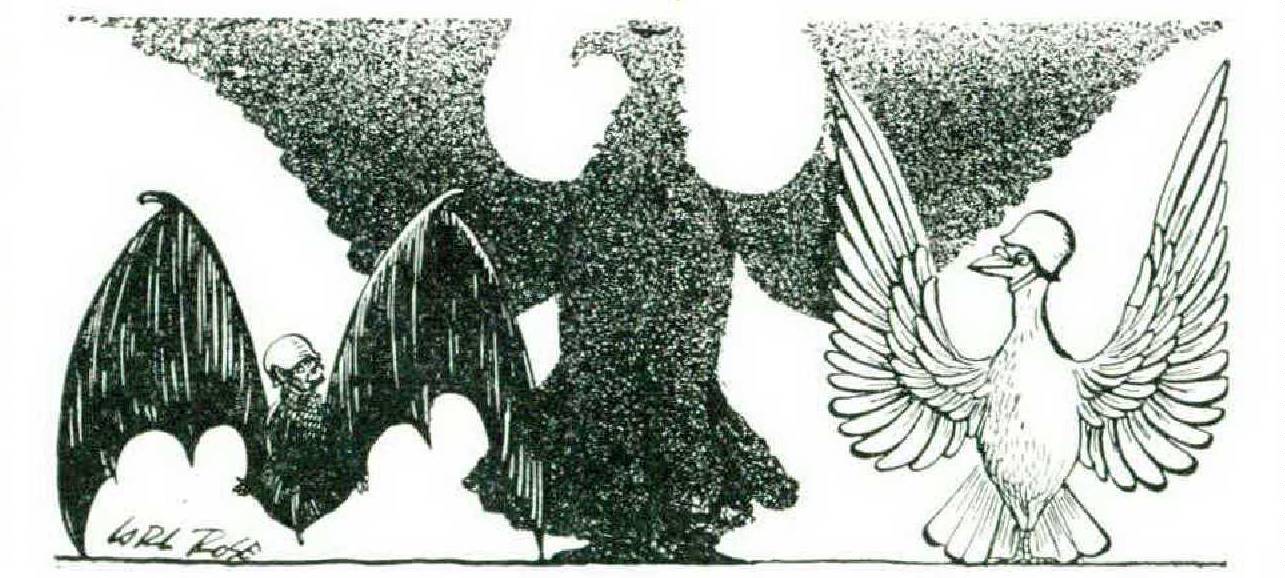
The series by Louis N. Ridenour which begins on the next page was originally entitled War Birds. We threw the title out, partly because we needed his subtitles and partly because of a vague idea that we should have to answer considerable mail pointing out that a bat is not a bird. The series does deal entirely with winged fauna, however: bats and pigeons which were selectees in the Allied forces, and a colony of sea birds of Axis sympathies.
If Dr. Ridenour’s report on the bats strikes the reader as somewhat incredible, we can only say that the pigeons story which will appear in the January Atlantic will seem even more so. But they are factual accounts in which even the strangest detail is stoutly supported by Dr. Ridenour. We asked him, for instance, if he would really back the statement that the man carrying on the pigeon project fed the birds marihuana to step up their rate of peck. “Certainly,” he replied. “Everyone knows that many kinds of bird seed contain marihuana. Why, in some places the addicts simply plant bird seed and pull up everything else that comes up except the marihuana.” It made us wonder about goldfish food, but there are no aquaria in the series — not so far.
The reader is advised, then, that “Bats in the Bomb Bay” and our January installment, " Doves in the Detonator,” are not merely an alliterative caprice of Dr. Ridenour’s. They are accurate titles for the bona fide research on which he reports.
In response to an Accent on Living statement by Crosby Gaige that a cocktail party is “the lowest form of social intercourse,” the Atlantic has received a resounding endorsement of Mr. Gaige from Miami Union, Woman’s Christian Temperance Union, and a request for more Gaige in the Atlantic. We are happy to comply (page 117).
The Massachusetts traffic standard is so weird that the Chicago area has always seemed to us a motorist’s safety zone by comparison. Boulevard travel in that city is the easiest, the fastest, and the most highly disciplined of any in our experience. Yet the situation of the driver is rapidly deteriorating there and elsewhere, according to Bergen Evans of ihc Northwestern University faculty (“Look Out, Here I Come!” page 119). His own observations of behavior on the highways made him curious to hear what the experts had to say about traffic accidents. All that they could tell him, hopefully, was that “the driver who expects to survive must drive under the assumption that all other drivers are drunk or crazy.” No driver can “take it for granted that he has any legal rights on the road at all.” We trust that the Evans diagnosis will get a hearing before Detroit is again in full flower.
We once spent an evening with Russell Maloney at the New York tavern from which “A Night at the Mermaid” (page 121) was documented. For literary inspiration a night at a dog track, a freight terminal, or a foundry would be more rewarding. Even so, a familiarity with such a place would have done our own teacher of English composition no harm. We could have forgiven him an uninformed yearning for the Mermaid, but he lacked even the “secondhand gusto” of Maloney’s pedants. Our man taught nothing but his two grandiose obsessions. His first was a conviction that “aborigine” was a good word but its derivation made “aborigines” incorrect and that we should always use “aboriginals” instead. Secondly, he believed that Theodore Roosevelt was the greatest American of all time, and all our composition subjects covered, aflirmatively, his doings. Beyond these two nuggets, we recall him only for his tweeds and his handsome, Roman-coin profile.
In these days of canned journalism, when the mimeographed handout conquers all, it may seem ungenerous to raise questions about the reporter who actually takes the trouble to ask a question and write down the answer. But the answers are oftentimes so puny that we are glad to give R. J. Hicks his fling at the matter (“And I Quote,” page 123). The worst we ever heard was on the radio last year when a diligent reporter, in the hubbub over a false Armistice rumor, provided his wire service with the following bulletin: —
“An unnamed official, who declined to be quoted, said: ‘I have nothing to say.’”
C. W. M.