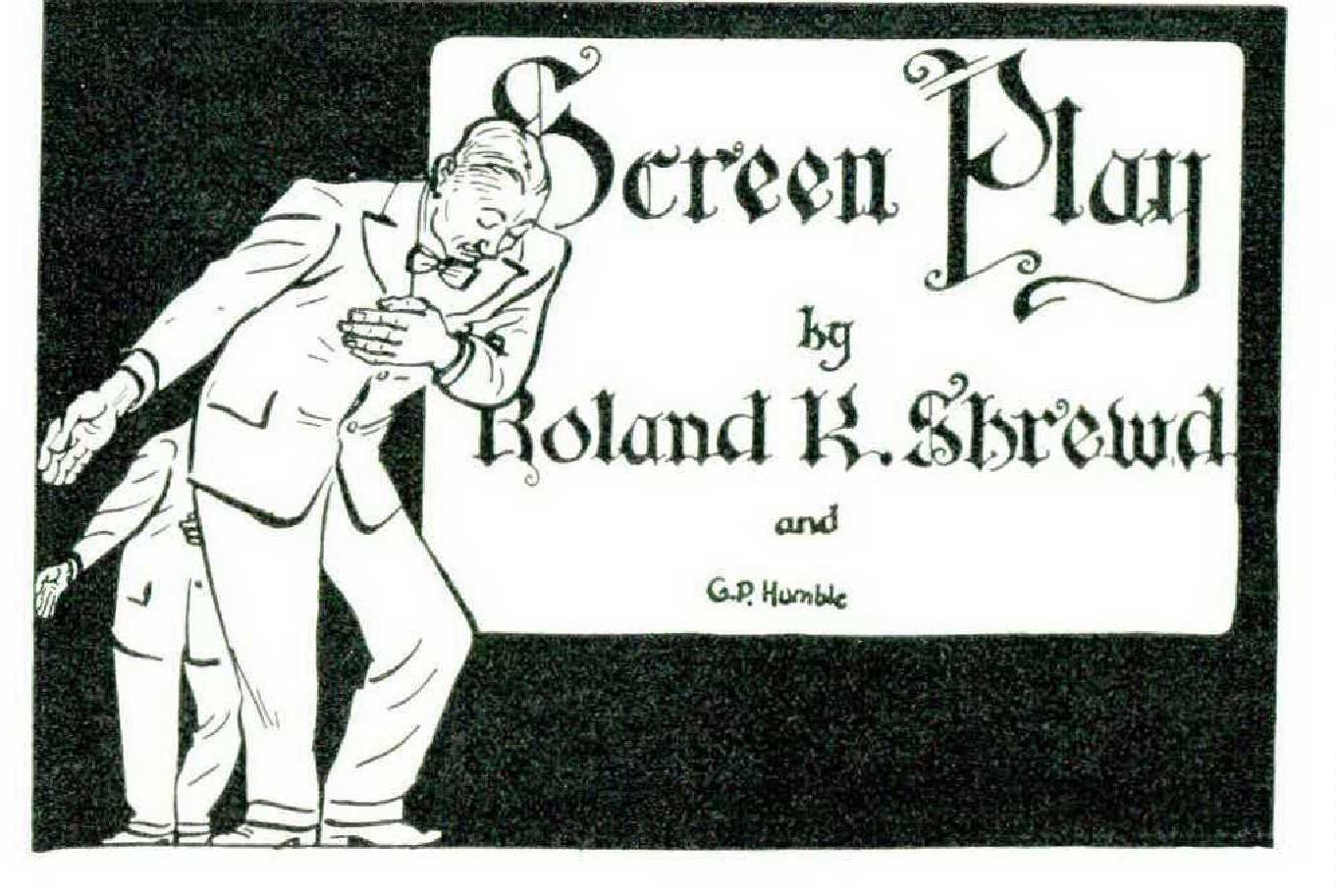
Two Men on a Vehicle
ROLAND KIBBEE is a Hollywood screen writer. He spent several years in the field of radio writing and has had considerable experience in commercial and military aviation. This is his first appearance in the Atlantic.
HOLLYWOOD
by ROLAND KIBBEE
I DARESAY you have no intention of becoming a Hollywood scenarist, but in these days of sudden peril it is wise to be prepared for any catastrophe, however unthinkable. Should disaster ever befall you, console yourself that you may survive very nicely as a movie writer without ever writing a movie.
You may have noticed, with some annoyance, the startling resemblance between a page of the telephone directory and the writers’ credits preceding a film. These collaborations are rarely spontaneous with the participants. Rather they are imposed by fate, circumstances, producers, and other unpredictable forces. All that is required to succeed in such a collaboration is a heart of stone, a congenial mien, a flair for larceny, and, of course, a writer — preferably a talented one, trusting, with big, baby-blue, wondering eyes.
Most of your victories will be scored in the story conferences with the producer, but the outcome of these sanguinary tactical engagements is never assured in your favor without sound maneuvering during those long hours when you are alone with your conscience and your partner. It is while his brain is in labor with the deathless prose for which you will eventually take credit, that he can best be prepared for the inevitable insertion of the bodkin.
From the very beginning you must adopt an air of subtle and reluctant superiority. Find out his background. If, for example, he was at one time a radio writer, simply remark at every opportunity:“ Really,old man, that may be all well and good on the wireless, but it’s not the way we do it in films.”
The British affectation is optional, but I believe you’ll find it effective. It is consistent with the device itself, which is clearly intended to give the fellow a feeling of inferiority mingled with awe. The fact that you have no idea whatsoever how it’s “done” in films is immaterial. Neither has anybody else.
Of course, you may be up against a man who has been writing films for some time and who has no shameful past like radio writing which can be used against him. But the chances are that he has written something somewhere sometime that he would rather forget. See to it that he doesn’t. In response to one of his suggestions for your project you may say: “Isn’t that rather like the scene in your (name of flop)?”
Whatever the case, you will always be able to find a vulnerable spot. Being a talented writer, he will be possessed of such artistic failings as humility and a willingness to accept criticism. These can be used to place him in the pale of your preeminence. Once this is accomplished, you are ready to erode his belief in his own craftsmanship while, at the same time, improving his conception of yours. You make him believe that you are contributing more to the story than he is, although he is doing all the writing!
The methodology for achieving this highly desirable confusion can best be illustrated by a dialogue that, in substance, has taken place time and again between film writers in collaboration. Let us take two partners and call them Shrewd and Humble. Humble is the writer. Shrewd is the professional collaborator. The two men are at work in Humble’s home.
(NOTE: Always work in the other guy’s home. We are all self-conscious about certain intimate details of our family life. Nothing will make your partner more ill at ease, or induce a deeper feeling of apologetic subordinacy, than to have you see his wife in an old kimono.)
Now, then, Shrewd and Humble are diligently at work — Humble on the story, and Shrewd on Humble.
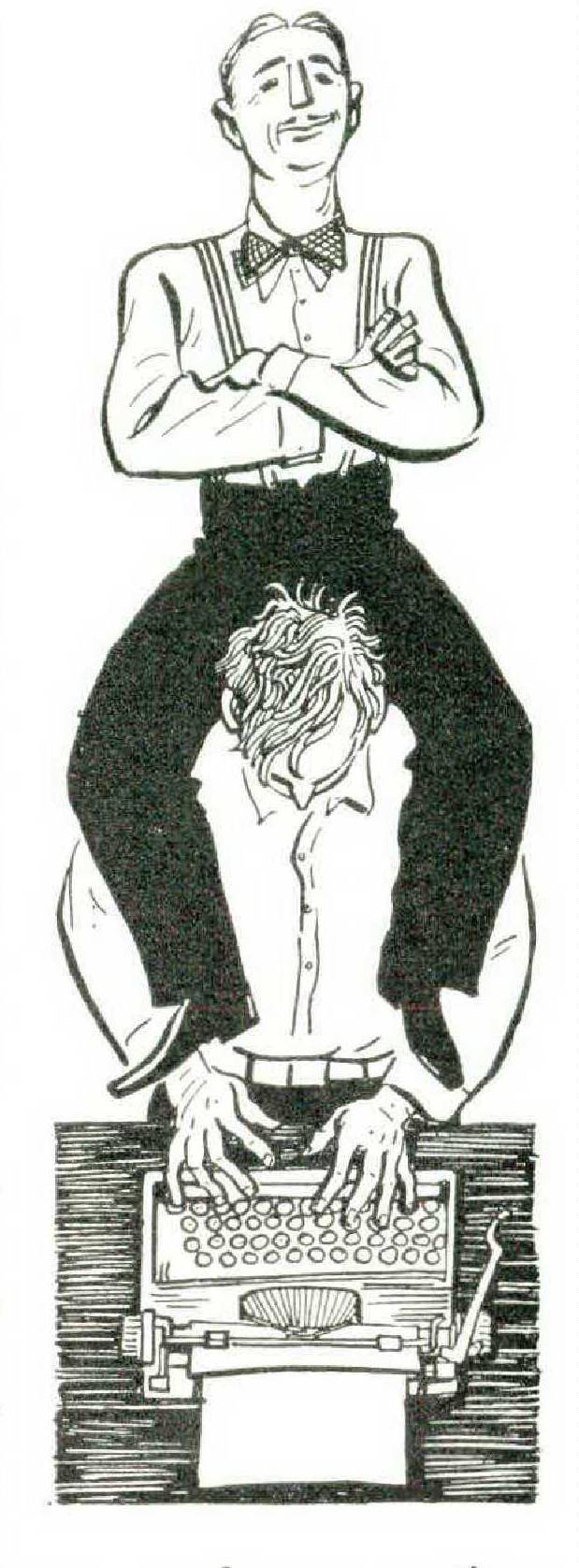
HUMBLE: Say, Shrewd, I had a notion about the finish yesterday.
SHREWD (preparatorily): I phoned you last night but couldn’t get an answer.
HUMBLE: That’s funny, I was in. But anyway, about the finish. My idea is to break it open for comedy and have the girl play the scene in the boy’s pajamas.
SHREWD (thunderstruck): Good God!
HUMBLE (dismayed): You don’t like it?
SHREWD: Like it! Man, that’s the exact idea I phoned you about last night. It came to me when I was putting on my pajamas. Cripes, it must be Fate!
Whereupon Shrewd, visibly moved by this manifestation of supernatural forces, pours himself a stiff shot of Humble’s best Scotch. And Humble, impressed and a little flattered at having stumbled onto the same idea as Shrewd, hurls himself at the typewriter and begins to work the scene into the story.
Needless to say, the accomplished collaborator does not overdo this technique. While not a writer, he is frequently something of an actor. He knows how to underplay. The technique here is to let Humble repeat the new idea over and over again while Shrewd is apparently lost in thought. Nothing sounds deadlier than an unwritten, undeveloped story idea, even to its creator, when he is forced to state it and restate it and state it yet again for a deadpan auditor.
Eventually, Shrewd will nod sagely, vouchsafe a tentative “Could be,” make a minor change which “might make it work,” and generously permit Humble to incorporate it into the script. When the finished product is admired, this particular item bears such an unpleasant association in Humble’s mind that he is not likely to claim its authorship. Psychiatrists know this condition as oblivescence — the faculty we have for conveniently forgetting that which we do not wish to remember. Psychiatrists also know Humble.
The whole idea, as you can see, is constantly to discomfit your partner. I know a studio functionary who pretends to be hard of hearing during business negotiations, thus forcing his antagonist to shout and repeat. It is reasonable to suppose that if Shakespeare himself had been forced to shout a synopsis of Hamlet over and over again at the Lord Chamberlain he would never have written it.
One further word about your personal conduct with your partner. Don’t see him socially. If Mr. and Mrs. Shrewd have dinner at the home of Mr. and Mrs. Humble, then it will become necessary for the Shrewds to have the Humbles over to dinner. As was pointed out earlier, you can’t expect to have people nosing about your lodgings and still command their awe. Mrs. Shrewd probably looks just as bad as Mrs. Humble in an old kimono. “Familiarity,” as a collaborator once remarked to me, “breeds contempt.” He also remarked that it was his own line.
Once Shrewd holds the whip hand over Humble, the rest is easy. Ever more glib than his writer partner, Shrewd will have no trouble persuading friends, colleagues, and columnists that he had more to do with the script than Humble. And a few well-placed blows in story conferences will induce the producer to accept Shrewd as the mainstay of the team. Three sure-fire story conference techniques follow. They have never failed.
1. Arrange to sit side by side with your co-worker so that the producer sees both of you, but neither of you sees the other. Now the producer says that this or that portion of the script is inadmissible. The word usually employed is “stinks.” You quickly shoot a look of gentle reproach at Humble. It is not much, but the producer sees it and is left with the ineradicable conviction that your partner is murdering the script in spite of everything you can do to prevent it.
2. This is the same as 1 with reverse English. The producer says that this or that is okay. You instantly beam triumphantly upon your associate and expostulate: “What did I tell you!” You may indeed have told him it was okay when he thought of it. But the effect of your outburst, as will readily be perceived, is to give the producer the impression that the favored writing was yours, and that your associate fought tooth and nail to prevent its inclusion in the script.
3. When the producer is pleased with the way things are going, always refer to the team in the first person singular — “I think,” or “I did,” or “I will do.” When the producer is dubious about the progress being made, always say, “We think,” or “We did,” or “We will do.” It would be dandy if, in the latter instance, we could indicate our partner and say, “He thinks,” or “He did,” or “ He will do,” — but that is rather too obvious for practical usage. There’s no reason for gambling on a punch in the nose. You’ll get along fine if you’ll just follow the directives set forth in this article. If they fail, don’t blame me. Blame my partner — he wrote it.