How Cool Is a Cucumber?
AUTHOR, with his wife Margery, of various oddities in the field of natural science which first appeared in the Atlantic and which were recently published in book form, LORUS J. MILNE is a teacher, biologist, and biophysicist in the Department of Zoology at the University of Vermont.
SCIENCE
by LORUS J. MILNE
SCIENCE is wonderful. It measures everything. Even the proverbial coolness of a green cucumber comes in for evaluation and explanation. The cuke, it seems, is not particularly notable for low temperatures. Its real coolness comes from the refrigerator, not the garden, for only the shade of the vine’s leaves out of doors keeps it from getting hot on a summer day.
Lettuce is a very different vegetable. Not that the iceberg variety would be attractive to polar bears in July. But the lettuce head is actually many degrees cooler than anything else that grows in the garden. As long as it can evaporate moisture from its green surfaces, it can lose heat and staywell below the temperatures of near-by plants. The process is exactly parallel to the way in which man’s perspiration helps to keep his blood at 98.6 degrees Fahrenheit, no matter what the day or his activities may offer. To turn water into vapor requires five times as much heat as to raise it from the freezing to the boiling point. If a dry breeze comes along and absorbs some of the water as vapor, it carries away also a great many excess calories from both lettuce and man, and keeps their temperatures within comfortable limits.
The changes of temperature within garden fruits are surprising. Take a tomato, for example. If the night drops to 57 degrees, so does the round fruit on the vine. As soon us the day’s heat leaves it. the tomato stops ripening, though it could still grow in size if the roots had sufficient water. If the morning is cloudy, the tomato may remain at 58 or 59 degrees until noon. But let the sun strike the fruit and up soars its temperature. The heat is derived from the radiant energy that falls on the tomato, and soon this can bring it into the seventies although the air is still not above 65 degrees. The internal warmth accumulates in the same way as inside an automobile overheating in the sun, with windows closed.
These are the findings of scientists who believe in knowing what goes on, and who learn the answers through the use of sensitive metal thermometers, The instruments do not resemble any that hangs on the wall of the living room. Each is merely the short common tip of a pair of wires fused together. Since the wires themselves are line and flexible, this junction is not larger in diameter than the lead of an automatic pencil. It may be barely a quarter of an inch long. Hence it is perfectly adapted for insertion into parts of living plants and animals, to learn what the temperature is inside while ordinary processes are under way.
To yield information on heat levels, the two wires must be of different kinds. Customarily one of them is pure copper, the other a special alloy called constantan. The fused pair form a heat-measuring instrument of the simplest kind, called a thermocouple. The bimetallic junction produces an electric current according to the heat level at which it finds itself. And it is necessary only to connect the long fine wires to the proper meter to read the temperature directly.
These convenient heat-measurers have been thrust into eggs of wild birds in the nest, to learn whether an egg gets cold while a robin goes out for dinner. Under proper conditions a bird’s egg is incubated at about 93 degrees Fahrenheit. But when the robin left, in some instances her brood dropped to a chilly 44 degrees on a windy spring day. Then the parent returned, fluffed out her feathers over the shells, and the development of the young progressed a little farther.

It was found that the presence of the parent was not the only factor affecting egg temperatures. Direct sun or a strong wind penetrated the insulation of the nest and raised or lowered the heat levels inside the eggs by many degrees. Even the location of an egg in the clutch was important. One mallard duck was most solicitous in her care of eighteen eggs. But whenever the egg containing the tattletale thermocouple was in the center of the cluster, its temperature rose into the nineties. At the outer edge of the group the heat level wavered between the sixties and seventies. All this shows how important it is for the parent bird to keep rearranging the incubating eggs, so that each will hatch within a few days of the others.
The nesting season for birds ends before fall frosts set in. When cold weather arrives, robins and mallards are winging their way to sunshine and abundant food farther south. But many creatures are left behind, which must survive the winter on scant rations or on fat stores accumulated during the aut umn months. Bats of various kinds seek out caves where the temperature will not reach the freezing point, and suspend themselves from roof and walls for hibernation. Their body heat sinks to a few degrees above the air in the cave, and their slow breathing and heartheat match the new rate of living.
At 29 degrees the pulse still throbs six or seven times a minute, and thermocouples inserted into body openings of hibernating bats show that these flying mammals, though “warm-blooded,” will survive cooling to 19 degrees Fahrenheit. A “coldblooded ” turtle can stand cooling only to 22 degrees, but a honeybee can live in spite of slow chilling to 16 degrees’. Still smaller insects have been recorded with body heat down to 2 degrees above zero; each came to full activity when warmed once more to customary temperatures. In all these animals, breathing movements continue right down to the lowest point that life can stand. But if the animal drops a fraction of a degree below its critical level, respiration stops abruptly and ice forms in all the cells of its body. Until that point, it had been only “supercooled.” And below a blanket of snow, such chill seldom reaches hibernating insects among fallen leaves and under bark.
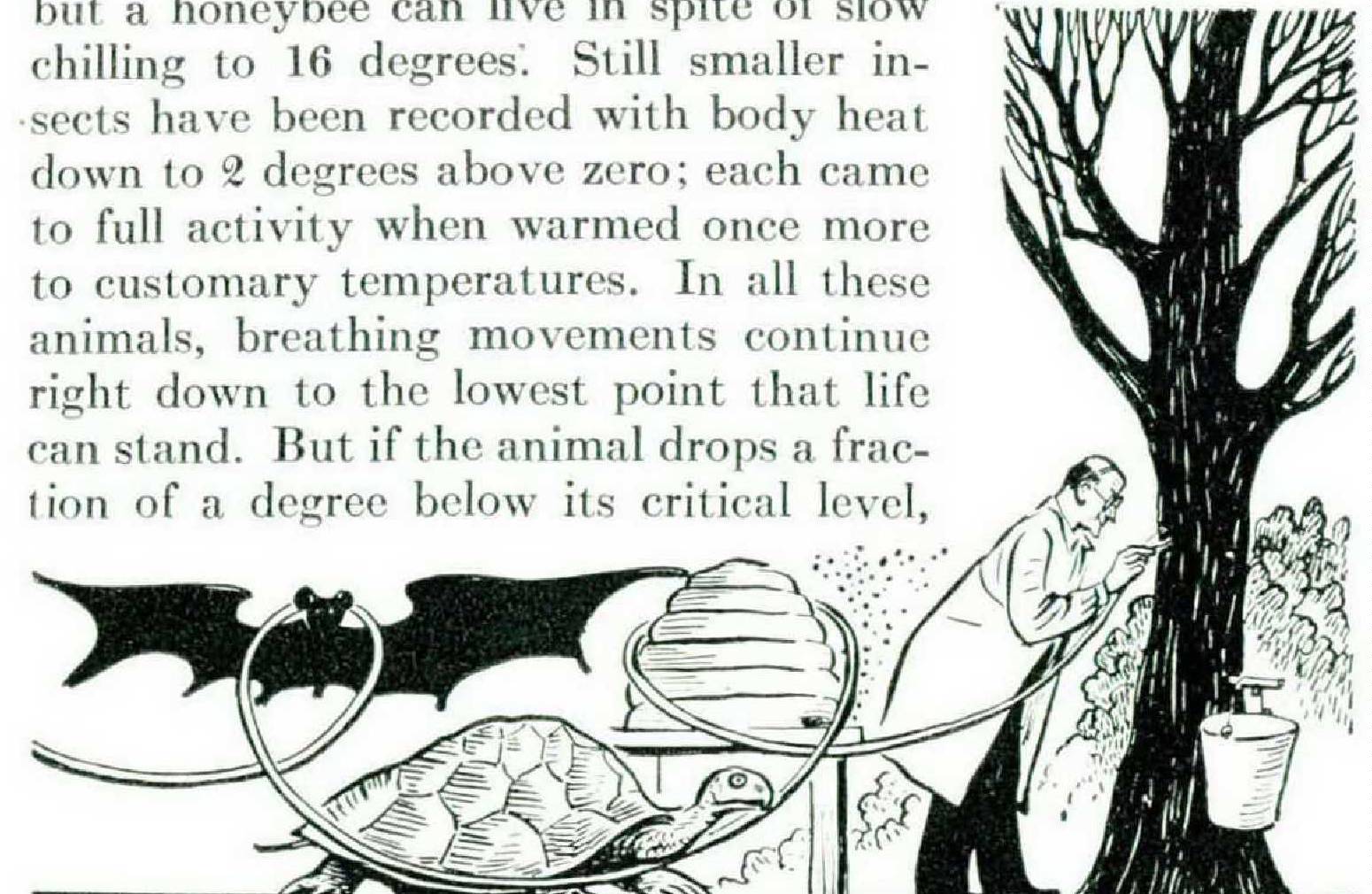
The problems that confront a scientist are endless. Whenever he discovers a new toy like the sensitive thermocouple, he is likely to take a sort of holiday — stabbing the instrument into a great variety of places, finding the answers to new questions as fast as curiosity supplies a suggestion. Often these apparently aimless measurements add up to something very worth while. Why, for example, should a sugar maple produce its sweet sap only in a very few days or weeks during the year? If the mechanism is there at one time, can it not be made to operate for longer periods or at other seasons? Again the temperature measurements supplied the answer. A sugar maple will produce sweet sap whenever it is chilled below the freezing point for part of each day, and raised above this level for a number of hours at a stretch. Weather providing such a recurrence of mild freezes and daily thaws is characteristic of early spring, of sugaring season. At other times of the year, either the temperature drops too far at night, or it rises too high during the day. Autumn is erratic. Some springs are also, and in those years there is a poor crop from the maple orchards of Vermont.
When the temperature requirements for sap flow were understood, a special air-conditioner was built to provide a maple log with just, such weather for months at a time. Twelve hours’ thaw, twelve hours’ freeze. The log of wood rested with one end in a tank of water, and maple sap ran from a tube through the bark every day. For months the machine operated without a break. Then the air-conditioner broke down and the maple log had a rest. When repairs were made and I he cycle began again, sap flowed once more. No end was found to this process. According to expert palates, the sap had all the line flavor of natural maple. Obviously the tree was slowly using its own substance to add to the water brought up from the tank, but there was no indication that the mechanism was harmed in any way by its steady use. Experiments with smaller logs, with parts of trees recognized in the Held for unusually high sugar content, and other proportions of thaw and freeze are still under way at the University of Vermont. Perhaps in the future a maple bush will merely grow trees to the point where they can be cut down and milked in an air-conditioned factory, turning the trunks slowly from maple logs to maple syrup. Where will the fall displays of brilliant reds and yellows go then? Perhaps some scientist with a thermocouple will find the answer to that too.