Step Off the Gas
THE most widely read living author of mystery fiction, whose total book sales have passed the 28-million mark, ERLE STANLEY GARDNER is an amateur of the outdoors. He is an archer, woodsman, and hunter, and his home at Rancho del Paisano at Temecula, California, is one of the most picturesque in the West.
by ERLE STANLEY GARDNER
IT WAS A day of clastic hours filled with interminable miles. Our parly had left, the train at Shoshone, Idaho, the previous afternoon and had driven most of the night over mountain roads, through Challis, then up to Meyers Cove, where we had thrown our sleeping bags on the ground for a few hours’ sleep.
We were up before daylight. Billy Meyers and his wife gave us a breakfast that was guaranteed to stick to the ribs. It was a job gelling the horses all saddled and the packs adjusted. Each side had to be balanced so that the packs would not roll or slip — bedrolls, tents, and bulky stuff on lop, and the small, heavy stuff riding in the panniers below.
Then we had taken off on horseback down Camas Creek, following for the first hour an old road, then picking up a narrow, winding mountain trail maintained by the Forest Service.
Down below us the Creek tumbled in a frenzy of white-foamed, roaring ecstasy. High above, a thread of blue sky showed between the walls of the canyon. The trail wound around precipitous bluffs, skirted tributary streams, cut through beautiful little valleys, climbed and dipped, turned and twisted until there seemed to be no end.
Tired ears ceased to delight in the roaring of the stream and the musical creak of saddle leat her. The dudes began to slump in their saddles, melting with every mile into postures of greater weariness. Along in midafternoon we reached the Middle Fork of the Salmon and headed for the old Mormon Ranch.
We were in Idaho’s “ primitive area” now. a place set aside for those who love the wild country. No roads were permitted anywhere within this district. The original plan had been that a great primitive area would be set aside, where a person could go by horseback or on foot, or be didn’t go at all.
Occasionally deer were seen bounding over the rocks. After we turned down the Middle Fork, a black hear loped across a flat., and one of the guides dropped his lead rope, unloosed his riata, and galloped after the bear, hoping to drop his loop over the bear’s neck. But the bear managed to get into the rough country where t he horse was at a disadvantage, and then went scrambling up the hillside, his frantic feet, throwing a barrage of loose rocks out behind him.
At night the dudes tumbled from their saddles. The packers arranged the duffel in a big half circle. The cook built a fire of small round wood which soon made coals for broiling. There were fried potatoes, onions, tender, juicy steaks, sugar peas, golden coffee, and over all a delicious sense of numbing fat igue.
Half an hour after the meal was finished, we were stretched out in sleeping bags, looking up at the stars. No automobiles, no traffic whistles, no blaring horns, no rumbling, tooting trains, penetrated into this country. The Middle Fork of the Salmon River made only a gentle noise as it slid toward the main stream, which, in turn, passes through the fabled “Canyon of No Return” to join the Snake.
We slept the sleep that, comes only to minds completely purged of all nervous worries. Occasionally we would waken to watch a new set of stars which had wheeled into position above us; then release again, into the depths of sleep.
With the first signs of dawn there was the bustle of activity in our camp. The whack of an axe sounded against dry wood, followed by the crackle of flames, the aroma of frying bacon and of boiling coffee.
The ground shook with the pound of the hoofs of pack horses being brought in by the wrangler. The bell on t he neck of the big gray mare made hysterical jangling as t he horses thundered in at an awkward, hobbled gallop.
My friend and I put rods together and slipped down to the stream for an hour’s fishing while the horses were being saddled and packed. Morning sunlight glinted on the ripples and the wet rocks. Below the rapids, the placid stretch of water was unruffled by even the faintest breeze.
We cast far out into the Stream, into the little whirlpools at the fool of the rapids. My fly snaked through the air, dropped lightly to the surface of the water, drifted for a few feet, and then suddenly disappeared with a “choog” as a trout surged up from the depths to jerk the line into a taut wire which hissed back and forth through the water as the rod bent in an are. By the time the packers called out that the horses were ready, we had enough fresh fish for a fine supper.
The fish were cleaned, wrapped, and placed deep in the pack under a down sleeping bag, where they would keep cool until evening. The pack train moved on.
That night we had fried trout, bacon, onions, golden-brown toast with melted butter soaked into the pores of the bread. Again there was a night of dreamless, relaxed slumber.
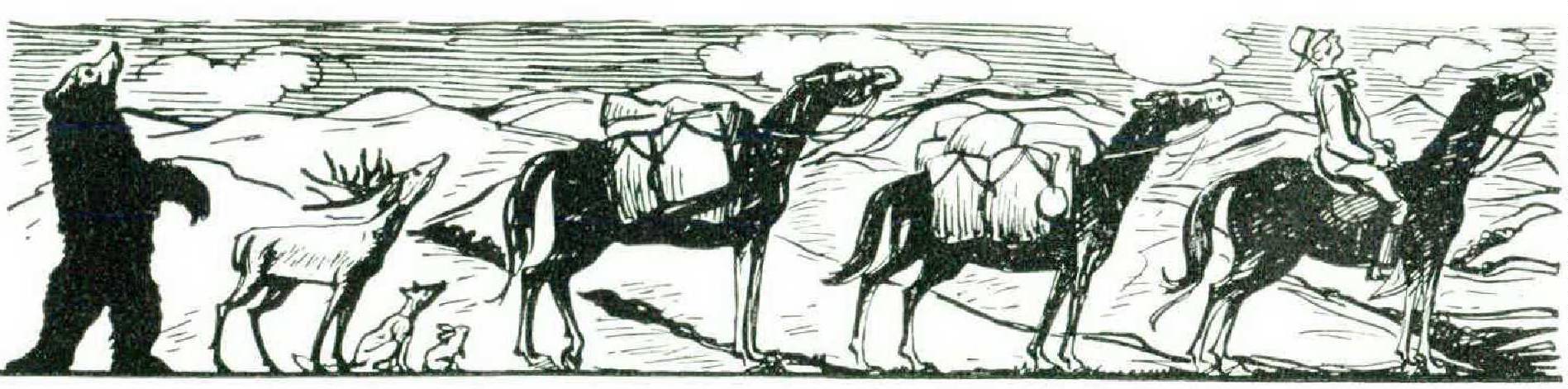
“ We’ll be in elk country by ten o’clock,”the head guide said at breakfast time. “You fellows can ride with your rifles in your saddle scabbards this morning. We’ll be almost certain to have camp meat by night.”
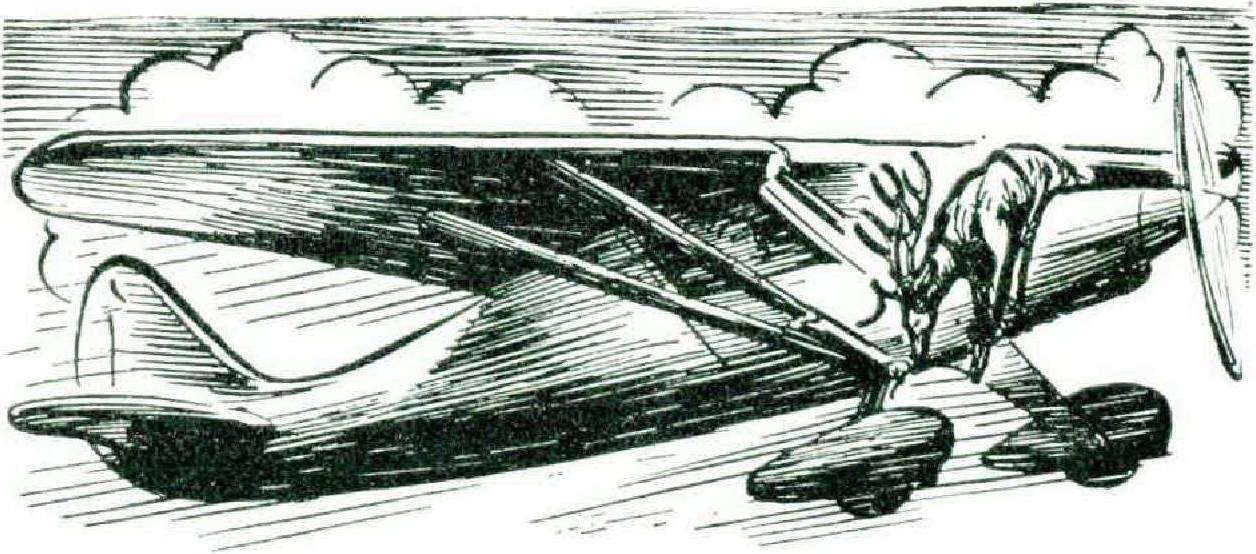
When we were on our last cup of coffee we heard the drone of a motor overhead. An airplane passed over us, circled twice, then slid into a landing. Ten minutes later it was off again and in the air. We were just climbing into the saddles when we heard the shots.
We rode on up the trail and half an hour later came on two men standing helplessly beside a fallen buck. They wore red woolen shirts, knee breeches, huge hobnailed boots with the lops of red socks rolled over the boot tops. They had big hunting knives and six-shooters in their belts, and carried high-powered rifles.
They had killed the buck, but they either didn’t know what to do next or were too lazy to tackle the job.
“How about hiring one of your men to do this butchering?” one of the men asked.
We stopped.
They were clean-shaven, tense, nervous, spickand-span city dwellers who couldn’t have been much over two hours away from pavement.
Our head guide said courteously, “Sorry, but we don’t hire out piecemeal. We’ve got a pack string and we’ve got to make camp by night.”
The men looked at each other with no relish whatever for the job ahead of them.
“Where’s your outfit?” I asked.
“We came in by plane,”the man said, looking at his wrist watch. “Left Boise this morning.”
City dudes nervously consulting a wrist watch while they wait for a plane to return don’t get much good out of a trip to a primitive area.
“Stay in the hotel there?”
“That’s right. Got up and had breaktast at an all-night restaurant, took off with the first streaks of dawn, and the pilot set us down in one of the landing fields maintained by the Forest Service for fire lighting. Then he went back to pick up a couple of our partners. He’ll fly them into some good country and put them down. Then he’ll come back for us.”
That’s the story. We hear a lot about our diminishing material resources. The one that is diminishing fastest is our wild life. We don’t have many really wild places left where men can go to find game and recover health.
The authorities were very shrewd in setting aside primitive areas where there would be no roads, but they overlooked a bet when they permitted hunters to be brought in by airplane.
You might as well build a paved road right through the middle of a reservation and bring the hunters in by automobile. We’ve done that lots of times. The result is burned forests, polluted streams, curiosity “shoppes,” and empty tin cans.