Tourist in Peru
RAY JOSEPHS has spent many years in Latin America as a newspaper correspondent. This report comes from his travels there last winter.
by RAY JOSEPHS
TRAVEL
WE had heard the rumor as we were heading down South America’s west coast. But not until we arrived in Peru’s viceregal capital of Lima did we realize what it meant. Entering the Bolivar, we had run a gamut of the characters who inevitably congregate outside a Gran Hotel. “Thirteen, Señor,” one whispered. “Thirteen-fifty,” hissed another. “Fourteen.”
We held on to our bags, relaxed in Room 428, and then from an old Limeño friend learned what was behind the frantic bidding. “Those wolves,” he explained, “are after your dollars. So is everybody else in Peru. But don’t be fooled into thinking 14 soles per Uncle Sam greenback is good exchange — even though last time you were here the rate was only 6.50. Let me show you.”
By afternoon’s end — and in the six subsequent weeks — the Señora and I discovered what dollar shortages can do, and why Peru is, at least, at this writing, the hemisphere’s dreamland to anyone with even a modest walletful of American money. Within two blocks of the Bolivar and Plaza San Martin we found as many as ten exchanges offering up to 15.50 soles for each dollar. Five merchants — everybody’s in the business now — bid as high as 15.80. One anted up 16.50, provided we had a large enough draft to cash. Our average was 16.10.
The Bolivar’s finest double, into which we moved just as soon as we could get one of Panagra’s (Pan American-Grace Airways) pilots out, cost, at this cambio, $1.92 for one, $3.22 for two. The place overlooked the Square; its furnishings were comparable to those of the best European or North American hotels; it had hop-to-it service.
Full board was 20 soles a day or $1.25; half board — any two meals — 12 soles or 75 cents. Even without the standard Lima midday gorging and with the hunger developed by Peru’s habit of 10 P.M. dining, we found it. impossible to tackle more than one of the regular tables d’hôte daily. For these were no boardinghouse Servings, but products of a fine restaurant.
Invariably they started with a rolling presentation of hors d’oeuvres. Then a piping soup. Next fish. Fourth a big steak or a rotisserie-grilled, tender chicken accompanied by enough vegetables to feed the average U. S. family. Finally, dessert which — in the Latin tradition — was uniformly rich enough to add an inch or two to the waistline. Coffee, of course, and home-baked breads and a half-dozen curls of thick butter.
Pre-dinner Johnny Walker and soda in the “Snake Fit” of the Bolivar — where all Lima gathers at least thrice daily for tipple and tea — was 8 soles or 50 cents. Still, only visiting dollar millionaires generally bothered with such imports. Peru’s favorite indigenous concoction is the pisco sour: pisco—a grape distillate — lemon juice, sugar, a drop of spiced beaten egg white atop. It was 2.50 soles or 16 cents. The assortment of tiny sandwiches, cheeses, olives, meats, nuts, and other “ free lunch” regularly served up on the house practically constituted another small dinner in itself.
There were other inns for luxury-seekers. El Country Club, no longer in the country now that Lima’s lush suburbs have surrounded its links, is another hostelry with faultless service and comforts. Rates: 20 soles or $1.24 for a single; 50 soles for a double; or 60 to 70 soles ($3.72 to $4.36) for a balconied, brocaded apartment. Club food was a little higher — breakfast americano cost 2.50 soles or 16 cents. A somewhat more elaborate dinner than the Bolivar’s was 15 soles or 93 cents. Drinks, however, were less. Pisco sours opened at 1.50 soles (10 cents) but the bartender or some member was always ready to roll the three-dice Bidou cups for double or nothing, a custom which can run the neophyte into money.
In one of Latin America’s loveliest gardened towns, in one of its pleasantest, least revolutionraked countries, there were other opportunities for those seeking to prove how far a dollar could go. The suburban Pension Beech, favored by the U.S. and Brit ish Embassy crowd, offered singles from 23 to 25 soles and its best private-bath doubles from 45 to 50 soles ($2.79 to $3.10). This included four meals, the fourth being louche or high tea served around 6 P.M. and consisting of the four to six courses apparently required to sustain life in the interval between noon and night dining.
In town, Chez Victor and Raimondi’s let you run the foot A-to-Z for about 45 cents. Even the Maury, Lima’s traditional socialite eating place, offered guests an 8-sol dinner (48 cents) plus good national wines at 7 soles or about 40 cents a bottle; best Peruvian vintages at 12 soles or 75 cents.
When we slarted traveling and acquiring, the thing became really fantastic, especially when we remembered prices at home or in such tremendously expensive Latin countries as Cuba and Venezuela. A cab anywhere in town was a sol or 6 cents; for near-by suburbs 3 soles if, of course, you were Limeño enough to arrange the price first and not appear too much of a gringo. Best seats in the best cine were 24 cents, bullfights 37 cents to $1.24, depending on sun or shade location.
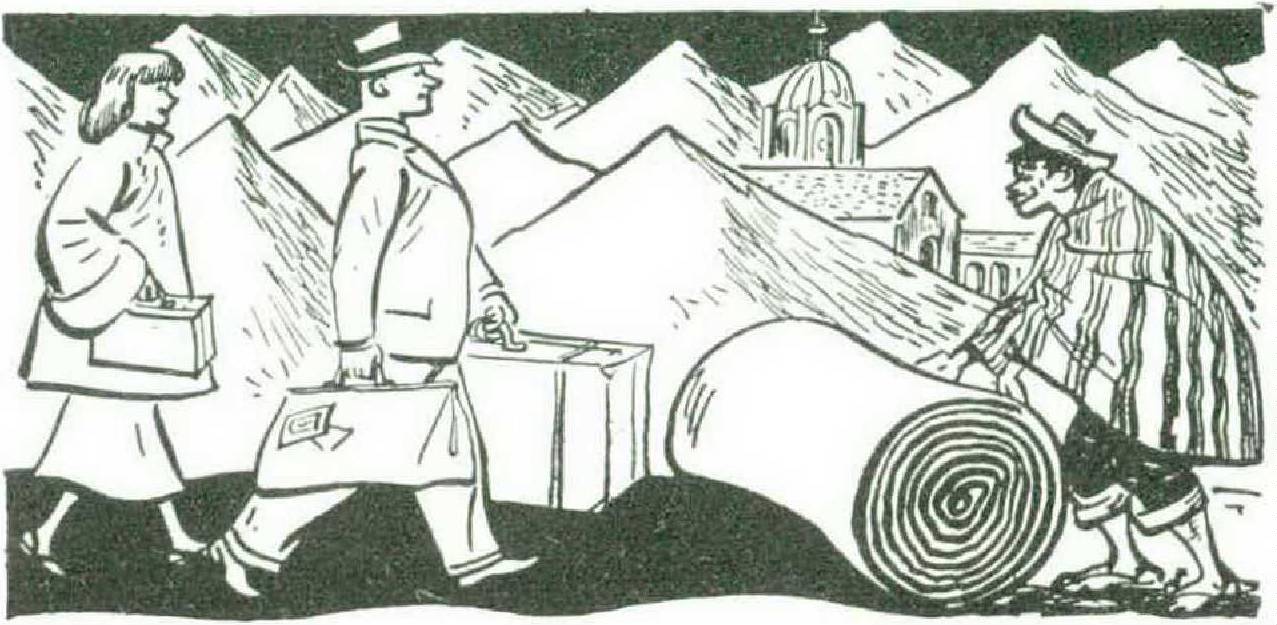
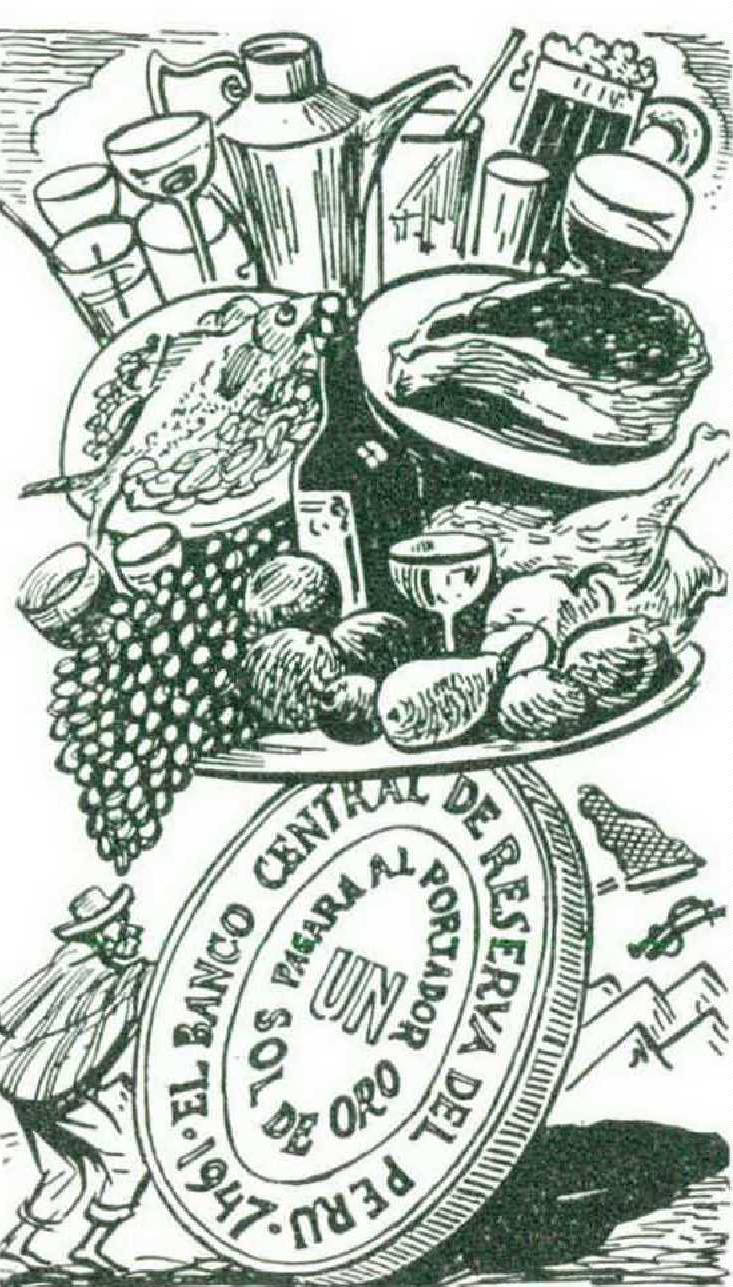
Smoking Luckies, which at Lima exchange cost less than 14 cents a pack, I grandly ordered two suits of the finest English gray flannels. Both were fitted and delivered by the Hungarian proprietor of El London House within ten days — at the equivalent of $55 each.
Then, to maintain the luxury mood, I dropped into the Bolivar’s barbershop and ordered the works. Oil massage, shampoo, manicure, and all the trimmings couldn’t run the bill beyond the equivalent of 70 cents.
Silver—Peru’s specialty — was an even more startling contrast. Fine, heavy, .925 pieces have always been cheaper there than almost anywhere else in the world. With soles at 16.10 or higher, they were practically given away. Crowding through the crush of other Americanos on similar buying splurges, we picked up a tea service exactly like one we’d often eyed in a New York window. The Fifth Avenue price was close to $1000; on Lima’s Jirón Unión it was just about 10 per cent of that.
Of course there is a 25 per cent duty on silver imports into the United States. But to make certain the Miami customs and doubting friends would believe we hadn’t exceeded the returning tourist’s $100 limit, Piaget made out the bill in dollars figured at the free-market rate. “For home display,” they said. “Everybody loves showing off bargains.”
Outside Lima, silver and everything else was still less. Suburban homes, while not as abundant as formerly, were advertised for 800 soles or just about $50 per month for a nine-room, furnished cottage with a garden. Anyone paying more than 2 soles or 12 cents daily for a maid was considered careless with money.
The houses out in suburban San Isidro and Miraflores were only a few minutes from the Pacific beaches, where from November through March — Peru’s summer being the reverse of ours — you can duplicate Hawaii, the South Seas, and New England’s summer, plus all the physical attractions of Los Angeles, without any of the hyperthyroid, neoned brilliance of Southern California living. A slightly broke Westbury polo player said he had kept postponing departure because one day in the States would cost more than the monthly bill of 150 soles ($9.30) to keep his string of six ponies.
A one-week trip to Cuzco for a look at the pre-Inca ruins, stopovers with Tia Bates at her Arequipa Quinta, and unhurried journeys to Sacsahuamán, the Indian Fair at Pisac, and Machu Picchu totaled 1059 soles — $65.12 or $9.30 a day. This included air passage from Lima to Arequipa and return, Pullman to and from Cuzco, sight-seeing, lips, and all taxes.
We didn’t have time for a balsa raft sail across Lake Titicaca, the world’s highest navigable body of water, over which travelogue suns are always slowly setting, or to the vast copper mines, the sugar haciendas, or the jungle borders which the Corporación Nacional de Turismo described alluringly. But we did run into plenty of Yanquis who had figured out that despite the additional $360.70 cost of a roundtrip Panagru fare from New York, they had more than made up, in a thirty-day Peruvian stay, what it would have cost to go to nearer — and more expensive — places.
One, apparently convinced that by now dollarsto-soles could get anything, sought to claim loss of his return ticket and repurchase a new one with free-market soles. It didn’t work. Sol tickets are sold only to bona fide residents. Panagra, with piled-up Peruvian funds, wants greenbacks.
During the war Peru sold her sugar, cotton, and minerals at good prices, and accumulated dollars for which she could buy little. War’s end and resumed U.S. production caused heavy spending for both needs and luxuries. Unlike some Latin countries, there were few controls in Peru on how and what Peruvians could buy. Dollar reserves quickly dried up and Peruvian production diminished, exports decreased, and the balance got more and more lopsided.
In February, 1947, importers — and most manufactured items Peru needs must come from abroad — began to feel the pinch and went out to buy dollars where they could. The turistas were the handiest source. Slowly the sol was worth less and less, the dollar more. Government accuses business, business points the finger at government. And solearning Peruvians, who have found prices slowly rising as canned goods, cars, and commodities have had to be replenished by new imports at free-market rates, sit in the middle.
Even if the rate drops back to 6.50, I have enough custom-made clothes, hand-beaten silver, alpaca rugs, vicuña scarves, pre-Inca pottery, and pisco bottles to keep us stocked until it rises again.