Eardrums a Long the Mohawk
RENÉ MACCOLL, Washington correspondent of the London Daily Express, here doffs the pseudonym of “ R, .J. Hicks” under which he has written other pieces on radio for these pages.
RADIO
by RENÉ MACCOLL
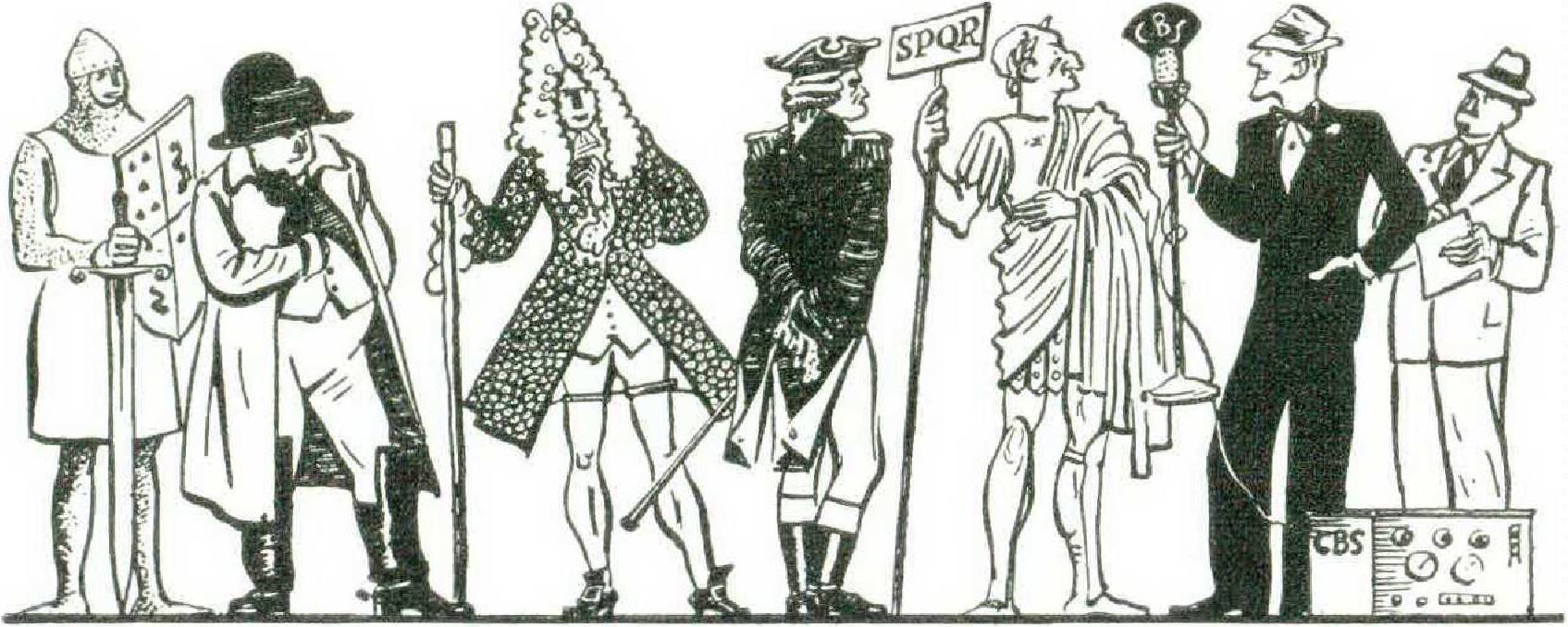
THE Columbia Broadcasting System has been spanning centuries as well as continents to bring its listeners History the Hard Way with a program entitled “CBS Is There.” Whatever the incident and whenever the date, CBS — so goes the genial make-believe — was present and on the job. That devoted selection of Dreft-dipped larynxes which brings you the contemporary world news roundup at breakfast time every morning now reaches into the past to destroy what few illusions you may have shepherded into later life from your schooldays. The last night of Mary Queen of Scots before she paced to the scaffold? John Daly, you may be sure, was right there at Fotheringay Cast le. Columbus discovering America? Daly again is on the bridge with the Admiral. ("Si, señor — eet ees land!” “Thank you, Admiral!”)
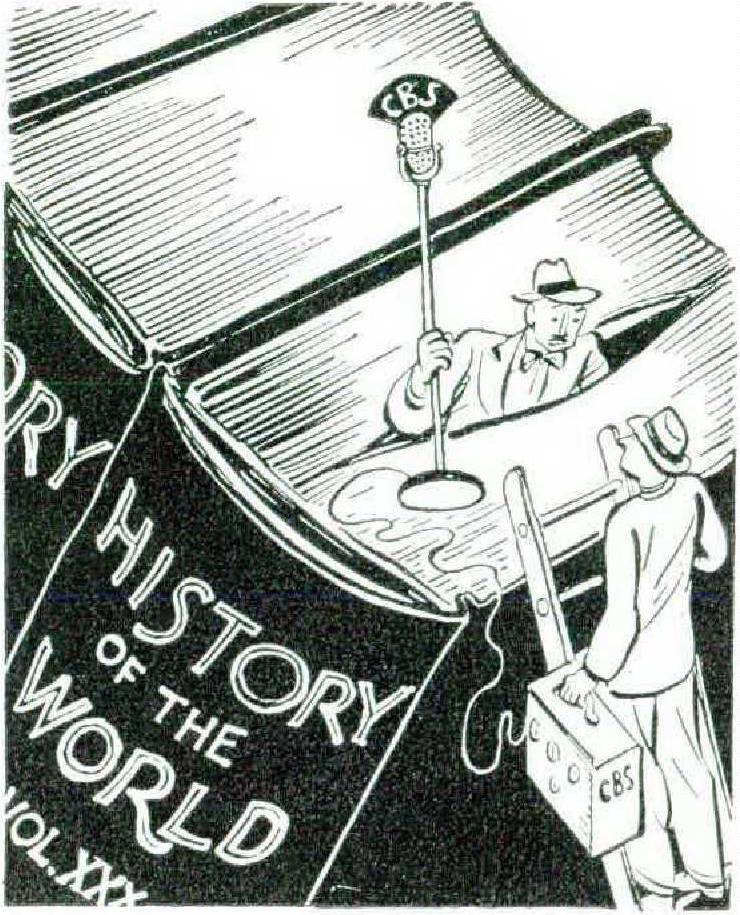
The adventures of Daly are better than anything imagined by H. G. Wells in his Time Machine. Wells rather drearily sent his hero forward into the future only. Flimsy stuff. Daly ranges the legends and events known to all.
Gettysburg? Only the middle of the line facing Pickett is good enough for Daly. But Daly is discreet, back there in 1863. As the cannonade rises to a crescendo and the rebel yells grow shriller, a gruff Federal voice shouts, “Get out of here, Daly!” “Yes, sir,” replies Daly with obvious relief, and the broadcast is nimbly returned to rear headquarters.
It’s not only Daly who adds to his prestige. The Gettysburg report produced what must be the alltime high in professional dream fulfillment. At one point, while HQ was waiting to contact Ken Roberts on Cemetery Hill, the HQ man said, “While we are waiting, I will ask the CBS special military expert to give you a rapid analysis of the battle as he sees it, and a forecast of the probable Confederate plan of action. Take it away — Major George Fielding Eliot!” Pretty nice. For once, a military expert could really state without fear of later contradiction.
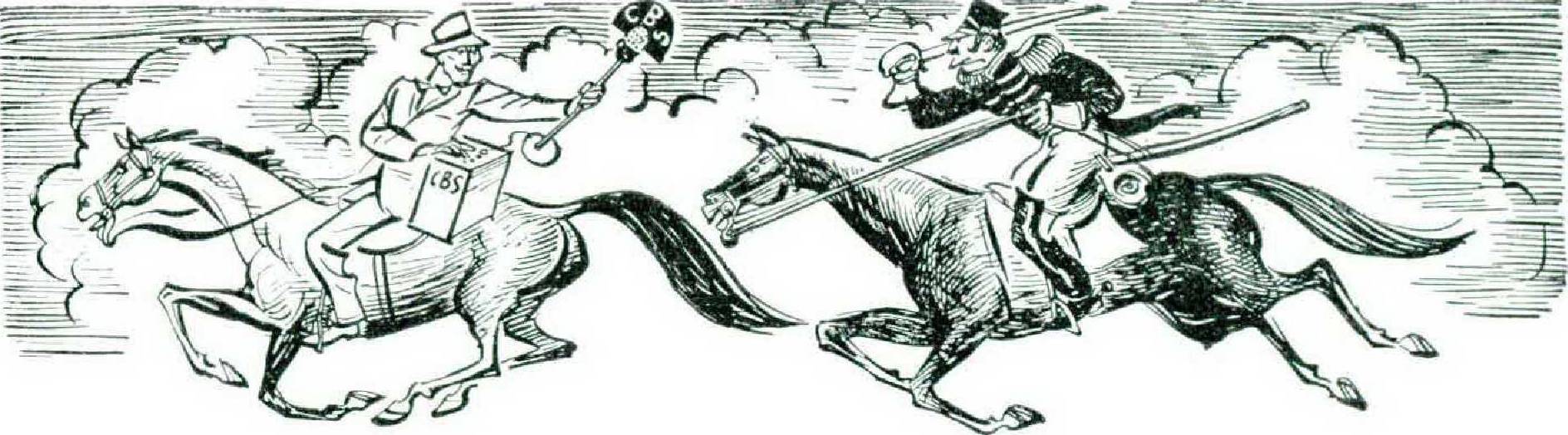
But what I’m hankering for is CBS coverage of the battle of the Little Big Horn. How does Daly get away with that? And what sort of analysis does Major Eliot provide — and where from? Only way out, as I see it, is for CBS to have Daly or Eliot —or both — attached to Sitting Bull’s staff. (“But here comes General Bull now. Will you say a word into our microphone, General?” “Hunh! Paleface Custer he plenty sunk!” “That was General Bull, commanding the Original American forces. He sounded very confident.”) The trouble with the brave pioneers-inreverse at CBS is that they lack the courage of their hindsight. As it is, they merely dabble in anachronism. Once grant that you may have Daly and his mike at Cannae, Monroe’s inauguration, or the death of Socrates, and it seems to me that you can have pretty well everything else in radio 1948 there as well. Like this: —
Good morning, everyone. This is Douglas Edwards. It is cold — very cold — out here in the Crimea, this frosty morning of October 25, 1854, and those British troops who have not had a delicious bowl of steaming Campbell’s Soup along with their iron rations must be feeling the climate—the Russian climate, that is — keenly. But now we have several of our correspondents waiting to be heard from, so we switch you to John Daly, at Lord Raglan’s headquarters. Come in, John Daly.
DALY: Here at Lord Raglan’s headquarters there is an air of muted, disciplined bustle. (Sound of bugle and neighing in the background.) The British Heavy Brigade, under Brigadier General Scarlett, has just completed a most successful charge. Now attention is focusing on the Light Brigade, commanded by dashing Lord Cardigan. Lord Cardigan — and how we could use more cardigans and raglans in the sub-zero temperature, ha, ha, ha — disposes of some six hundred cavalrymen. Trained to a hair, they are actively preparing for action. But here beside me is the British supreme commander, Lord Raglan. — Your Lordship, those Russian guns up there in that valley are rather troublesome, are they not?
RAGLAN: Yes, Daly. Dashed troublesome, if you ask me. But I must rush now, for here comes Flo Nightingale!
DALY (in a touchdown gabble): The troops are springing to their feet and saluting all around me. Even the toughest old survivors of the Napoleonic campaigns are stilling their customary rough oaths as Miss Nightingale advances through the lines.
VOICES: God bless you! Here comes Flo! She’s my pin-up girl. She discovered germs.
Miss NIGHTINGALE: Thenk yeou. Thenk yeou. Thenk yeou, one and all.
DALY: Miss Nightingale, how does it feel to be the first woman in history to go on active service as a nurse?
Miss N.: Ai can’t tell yeou heow inspairing Ai faind it, frenkleh. But Ai’m sure as sure could be that many others of mai selfsame sex will follow in mai footsteps.
DALY: You see this thing catching on?
Miss N.: But definiteleh. Ai think there will one day be a perfectleh splendid Ameddican Red Cross. But parm me, heah comes — Lord Lister!
[Loud applause from the troops.)
DALY: Lord Lister is Miss Nightingale’s guest star at Balaclava today.
LORD LISTER: Alorning all. That’ll be twenty guineas.
(A gun booms loudly.)
DALY: There seems to be — I can’t quite see — yes, there’s something happening over there. I return you now to Douglas Edwards at Base HQ.
EDWARDS: And now, over at the French HQ of General Bosquet, Ken Roberts is waiting to tell us how the situation looks to the Gallic contingent.
ROBERTS: Waiting at the microphone beside me is General Bosquet, French Commander in the Crimea. General, what is your prediction?
BOSQUET (gloomily): O’est magnifique, mais ce n’est pas la guerre.
ROBERTS: Which means, of course, ”It is magnificent, but it is not the war.” Let me find out to what the General is referring. General, what is not the War?
BOSQUET: Ze — ow you say —wine ration, she ‘ave not reached us for three weeks. Zut alorsl
ROBERTS: The troops are restive, General?
BOSQUET: Ze troops? Je m’en fiche! I, Bosquet, am restive.
ROBERTS: That was General Bosquet, telling us of the privations endured by the men of his command. And now, back to Douglas Edwards.
EDWARDS: Somewhere out on the left, where the English Light Brigade is wheeling into position, Jackson Beck is waiting to tell us how things look from the forward zone. For that story, we switch you now to Jackson Beck.
BECK: The Tommies look debonair and gay. They seem not to recognize the ordeal ahead of them. Their horses are sleekly groomed. They might be on a parade ground in faraway Aldershot. But here comes a familiar figure. — Why, Lord Tennyson, I didn’t expect to see you so far up near the Russian guns!
TENNYSON (heartily): Got to get the close-up picture, young man. But it’s just plain Mister Tennyson, you know.
BECK: Don’t worry, Mister Tennyson. You’ll be a Lord before you’re many years older. Well, what do you think of the Valley of Death this morning?
TENNYSON: Valley of Death?
BECK: Yes, (hese six hundred here are getting ready to ride into it.
TENNYSON: Hmm. Not bad. Not bad at all. Lend me that pencil a moment.
BECK: . . . back to Douglas Edwards . . .
EDWARDS: We will now try to contact Harry Marble, who is attached to Russian General Li* prandi’s art illerymen. Come in, Harry Marble. . . . Come in, Harry Marble.
MARBLE: This is Harry Marble, reporting from the Russian lines. As I look down towards — (Sound, of blows.) Tovariseh! Tovarisch! No, no! My papers are in order, I assure you —
VOICE (gruff and unfriendly): Nichevo! You are a warmongering correspondent and a capitalist spy!
(More blows. Silence.)
EDWARDS: We regret that the signal from the Valley of Death this morning was not up to normal broadcasting standards. Now back to Jackson Beck.
(A rush of feet. Groans. Cries of “Make way for the stretchers!”)
BECK: This is going to make medical history! The first wounded are coming back now from up the valley. Right before my eyes Lord Lister, with an assist from gracious Miss Nightingale, has set up an advance casualty clearing station and is about to start operating. . . .
The first man has been lifted onto the table. He seems to be a Russian, although he is so covered by blood and contusions that it’s difficult to make out exactly. He’s in a bad way, all right. Miss Nightingale is burning brown paper under his nose. Lord Lister, stripped to his moleskin waistcoat and spats, is sharpening a bayonet. While they conclude their last-minute preparations I will try to get a few words out of this badly battered Muscovite. . . . Good heavens! His eyes—I know them! Glazed, but unmistakable! It can’t be—it is! Harry Marble!
MARBLE: Jackson . . . the Iron Curtain . . . Russians . . . waiting to infiltrate . . . millions of them. . . . Today it’s the Czar — tomorrow it will be some other leader. . . . Warn the Western world . . .
BECK: Quick! (Confused minor sounds. Groans. Music up and under, fading into sound of chipping, as of pick in quarry.)
BECK: Lord Lister has just completed the first trephining on record, carried out entirely with a bayonet. . . . Harry Marble will—LIVE!
DOUGLAS EDWARDS: Yes — Harry Marble was destined to live — in history. And so, nearly a century before the Iron Curtain was rediscovered by the world’s statesmen, a CBS correspondent had unearthed this tremendous secret and key plank in Russia’s platform.
Don’t fail to listen again at this same time next week, over this same network, when CBS reporters will bring you “CBS Is There — The Rape of the Sabines.” And now, a word to the ladies.