Through the Films Darkly
JACK MASTERS left Sandhurst in 1934, served in India with the Prince of Wales s Own Gurkha Rifles, during the war was with General Wingate s Chindits in Burma, and was decorated with the D.S.O. and O.B.E. He retired from the Indian Army at the beginning of this year.
HOLLYWOOD
by JACK MASTERS
I DO not pretend, of course, to be an expert on slang, but I do like, in casual conversation, to put Americans at their ease by a judicious use of current racy idioms. English-made films are quite free with their utilization of American cant, and I have frequently made useful notes, by lighting matches during the performance and jotting down the more vivid and memorable phrases.
This forethought has paid off remarkably well. The other night, in the bar of my New York hotel, I ordered a dry Martini and said cheerily, “Twentythree, skidoo,” to the bartender, who was kind enough to offer me a cup of steaming hot coffee.
Shortly before that I came upon a man on Ascan Avenue, in Forest Hills, Long Island, whom I greeted with “So’s your old man.”To his dog I said ingratiatingly, “Sez you; sez me.” Both dog and master hurried off to relate their experience.
Upon my arrival here, several months ago, I told the customs officer that it looked to me as though the United States were the cat’s pajamas. After a cursory examination of my luggage he escorted me to a cab and told the driver to hurry and take me to wherever I was going — demonstrating a type of thoughtfulness not always encountered in customs officials.
It is my considered opinion, however, that Americans, on the other hand, should be extremely careful how they employ the English slang, socalled, that is bandied about in Hollywood films, because it is often inaccurate and out of date. A brief tabulation will perhaps explain my point: —
| Phrase Used in Movie | Date in Fashion | Probable Meaniny | Fairly Modern Equivalent |
|---|---|---|---|
| Oorbliiney | 1900 | I am surprised, shocked! | !!! |
| Eye sye, myte | Never | May I have your attention, please? | Oi! |
| Abso-bally-lootly | 1924 | I concur. | Bang-on. |
| ‘E's napoo. | 1916 | He's dead. | He's had it. |
| Wot 'o, pel! | ? | Good morning. | Good morning. |
’E’s napoo. 1916 He’s dead. He’s had it. Wot ‘o, pel! ? Good Good morning. morning.
The England inhabited by these users of picturesque, if anachronistic, slang is of a noble simplicity, designed with a single stroke of some unknown master in the beginning, and kept reverently intact by devout disciples ever since. It consists of three elements: (1) 12,000 acres of park and pasture owned by a lord, or by Bulldog Drummond, and containing a rambling country house; (2) a small market town; and (3) London. When the fog lifts or drifts away sufficiently for one to get a clear view, which it generally does after no longer than twenty minutes, one can appreciate, particularly if the film is in technicolor, the rare quality of this landscape and its animated scenes.
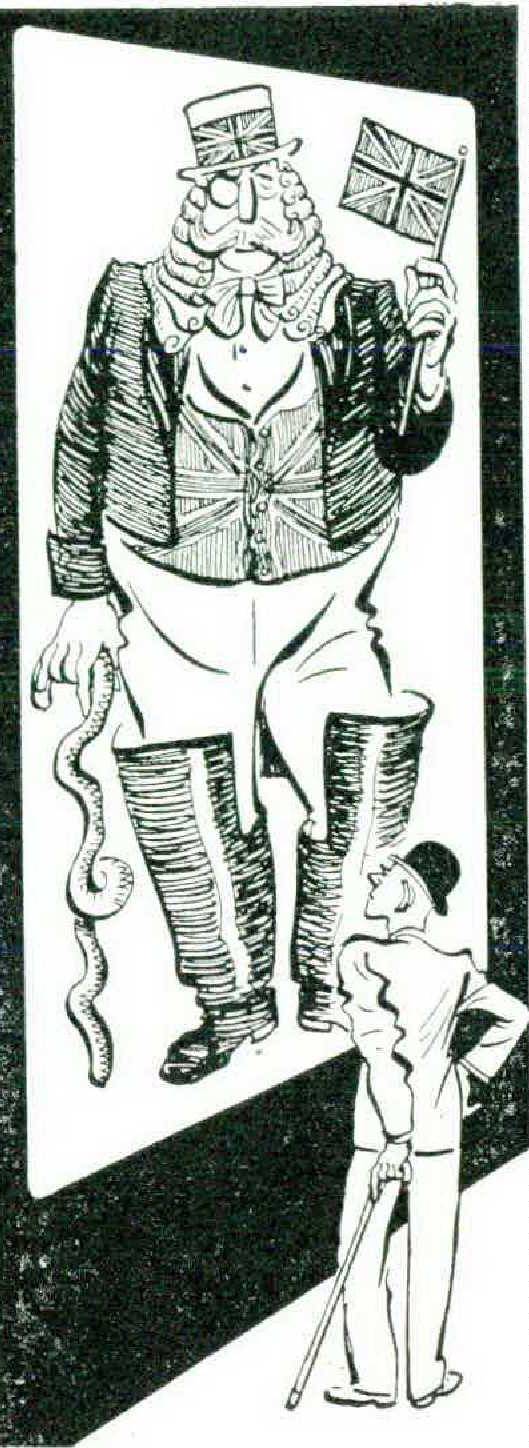
Here are the familiar vivid yellow-green fields, startling as a slap in the face; the old brick houses glowing from some vast secret conflagration within; the young lordlings at play prior to being tucked into bed by Her Gracious Ladyship. Here are the orange faces of the huntsmen peering over their purple coats and between the ears of their varnished walnut race horses; here, more diabolically close, are the same orange faces as, with no effort, they and their mounts rise disembodied through the air over a sixteen-foot hedge, post, and rail to land among the hundred heedless thoroughbred dogs yapping at the heels of the scurrying fox.
And here are the dewlapped judges, permanently buried in the full wigs they are thankful to be forced to wear only once or twice a year in real life; the fleets of long, low, convertible roadsters with their tops permanently down; the distinguished barristers, Sir Charles, Sir Morgan, Sir Henry; the male protagonist, Captain the Honorable Viscount Montmorency of the Blues — and we know his role is important because no one but Montmorency would dare face his Adjutant wearing the buttons of the inglorious General Service Corps, tartan trews borrowed from a friend in the Cameronians, yellow boots, and Hussar spurs.
Here are the English trains — snail-slow, gaslit strings of minute boxlike cubbyholes on wheels, creeping apologetically through a fog they know they ought not to move in; crossing (quite correctly) the Forth Bridge on their way to Aberdeen, and crossing it (incorrectly but without surprise) on their way to Birmingham, Plymouth, Haddingham Hall, Lancaster, or Harwich; thinking, perhaps with regret., of the times in real life when they used to be scheduled to make a daily trip between London and Newcastle in four hours, or of that day in 1938 when one of them got up to 125 miles an hour and averaged over 100 miles an hour for 40 miles.
Here is London without its scarlet-beetle buses, its million trains, its traffic-operated lights, its ant like swarms, without its shops or suburbs. Here is the essential core, drawn from its wrappings and presented alone: a glimpse of black, treacly water, the tower of Big Ben, a policeman in a Keystone helmet. . . . Then there are very slow, reverberating footsteps, a Cockney ejaculation, a brief chase in a cobbled alleyway, a shot of a man in a snapbrimmed hat — and the fog boils up again.
But I am, after all, merely a colonial Englishman from India, and am probably not really qualified to speak for the native British Islanders. It is more seemly, perhaps, that I offer up praise on behalf of Britons who have lived or worked in India or Pakistan — those fabulous regions in which, according to the best California research, motives are never complicated and the thermometer stands steady, rain or shine, at 114 degrees. It is far more convenient than the variations of heal and cold, pleasant and unpleasant, that some of us experienced in these countries— the snow, the hard winter mornings, the gray, dull glare of the hot weather.
In That Place, Englishmen are either sweating heroes or sweating cads; but that is preferable to finding, as some of us did, that our degree of perspiration varied with the temperature and our behavior with our characters. The sweat of the Hollywood Anglo-Indian can only be compared with the unbelievable Niagaras of rain, the solid walls of water, which are Hollywood’s capricious monsoon, striking, as the plot pleases, in January, May, or November.
In That Place we all wear peculiar but attractive white topis of a pattern favored roughly seventy years ago by lady missionaries. We keep our topis on until two in the morning to ward off, I suppose, the lascivious effects of the moon; indeed, we seldom remove them at all, except, to greet the Colonel’s daughter, who wears jodhpurs, a similarly shaped topi, and a thin shirt, and who never, never sweats.
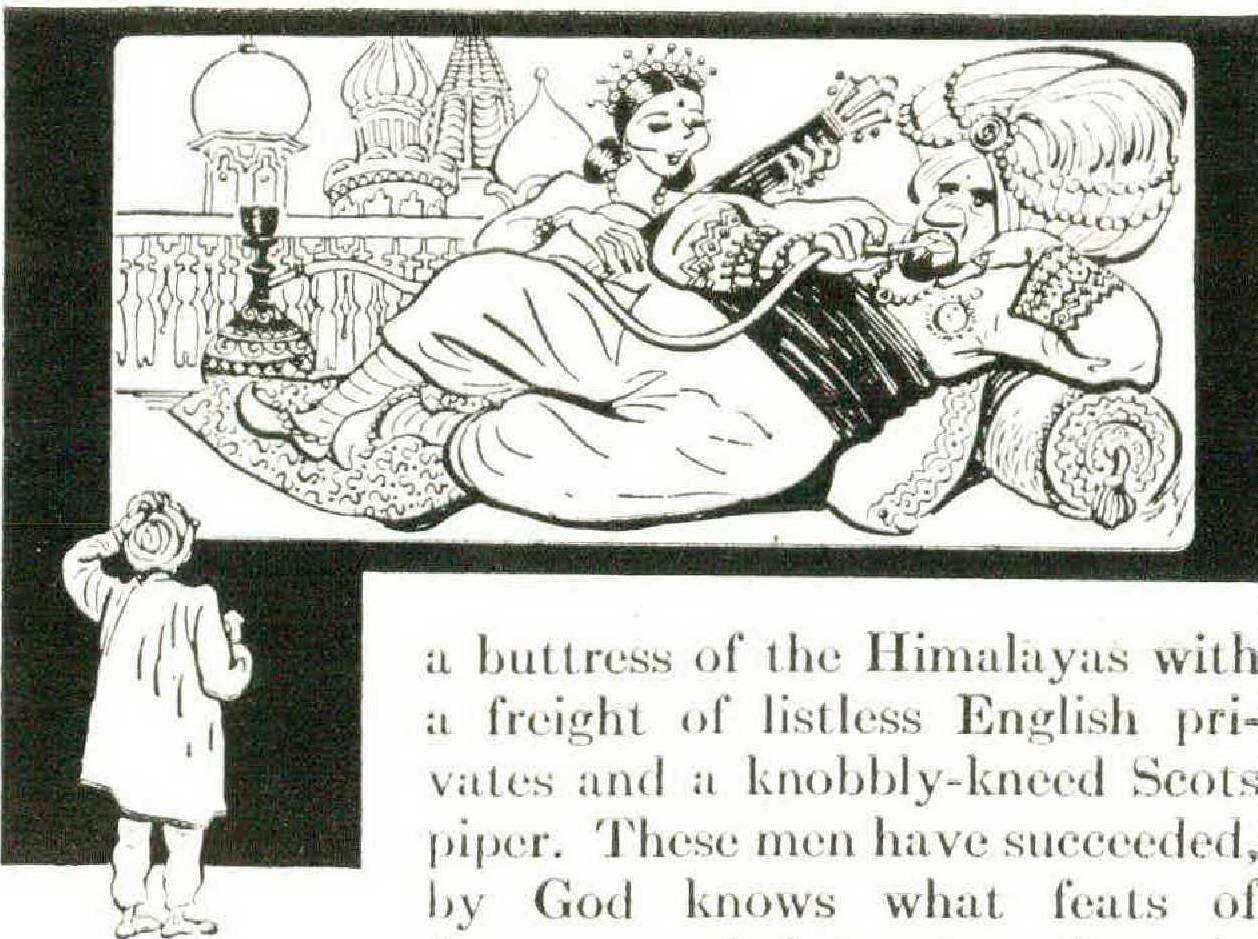
There is my old friend, the Hindu Maharajah Mir Chandra Gopalaswami Khan Singh, with his swarming retinue of Mexican servants. The Maharajah, I note, is wearing an oulcaste’s turban, Sikh trousers, and Mohammedan slippers. His wife, that exotic creature, has nose rings, bangles, trousers, a Mohammedan yashmak to cover part of her face, Hindu caste marks, and the forehead, eyes, and nose of a well-tanned Pasadena cigarette girl.
Litter we come upon an elderly elephant caparisoned for a fair in faraway Bengal and looking unhappy, as well he might, climbing unsteadily up a buttress of the Himalayas with a freight of listless English privates and a knobbly-kneed Scots piper. These men have succeeded, by God knows what feats of forgery and impersonation, in joining the Bengal Lancers, which, in my time at least, used not to have any British personnel except commissioned officers. The elephant’s mahout maintains he is a Sikh, but since he is very black, a loot or two under height, has no beard, smokes a hookah in blatant defiance of his religion, and has borrowed a turban from a Mahratta stable buy, we suspect him of being the hero in a baflling disguise — perhaps George Raft himself.
But time is drawing to a close. And so, as the soft-voiced khitmatgars sing in the chutney bushes and long lines of pink flamingos wend their homeward flight across the golden path of the setting sun, we bid a regretful farewell and aloha to these colorful lands of mystery, lands of enchantment —Hollywood’s British Commonwealth and Empire.