The Street Called Solitude
A Londoner long a citizen of the United States, A. HAMILTON GIBBS is the author of many books and stories.
TRAVEL
by A. HAMILTON GIBBS
ONE end of Solitude is practically in the sea. The other blossoms into a noble tree-lined avenue in the heart of Havana. It is intersected by Virtue, Harmony, Neptune, St. Martin, St. Raphael, the Big Ditch, and Jesus the Pilgrim. Its current is passionate and deep. Tortured bodies come down Solitude for healing. Twisted souls creep into the shadow of the great Virgin of Carmen. Murder in blinding sunshine only stops traffic for the briefest moment, and a block away the unwanted baby can be poked through a hole in a wall to be taken care of by the quiet nuns and no questions asked. . . .
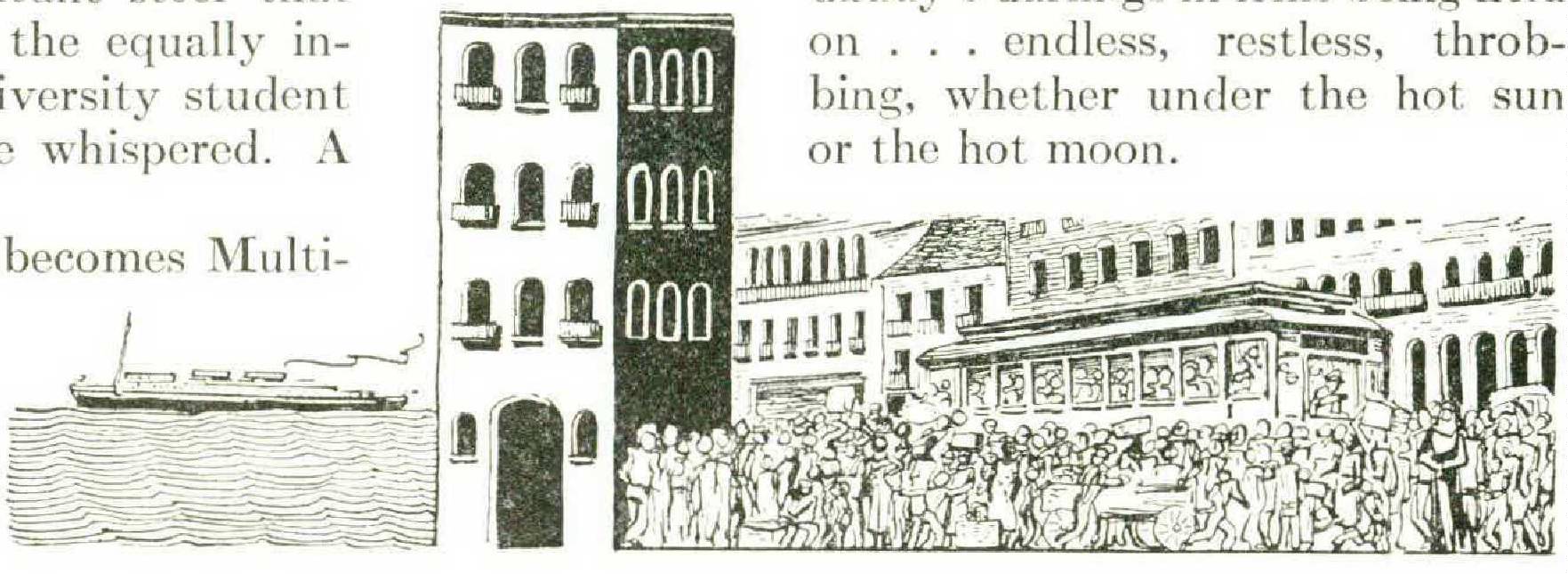
For four months I lived on Solitude Street, in a sky-high apartment at the sea end. Its back windows look out on escape, — a vast stretch of subtropical sea on which grow ships of all flags that come nosing their way past Morro Castle into the city, while clouds build themselves into castles so majestic that Morro and the Capitol and the whole city are reduced to impertinent pinpoints over which the black vultures eternally float and wheel on outspread wing tips; and below, like ants about their endless task, brown women hang up and take in miles of washing on an infinite number of flat red roof tops. And as the hot sun crawls up and down the sky, the city runs the gamut in changes of color, from drab limestone gray to stark white, from yellow ochre to rose pink, and on into deep blue, until finally night takes over and then the soft darkness becomes festooned with neon reds and oranges and greens and whites.
Enticing windows these, that let the trade winds blow in your face across a thousand miles of bluegreen sea.
But on the other side of the apartment is the balcony, and the balcony looks down not on escape, but on unbelievable reality — on the surging street of Solitude in which the dawn comes up to the thunderous grind and clangor of streetcars, the petulant blasts of bus exhausts, the long deafening honks of auto horns, the shrill yells of newsboys bawling the headlines; a crescendo of magnificent assonance, dissonance, cacophony, swelling and sinking, at times a low roar punctured by the individual melodious wail of a street vendor, the beat of a schoolboy drummer, by the birdlike screams of many urchins at recess, by the strident longing of a juke-box tenor, by the barking of a toy dog on a neighboring balcony, by the growing tremendousness of a sound-truck urging the denizens to political fury, or by a burst of revolver shots at the corner which might imply either the slaughter of an insignificant steer that got away from the marketeer, or the equally insignificant shooting down of a University student for saying aloud what others have whispered. A trigger-happy people.
At moments like these, Solitude becomes Multitude indeed. From every balcony hang women and girls, leaning far over, waving excited hands; and in the street people begin to run. . . . Somewhere down there a sparrow has fallen. Perhaps it is registered somewhere. The dominating bronze Virgin of mercy gives no sign from her high tower. Only the floating vultures whirl momentarily nearer. ... A breath only of interruption and then, under the baton of the Great Master, the symphony of urgent life swells again under the hot sun.
The trade winds are impotent to blow the noise of it away. They are no more than a spoon to stir it up. Inescapably one is in and of it, day and night vibrating, willy-nilly, to its rhythm. The glassless windows have only strips of wood that repel glare but welcome into your being the incessant roar of Solitude Street. According to your temperament, you can try turning your mind to other things; or you can get used to it once it has forced you to isolate the component elements of its percussion — guitars, horns, drums, maracas, pieces of wood being banged together, the exaggerating juke box in every open-air saloon, the off-key radio in every shop door, the hundred different calls of itinerant vendors.
If you are lucky enough to have the gift, you can revel in it, in the same way that you degeal in the fierce Cuban sun, surrender yourself to its unnorthern manifestation of living, drink it in with the same excited liking with which you absorb its color,—the naked brown babies spilling out of dark doorways into the sunlight; the ancient knife grinder playing his Panpipe along the street; the piled-up fruit stand blazing under the branches of a laurel tree; brown-skinned girls sheathed in gaudy cotton dresses of yellow, violet, purple, green, but lovelier-featured than any Madonna; midinettes flirting along on the inevitable gold-strapped sandals, sisters under anybody’s skin; brown children on roller skates flashing in and out of traffic as intricately as swallows; brown men dwarfed by enormous bouquets of artificial flowers so real that at a distance you can almost smell them; the broom man pushing a fantastic little cart with long antennaelike fishing rods with a brush at the tip; the whitehaired Negro chanting his sugar cane, his enormous plantains that fry up like potato chips, his mountains of tiny three-inch bananas that melt in the mouth; brown and white cherubs from the convent parading sedately in their blue and white uniforms: the street fair at. the corner crowded with pickaninnies in rags riding the horses like centaurs, and daddy’s darlings in frills being held on . . . endless, restless, throbbing, whether under the hot. sun or the hot moon.