This Month
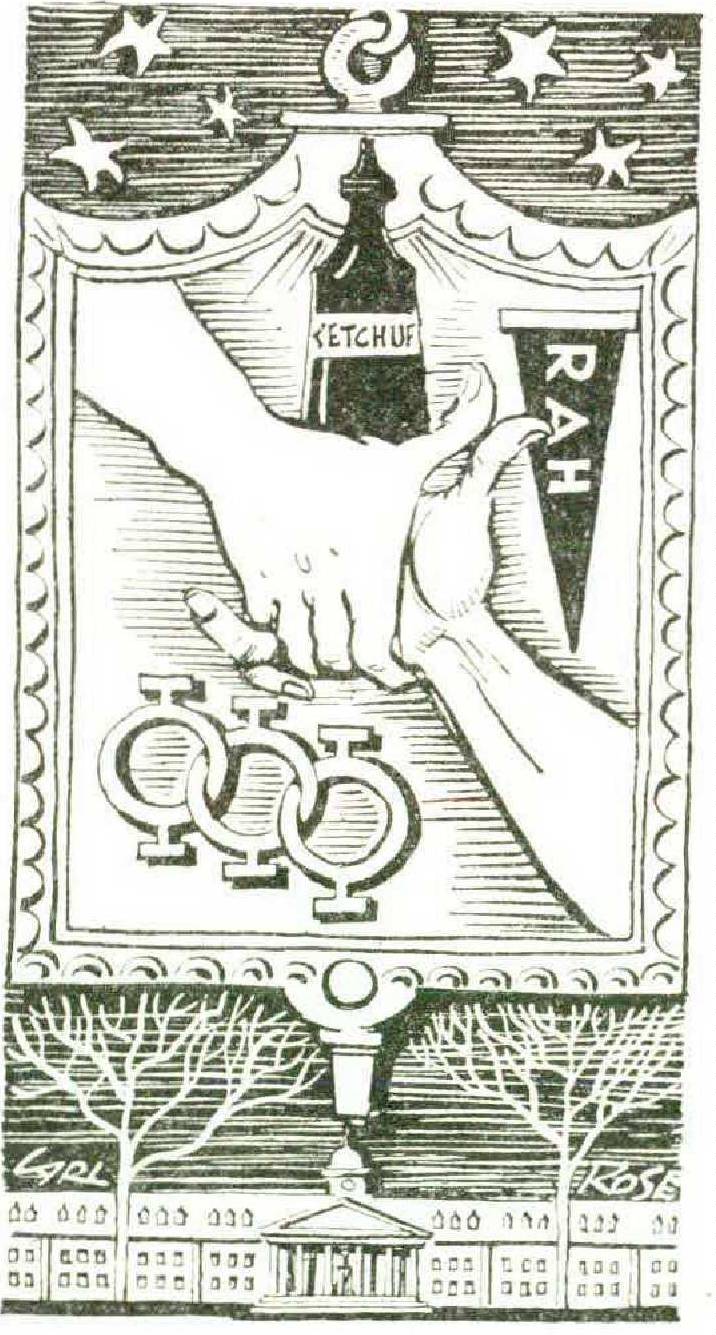
As the Class of '52 moves in and unpacks, the Greeks are already winnowing the barbarians along Fraternity Row. Some thousands of “charges” are entering the annual ecstasy of self-renewal. The undergraduate of sufficiently bland racial, religious, and financial status awaits the call of brotherhood. The insufficiently bland will join the Commons Club or whatever euphemism the college has devised for barb-solidarity. The college president turns resolutely away from the whole subject: these are matters of taste and congeniality for the boys to settle among themselves — and besides, the college could never afford to take over all that real estate at today’s prices.
Fraternity Row is a neighborhood of teen-age Little Scorpions Clubs, each with its secret grip, passwords, and recognition signals. It may well be that all fraternities arc using the same grip without knowing it; but no matter, since secrets of this caliber, like the mysterious meanings of the Greek letters themselves, can never be divulged, let alone compared. Each group or chapter occupies, or hopes to occupy, a rather more expensive house than it can afford. (Fraternity house mortgages usually run for a fixed term of, say, two hundred years and represent, about 150 per cent of the property’s estimated market value as of the spring of 1929.) The local chapter keeps decently to itself, avoiding traffic with neighbor fraternities and above all with the barbs, but it maintains, or would if the occasion arose, a vehemently brotherly relationship with its “affiliated” chapters elsewhere. Thus, whether the college is large or small, the fraternity man can go through it as one entitled not to meet more than forty or fifty other undergraduates. Moreover, he can wear a pin which identifies him as the holder of this privilege. Fraternity meals, like the fraternity mortgage — and probably in consequence of it — are distinctive, and few Americans not confined in a state prison eat anything comparable to them as a steady diet. Consumption of ketchup along Fraternity Row is estimated at 1.27 gallons per week per brother.
By the simple method of Greek letter groupings, the undergraduate can tick off the qualities of the student body in a jiffy, and the social definitions which he learns at this stage will stay with him forever: the Alpha Alphas are grinds; the Beta Betas are a bunch of hicks; all Gamma Gammas are bonehead athletes; Delta Deltas drink too much; Theta Thetas are rich, very well-off; the Phi Phis, a new crowd that used to be a local club, are quite impossible. All non-fraternity men, the culls, would prove to have some extraordinary defect of character if the truth were known.
Beyond what it offers the undergraduate, the college fraternity is highly regarded by manufacturing and retail jewelers, dealers in seed pearls and chip diamonds, and, naturally, by the ketchup industry.
The principal beneficiary of the whole setup, however, is none of these, but an individual known as the executive secretary, perhaps the alumni secretary, of the national fraternity itself. It’s a life job, and because no one really knows quite how the executive secretary got it, there is no ready way of getting rid of him and no reason for doing so anyhow. All executive secretaries die in harness, leaving a home in Scarsdale or Kenilworth, with a three-car garage and a comfortable estate in highgrade securities.
Death must seem a welcome release to the executive secretary, whose entire life is spent in confecting doleful yet enthusiastic appeals for funds. Never was the crisis so dark or the prospect so brilliant for dear old Zeta Zeta — such is the schizoid theme which he is forever restating, in far-flung goat rooms which he visits annually, and in countless mimeographed communications to the graduate brotherhood.
The crisis is just as peculiar to the fraternity system as the food and the mortgage. It never changes and each year it looms again, as predictable as the ocean tides. Word of it comes in the executive secretary’s report to graduates about affairs at their old chapter house. Everything at the house is wonderful, but the graduates themselves are amazingly indifferent to the money needs of the national organization. Without the strong national patterns — lacking which, the secretary declares, no local chapter can keep afloat — the whole fellowship is going to smash.
Here again is one of the mysteries of the fraternity, for it must seem to the graduate that his local chapter is floating very buoyantly indeed, in spite of the woes of the national outfit.
Of all the mysteries in the fraternity system, none is more inexplicable than the complete disappearance of the fraternity man, as such, shortly after his graduation from college. No managing editor was ever heard to say, even in a Hollywood film, “Lead the paper with Himmelfarber’s story — he’s a Sigma Sigma from the Wingding School of Mines! I understand the Tau Taus were after him too.”
And the hostess still sizes up the extra man in terms of his availability for marriage rather than his Greek letter pedigree. Who ever heard of a fraternity man, even with distress signals flying, beating out a son-in-law for a fat job in the family business?
C. W. M.