Among the Patronesses..
LORNA SLOCOMBE is a second-generation contributor to the Atlantic, which has published essays by her father, the Reverend Edwin M. Slocombe.
b y LORNA SLOCOMRE
HAVE been hampered from taking my place among the Iioston aristocracy (to which I feel I naturally belong, although just why escapes me) by several unfortunate tendencies, including an impulse to spend money freely and an uncontrollable urge to dress in the latest style. But still I have always felt that at heart I am essentially an upper-crust type, and with this obsession you can understand how easily I fell prey to the temptation to become a Patroness.
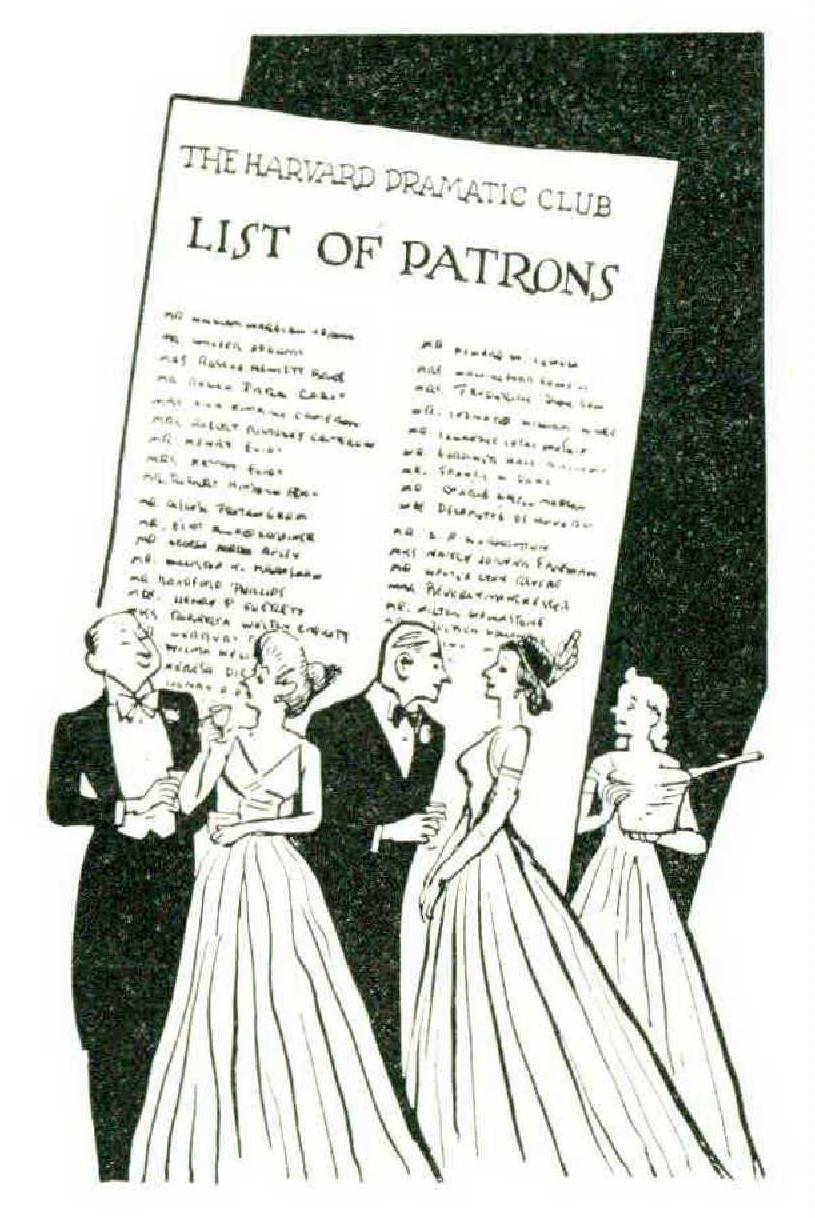
For years I had been reading lists of Patrons and Patronesses in newspapers and on programs, names of people of distinction (or so I had always assumed). I recognized in the lists luminaries of State Street and Brattle Street, of Beacon Hill.
There were other names I didn’t recognize at all, but I took this for an indication that I simply wasn’t in the know. These people were probably so rich, so social-register, and so austerely distinguished that no one ever heard of them.
Or that’s what I thought until I became one of them. By what strange course of events I shall never know, my name got on the list of the Harvard Dramatic Club, and I received a sort of engraved invitation asking me to become a Patroness.
The fact that this entailed buying tickets to the forthcoming production at a higher price than ordinary people paid I accepted as a tribute to my solvency.
The opening night of the show (my first tremulous appearance as a Patroness) was accompanied by a blizzard — a real sockdolager. Transportation stopped dead, the wind howled, even taxis gave up. But I was determined to show up at the performance. I climbed into ski pants and boots and hiked through knee-deep drifts to Memorial Hall.
Harvard, inconceivably, has no stage where students can put on a play; Memorial Hall — besides being obviously haunted and therefore unsuited to comedies— has no footlights, no curtain, and the fire laws have condemned the use of scenery.
I was mortified and amazed to find the other Patrons and Patronesses there in impeccable evening dress. An usher quietly showed me to my front-row seat in the midst of the starched shirt fronts. I still don’t know how those Bostonians got there; I suspect some of them simply materialized out of the shadowy grottoes of Memorial Hall. They duly sipped punch in the entr’acte while I huddled as inconspicuously as possible in a corner and consoled myself by reading my name on the program among the Forbeses, Endicolls, and Peabodys. I thought I’d better enjoy it while I could: after my debut in pants, surely my career as a Patroness was Over.
But it had only just begun.
For my second appearance, I was determined to be at least correctly dressed. I was standing before the hall mirror giving myself a last anxious checkup, when the telephone rang. A nice young Harvard accent said courteously, “Are you just leaving for Memorial Hall?" I said I was. “This is one of the members of the Dramatic Club,” he said. “We were wondering if you could bring over a pot.”
“A pot?” I said.
“Yes,” he said.
There was a brief pause, while I assembled the sang-froid I felt a Patroness should have on all occasions.
“What kind of pot?” I asked.
“A cooking pot,” he said.
“Oh,” I said. “Why, sure. What size?”
He thought for a moment and finally said very positively, “Medium size. It’s for a man.”
I grabbed the only medium-sized cooking pot in the house, which happened to be on the stove and recently full of stew, and I dashed off for the hall, only to arrive, alas, in the midst of the shirt fronts. I made my way through them, clutching the greasy pot. It was no consolation when this undistinguished utensil made its appearance in the third act. A bum shambled on the stage waving it and announcing: “This is a poor man’s pot.”
In gratitude for my magnificent contribution to the play, I was invited to a party after the performance. It was given at the Dramatic Club’s headquarters — an old and unheated swimming pool — where they manage to store scenery, rehearse, and catch colds. The party was late in starting — a rumor went around that the man who was to make the punch had got mixed up with the Hasty Pudding masquerade across the street and inadvertently won First Prize. Presently he came in, with a large loving cup — not the alleged First Prize, but a receptacle to mix the drinks in. It was set on top of a chugging machine which turned out to be a diaper washer.
In search of a quiet corner, I moved a chair and found myself teetering on the edge of a twelve-foot drop into the swimming pool proper. I shrank back and ran into a member, who smiled and waved his hand grandly at the diaper washer. “May I get you something to drink?”
The Bostonians were all sitting around sipping out of paper cups and chatting socially. “Thanks,” I muttered, “but I must be going.”
I felt I had failed again, but it is all right. I have just seen the new program and my name is still listed among those “whose continued patronage makes possible the existence of drama at Harvard.”