Ignorance Preferred
BERGEN EVANS is, the author of The Natural History of Nonsense, parts of which appeared in the Atlantic. The following article is in the nature of a footnote to that work
by BERGEN EVANS
FEW speculations are more pleasing to popular philosophers than that of imagining the awe with which our ancestors or other primitive folk would be overwhelmed if they were brought face to face with a radio, an airplane, a machine for vending chewing gum, or any other of the mechanical marvels which our blase generation takes for granted. And, as a sort of corollary, it is generally assumed that anyone with modern knowledge would have had the world in his grasp had he lived in the past or suddenly been set down among savages.
Both of these assumptions overestimate gadgets and underestimate people.
It is probably true that many things to which we have become accustomed (though most of us no more understand them than Methuselah) would seem magical to our ancestors. But it is we, rather than they, who would be amazed by magic. Habitude will make even the supernatural commonplace. Luther relates that, hearing a strange sound in the cloisters at Wittenberg one night, he was alarmed until he perceived that it was only the Devil, and went back to sleep.
So with some of our contemporaries. When Alexander Kirk, the first American minister to Saudi Arabia, flew to Riad, an engineer was sent ahead to prepare a landing field, no plane ever having been there before. As the engineer sat beside his radio wailing for the plane to come in, he told a curious Bedouin that a Djinn in the box had informed him that in an hour and a half a huge bird would appear bearing men in its belly. The Bedouin thought that would be worth waiting to see and the engineer eagerly anticipated his amazement when the plane should arrive. But when it did arrive, twenty minutes late, the Bedouin merely remarked that the Djinn had been incorrect in estimating the time!
Many mechanical devices are not truly efficient, or at least nowhere near so efficient as it pleases us to think them, and one not accustomed to them and to the paean of praise that surrounds them would probably perceive this at once. The demonstration a year or so ago that the trained operator of an abacus can whip the pants off the trained operator of an electrical calculating machine at adding and subtracting came as a jolt to our complacency— though not, be it said to his honor, to that of an official of one of the largest addingmachine companies, who cheerfully confessed that “the abacus is twice as fast as a machine.” That it did not come as a stronger jolt shows the grip that gadgetology has on our minds.
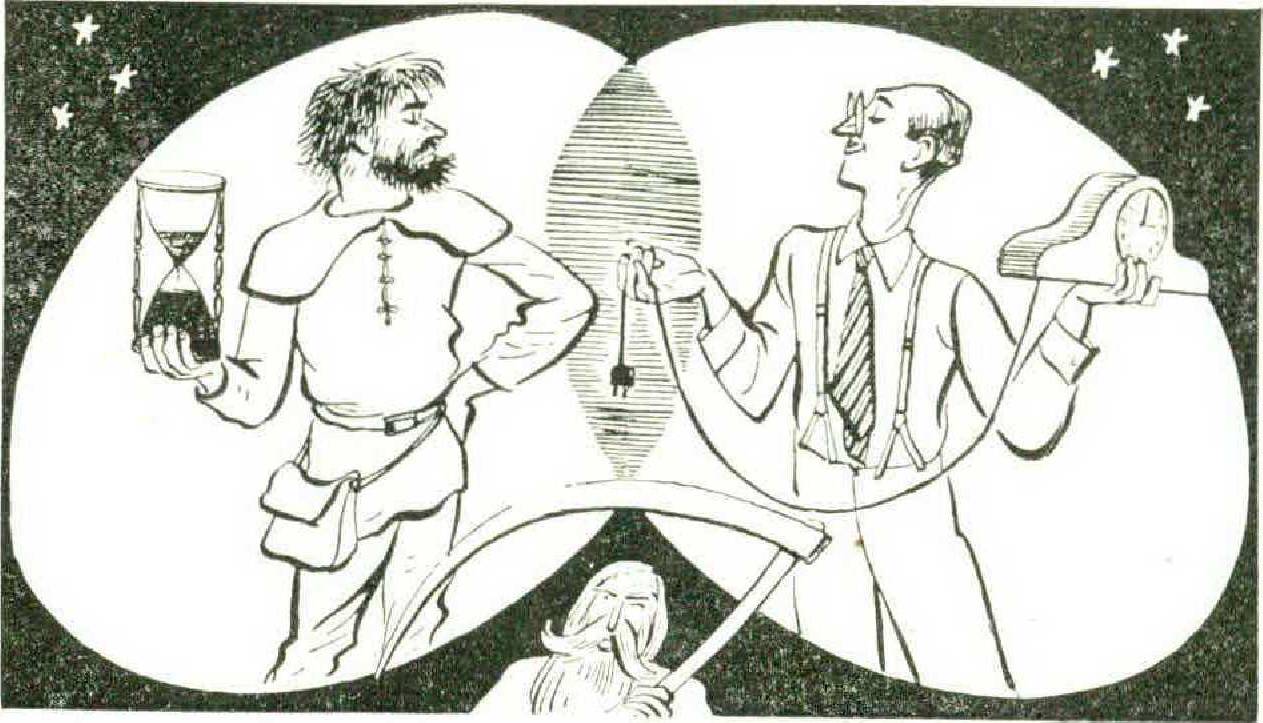
Then we pay a high price for our gadgets and the visiting primitive or the revived ancestor might pay more attention to the price than the product. When we expected him to admire a car, he might well be shuddering at the traffic. Instead of gasping at an automatic bread slicer, he might gasp at the inferior quality of the bread being sliced. The ingenuity with which we enrich canned dog food with vitamins might not astonish him as much as the preposterousness of doing it at all. And when we tried to stun him with a display of 1948 furniture, we might find the perverse devil a few doors down the street grinning into the window of an antique or art shop at the prices we are willing to pay for some of the things he made.
The other illusion — that a man with modern knowledge would have the world in his grasp if he were miraculously transported into the past or thrown among savages — has furnished a score of comic strips and provided the basis for some very good novels. Mark Twain, Kipling, and H. Rider Haggard have all used it and thereby contributed happy hours to millions of boys. But it is a boy’s dream. Wholly apart from ignoring the necessity of having the devices, the materials, and the myriad skills by which ibis knowledge can be utilized, these imaginings overestimate our power and underestimate the others’ obduracy.
The ignorance of the past was upheld by some mighty solemn people and il was harder then than it is even now for truth to get a hearing. As G. H. Shaw has said, if Mr. Pickwick’s physician had advised him to throw away his bed curtains and open his window at night, Mr. Pickwick would have changed not his habits but his physician. To have protested against phlebotomy or to have doubted the theory of the four humors when that practice and theory were current would have earned not the gratitude but the detestation of mankind.
In reading history one is often moved to shout advice back down the vistas of time. A man feels that if he had been living in the age of witchcraft persecutions, say, he would have spoken sense and that particular installment in the serial calamity of humanity would never have been. But the least reflection is enough to show that this is a hallucination of hindsight. Our modern conclusions would have been undemonstrable and the skeptic would most likely have ended on the pyre, one more witch so far as the public was concerned.
Orthodoxy always has the advantages of possession. Stefansson, when he first came among the Copper River Eskimos, encountered a Shaman who, envious of the attention the visitor was attracting, professed to be quite familiar with the white man’s land. He said that he had frequently visited it by magic and its wonders were old stuff to him. Stefansson challenged him to speak the white man’s language and the Shaman responded by jabbering some gibberish. Stefansson triumphaniK said that that wasn’t any white man’s language that he knew and at once found himself discredited. The Eskimos did not say, “Our Shaman is shameless,” but rather, “The stranger is an impostor. He professes to be a white man but admits he does not understand the white man’s language when our celebrated Shaman speaks it to him.”
No and alas, much evidence suggests that our fathers and our savage brothers are too much like us to be easily impressed, credulous and incredulous at the wrong limes, enamored of their own ignorance, learning the simplest things only through repeated disasters, and reserving their admiration chiefly for themselves.