u.s.a. Retasted
FOOD
THIS is the first of two art ides on food and drink in the United States by the President of the Wine and Food Society, ANDHE L. SIMON, who recently returned to his home in London after some months in this country.
by ANDRÉ L. SIMON
GASTRONOMY is the art of choosing, preparing, and presenting food and drink so that they do not merely satisfy hunger and slake thirst, but also delight our senses of sight, smell, and taste,
has gastronomy made any headway in the United States since the war? I cannot tell: my visiis have always been too short, before and since the war, and my contacts too few, to answer such a question to my own satisfaction, let alone anybody else’s. All I can do is to record what my personal impressions have been regarding ihe changes for the better or for the worse in the quality and service of both food and drink, during my recent visit to the States.
On the credit side there is one outstanding feature: the frozen foods. I know that the home freezer was introduced before the war, but it is only since the war that it has gained full recognition and that it has become part and parcel of the up-to-date kitchen equipment, both in the home and in entering establishments.
The differences of technique, space, and cosl belwcen the old cold-storage met hods and the modern freezing technique are beyond my understanding: I take them for granted, whatever they may be, and they are no concern of mine.
But what I found of the highest possible interest is the fact — a far more import ant one than all others for me — that tfie quality of the foods from the home freezer is greatly superior to that of the same foods from cold storage before the war.
This, I was told on good authority, is not due to differences in the two methods of refrigeration, although all appear to agree that the new freezing system is incomparably more reliable and satisfactory: the main reason why post-war frozen foods are of so much belter quality than ihe pre-war cold-storage foods is that, before the war, the best food was sold at the highest prices when fresh, and only the second best, or the unsold besl, would be put in cold storage to be sold eventually at a much lower rate. Cold-storage foods were saved; they were in an arrested state of put refaction and safe enough, but never the best. With the new freezer, on the contrary, it is the best that is held when at its best and freshest, even to a loaf of fresh, crisp French bread straight from the oven to the freezer duly wrapped up, of course, and at hand for the party a day, a week, or a year hence, when it can be depended upon to be as fresh and crisp as the day it was ba ked.
All the friends whom I visited had their own freezers, reeonlly acquired and greatly valued, but they belong to the “higher incomes” minority. What of the millions of people throughout the States who have no chance of acquiring and using a freezer of their own? Is this new refrigeration technique of any use to them? Indeed it is. In all great cities and industrial centers, many people have at least one meal a day in some restaurant or cafeteria where frozen food of far better quality than the average pre-war cold-storage variety is served, and stores everywhere carry frozen foods for home cooking. The millions who work on the land need not bother about freezers any more than they troubled about cold storage: they have the blessing of fresh food of their own as the mainstay of their lives, with some four hundred varieties of all manner of other foods to choose from, ready in handy cans, at the stores in the nearest town.
Another item which certainly deserves to appear upon the credit side of the American food balance sheet is cheese. It was probably because no cheese could he imported during the war from France,
Italy, Holland, or Switzerland that cheesemakers in the United States were led to do something about the situation, and they have succeeded in producing far better imitations of all the European varieties of cheese than I had ever tasted before the war.
Not so obvious, perhaps, but in my opinion an important point, is the fact that it has become more difficult than ever to get a cook at anything like a reasonable wage which means that most of the young people of today must look after themselves and do their own cooking, even when they come from homes where they enjoyed all the comforts and luxuries which rich American parents love to lavish upon their children. It is all to the good, because one is bound to take a more’ intelligent interest in one’s food when one has to buy it and cook it daily for one’s husband and children.
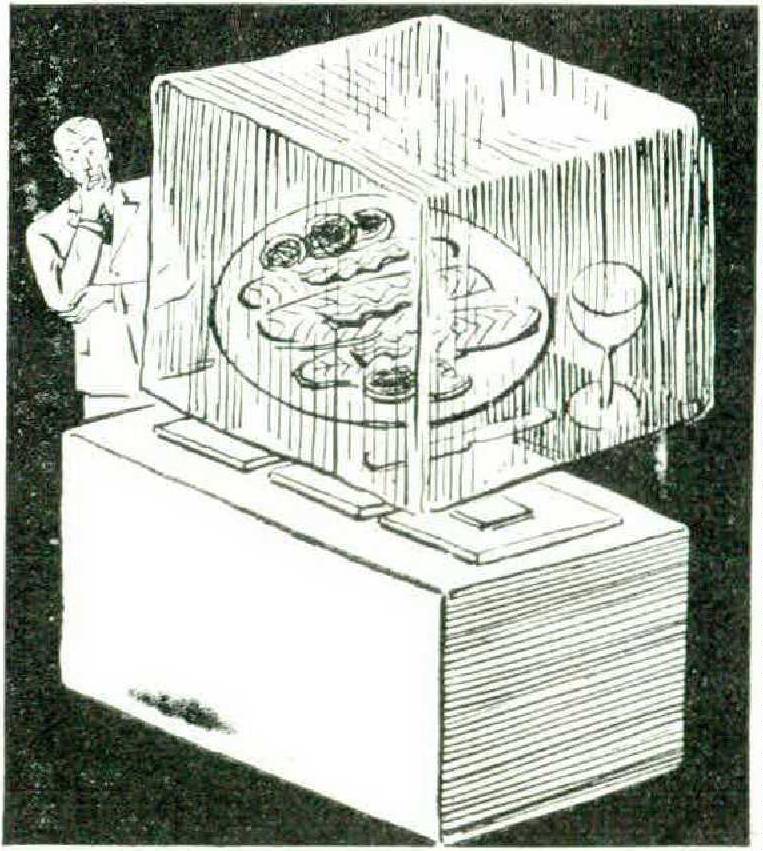
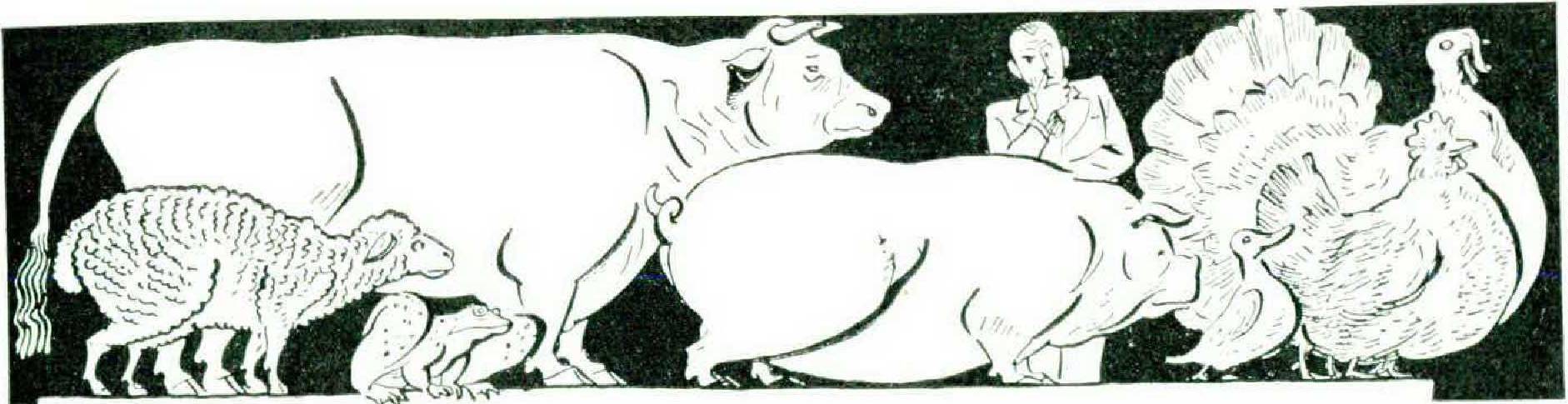
On the debit side, I feel inclined to put the ever greater priority given to the eye or sense of sight, and the disregard of the senses of smell and taste. Birds are bred which are all breast, and lambs which are all back; it may be the turn of frogs next to be all legs. A New York restaurateur told me that he had a farm and bred turkeys that never stood on anything but a wire-netting floor so that they could not pick anything from the ground: also that Ins birds got corns and iound it painful to walk and even to stand, so that they just squatted and spent the I ime of day eating and resting. The result was splendid, he assured me: all breast and so white and lender.
That may be, hut I could not help thinking of a friend of mine who a also had a farm, at Hambouillet, near Paris, with many acres of wooded land attached to it; he reared pheasants and he also reared some turkey s in the same way, food being scattered a bout for them in plenty, but even then some ol that food was obviously poached by ot her birds and their four-looted enemies, so that the turkeys had also to fend for themselves. This was in pre-war days, when rich people could have keepers lor their game, and these semi-wild turkeys, although they could not be matched against those reared by my New York friend breast lor breast, must have been of far finer flavor — which is, after all, what matters most among gastronomes. But I should like to go further, although I know nothing about medicine: I feel quite sure that the firm meat from a healthy bird reared in liberty must be more completely assimilated and do one more good than the flabby flesh of the obese recluse squatting on its wire couch.
This demand for that which looks fine or big, whether better or worsens regards flavor or texture, should be discouraged before it does still more harm. It is particularly disastrous as regards fruits and vegetables. There are some truly beautiful cherries, as large as Mirabelles, with the shortest possible stalks—which does not matter — but also with so little juice and so little flavor that they are best left in a glass or silver dish in the center of the dining-room table as a colorful part of the table decoration. I am not at all sure whether watermelons are fruit or vegetable, but I am certain that they would be much better flavored if they were picked before they have reached the huge size of those one sees in all the shops.