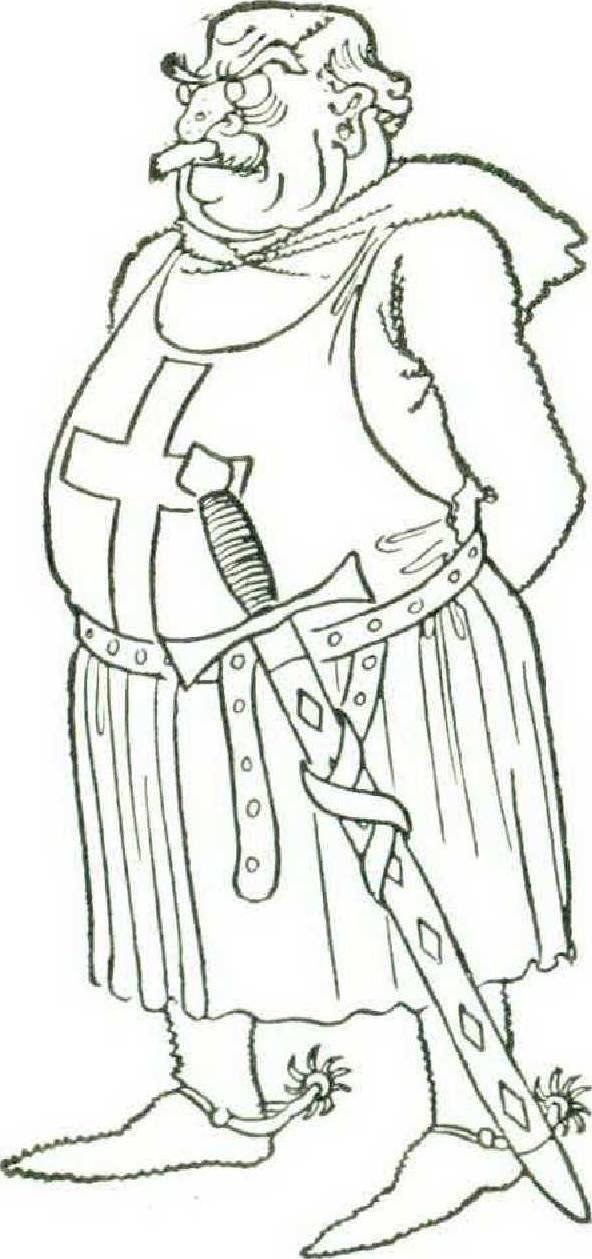
The Saracen's Head
English artist and writer, OSBERT LANCASTER came down from Oxford in the early thirties and studied at the Slade School. Later he became the art critic of the Observer and a cartoonist for the Daily Express, and so embarked on the writing and drawing which have earned him a delightful reputation. During the war he lived in Greece for eighteen mouths in a semi-official capaci ty, and the notes and sketches he made at that time have recently appeared in his new book. Classical Landscape with Figures. Now, in wholly different vein, he devotes himself to the adventures of William de Littlehampton, the reluctant Crusader.
by OSBERT LANCASTER
7
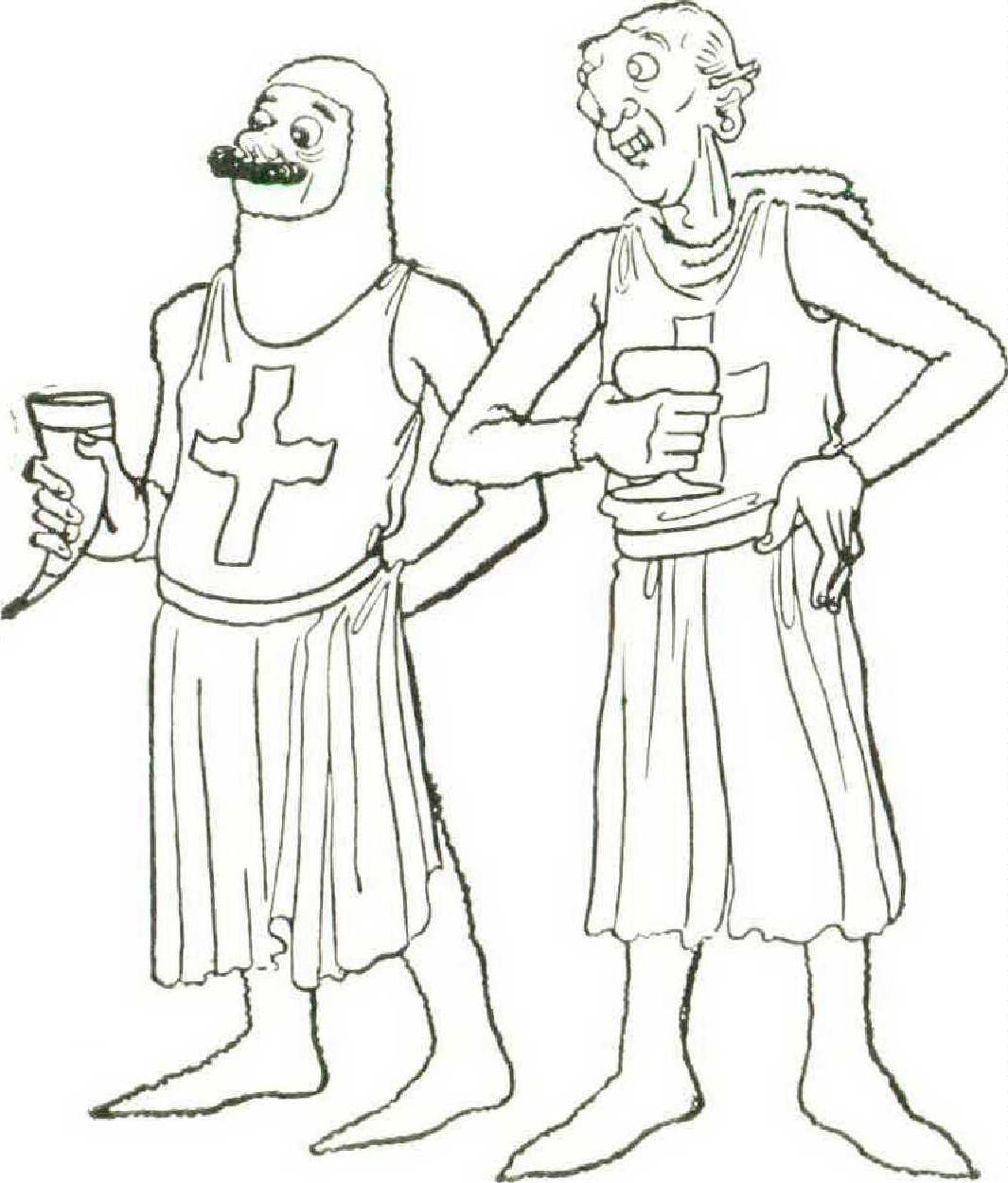
LONG before it was light on the morning after his arrival in the Holy Land, William, together with the rest of the camp, was aroused by a prolonged blowing of bugles, and after a short but busy interval of dressing, packing, and parading he found himself, just as dawn was breaking, one of a long line of horsemen jogging southward across the rosy desert.
When the cavalcade of knights and men-at-arms had been riding for about three hours they came to a point where the desert track divided; one branch swung away to the right, the other continued straight on towards some low hills on the horizon. While the Baron of Barking-West was still consulting with his lieutenants as to which route to take, there appeared a pair of pilgrims of a very holy but sadly scruffy appearance. Upon being questioned these venerable men assured the Baron that both tracks would lead them to the city of Acre, but advised strongly that they should take the one to the right — although, when pressed, they readily admitted it was considerably longer.
“Why, O holy men,” asked the Baron, “do you recommend us, whom you must know to be anxious to rejoin our sovereign with all possible speed, to take the longer way?”
“O Lord,” replied the elder, holier, and dirtier of the pair, “were you to continue on the road ahead your path would lie directly beneath the walls of the castle of the fearful Almanazor-el-Babooni, whose ferocity, strength, and insatiable appetite for Christian blood have made his name a byword throughout the East. No one has ever yet crossed that pass without his leave and come down on the other side alive.”
“O miserable, sniveling rogues! Do you dare to suggest that fear of one contemptible Hottentot is likely to deter a company such as ours — that a force that includes such renowned warriors as the lords of Potters Bar, Tooting Bee, Bromley Common, and East Grinstead, as well as innumerable knights of the highest reputation, can be diverted from their chosen route by old wives’ tales such as these? Do you dare to suppose that any man of us could ever again show his face in Earl’s Court, or even Baron’s Court, if we were to give a moment’s heed to your craven warnings?—Hi there,” the Baron, by now deep purple with rage, called to some men-at-arms, “seize these insolent scarecrows, and teach them the respect due to their betters.”
Whereupon two lusty fellows rushed at the unfortunate holy men, belaboring them soundly with the flats of their swords, and continued this treatment until at last their victims ran bawling away down the hill. By the time they had rejoined their companions t he little force was already some distance along the road which led to the mountains.
From now on until they reached the top of the pass the greatest excitement prevailed among the Crusaders. It was generally agreed that the Baron had acted most properly in his summary rejection of the pilgrims’ advice, and the only doubt which was generally expressed was as to whether he had not been overlenient in his treatment of the wretches and whether it might not have been better to string them up by the roadside with a short notice pinned round their necks recounting their crime by way of warning to others who went about spreading alarm and despondency in this way. William, as soon as the pair had come clearly into view, felt that his worst fears had been well founded. El Babooni was a man of powerful physique with a great forked beard through which his sharp teeth gleamed like marble tombstones in an overgrown graveyard. On his head was a spiked golden helmet around which was bound a striped turban; in his left hand he held a small round shield, while with his right he whirled an enormous scimitar with what William felt to be a deceptive nonchalance.
The only person who did not fully share in the general confidence, you will not perhaps be surprised to hear, was William de Littlehampton. To him it seemed just possible that the holy men, who had obviously been a long time in this part of the world, might know what they were talking about. In particular he felt that his companions might possibly be underrating the Infidel tyrant whom, for his part, he was quite willing to believe every bit as formidable as he sounded. However, he knew enough to keep these unworthy doubts to himself.
8
SUDDENLY, less than an hour after the meeting with the pilgrims, a loud cry from the advance guard, who had reached the point where the road began to descend to the plain, brought the whole cavalcade to a halt. When William, who crowded forward with the others, reached the spot whence the cry had come he saw, immediately below, a level stretch of country dominated by the walls and towers of a powerful castle in the Saracenic style. In front of its gates there was already drawn up what appeared to him to be an enormous host, their spears and scimitars flashing in the bright sunlight.
While the Baron and the more experienced knights, who had reined in their horses at the foot of the hill, were still discussing the best plan of campaign, a solitary horseman was observed to detach himself from the enemy ranks and come spurring across the intervening desert in a cloud of dust. When he had come within a hundred paces of the knights he pulled in his horse in a most dramatic manner, causing it to rear hack on its haunches, and as soon as the dust had subsided was clearly seen to he a coal-black Negro of gigantic size, grasping a huge banner richly embroidered with incomprehensible hieroglyphics.
Before the Crusaders had fully recovered from their surprise the blackamoor herald, for such he proved to be, called out in an enormous voice and quite passable French that he was the servant of the illustrious, all-powerful, and most pious lord Almanazor-el-Babodni on whose territory they were now standing and who would suffer no Christian pig to remain alive for more than five minutes. So let them instantly begone! If, however, they were so foolish as to persist in their purpose his unconquerable master would be delighted to meet as many knights as would care to come against him in single combat.
This challenge, I need hardly say, was at once accepted, and while the herald was returning to his own lines to report, an eager dispute was carried on among all the knights as to who should have the honor of dispatching this Infidel braggart. At length, further discussion was prevented by the Baron of Barking-West deciding that, dearly as he would himself love to teach the Infidels a good lesson, he felt that it would only he fair to the younger knights, who probably had hitherto had few opportunities to prove their worth, if one of them were selected for the task. He accordingly commanded that the challenge should be taken up by Sir Simon de Gatwick, than whom no one of his generation enjoyed a higher reputation. Instantly there was a flood of congratulations for Sir Simon, together with hearty slaps on the back and cries of “Good old Gutters,”“Some people have all the luck,” “You beat the daylight out of him, old man,” which was only brought to a close by the sight of the herald returning accompanied by another horseman who could only be the terrible Almanazor himself.
However, his companions seemed in no way to share William’s nervous fears. They remarked slightingly on the size of the champion’s steed, which indeed, compared with their own great cart horses, looked small enough; they likened his shield to a saucepan lid; and his general appearance struck them as theatrical and flashy. It was generally felt, and by no one more strongly than that warrior himself, that Sir Simon would have a walkover.
At length the last encouragements had been given and the saddle girth finally adjusted, and Sir Simon, having put on his great helm, taken his lance from his page, and saluted the Baron, urged his horse forward towards the spot whore the Infidel champion was impatiently awaiting him.
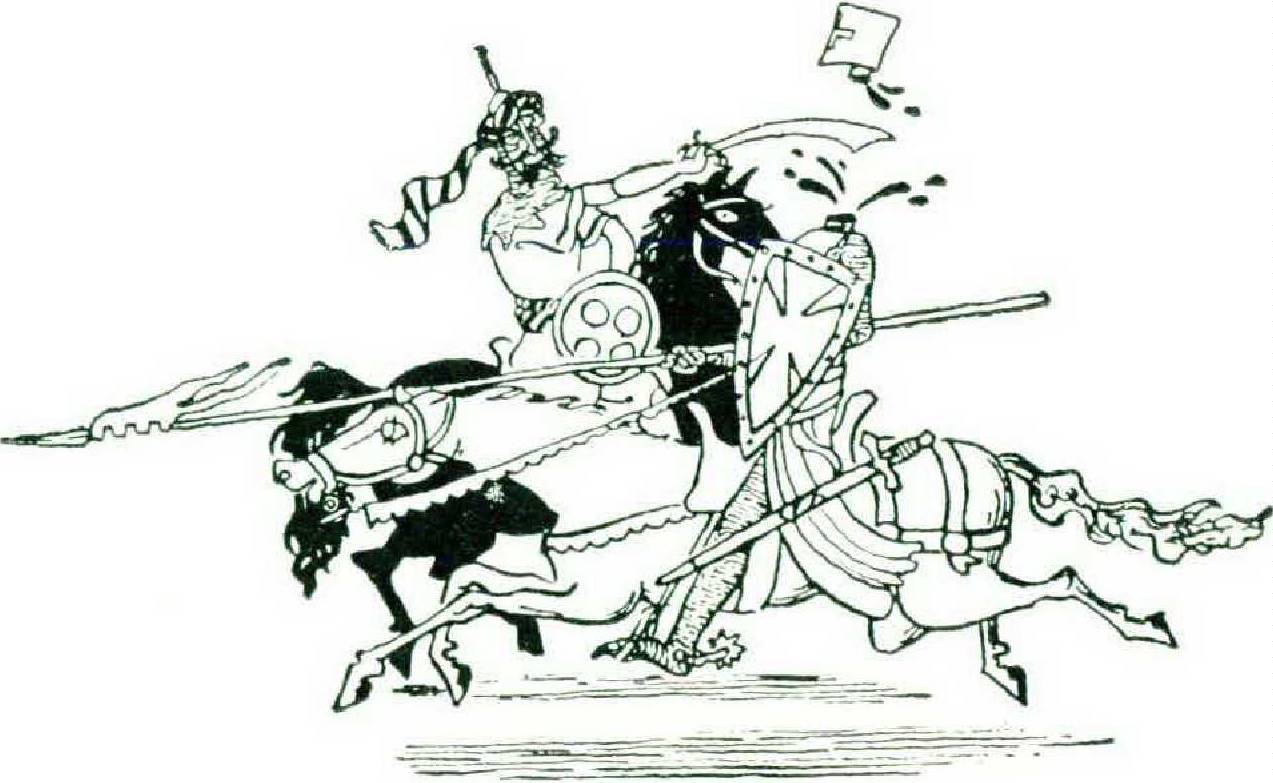
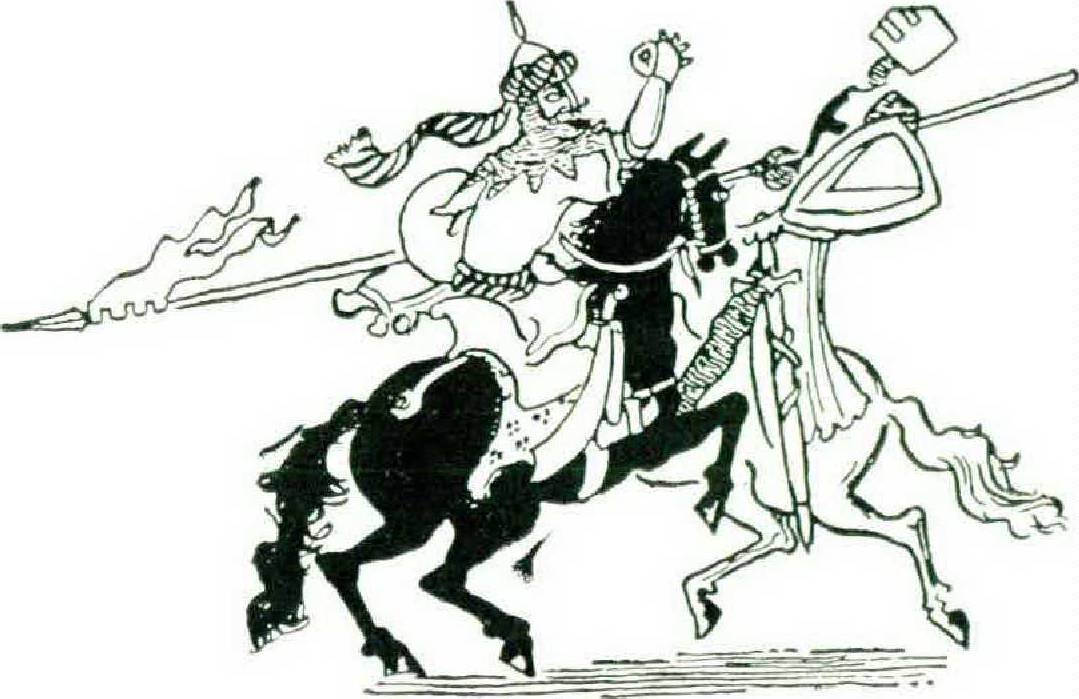
As Sir Simon, his shield held firmly across his body, his lance as straight and inflexible as a shaft of light, approached nearer his victim, his horse broke first into a trot, then into a canter, and finally into a full gallop. El Babooni for his part never moved, and as his opponent came closer and closer all the spectators held their breath, wondering if he were mad. Then, just as it appeared that nothing could prevent the point of Sir Simon’s lance from transfixing the insolent Paynim, El Babooni’s little black horse seemed to shy abruptly to the left, his little round shield shot out to catch and deflect the menacing spearhead, and with a seemingly careless sweep of his scimitar he severed the unfortunate knight’s head neatly from his shoulders.
At first the Crusaders were too astonished to speak, but when the initial shock had subsided there broke out a flood of explanations and regrets: “Poor old Gutters,” “Dashed bad luck,”“Why, if that wretched little pony hadn’t shied at the last moment that fellow would have been skewered as sure as eggs is eggs.”
Almost at once the queslion arose as to who was to have the honor of taking the place of poor Sir Simon and of avenging his death, but it was soon obvious that this honor belonged by right to his dearest friend, Sir Willibald de Wandsworth.
Once more after the last encouragements had been given and the saddle girth finally adjusted, a Christian knight, having put on his great holm, taken his lance from his page, and saluted the Baron, urged his horse towards the spot where the Infidel champion was impatiently awaiting him.
As Sir W illibald, his shield held firmly across his body, his lance as straight and inflexible as a shaft of light, approached nearer his victim, his horse broke first into a trot, then into a canter, and finally into a full gallop. El Babooni for his part never moved, and as his opponent came closer and closer all the spectators held their breath, wondering, though this time rather less hopefully, if he were mad. Then, just as it appeared that nothing could prevent t he point of Sir Willibald’s lance from transfixing the insolent Paynim, El Babooni’s little black horse seemed to shy abruptly to the left, his little round shield shot out to catch and deflect the menacing spearhead, and with an undoubtedly disdainful sweep of his mailed fist, not troubling to raise the scimitar which hung idle at his saddlebow, he caught the unfortunate knight a light clip under the jaw, lifting him clean out of the saddle and breaking his neck with the sound of a whipcrack.
9
THIS time the Crusaders were silent for much longer, and when finally they had got over their astonishment, although their regrets were as sincerely expressed as before, their explanations were offered with rather a less confident ring. Moreover, the question of who next should take his place in the lists was not so easily to be decided, and had the Baron not firmly intervened the dispute might have gone on for some time.
“Men,” he said, “I know that each one of you is burning with unquenchable eagerness to press forward and avenge your unfortunate companions. As there is now none among you who can justly be said to excel all others in martial virtues, I have decided that it would be fairest to all to draw lots. Thus you will all stand an equal chance of fulfilling the task which I know is closest to your hearts.”
Having thus spoken the Baron called to the Chaplain and borrow ing from him a small piece of parchment divided it carefully with his knife into small slips equal in number to the knights present. These were then handed round by a page, and after each knight had written down his name (or, in rather a large number of cases, made his mark) were collected and placed in a helmet. The Baron, as soon as the helmet had been well shaken, closed his eyes tightly, put in his hand, and drew forth a slip of parchment. With what keen, if suppressed, excitement did the company wait as the Baron fumblingly, for he had forgotten to remove his mailed gloves, unfolded the selected slip! How tensely did all hold their breath as they observed a look of surprise and then of humorous resignation pass across his face as he scanned the name! How completely they all failed to suppress a gasp, whether of astonishment or relief it would be hard to say, as at last in clear ringing tones he announced the name, “William de Littlehampton! ”
At first poor William could hardly believe his ears and then, as the full truth dawned on him, his head seemed to revolve rapidly on his shoulders and his stomach to start turning over inside him very, very slowly. When at length he had gained some little control over himself, he became aware of a chorus of hearty congratulations on his luck, in which, hazy as he was, he still thought he was able to distinguish a faint note of insincerity.
Before, however, he could pause to consider this point his lance was being thrust into his hand by Leofrie, his helm was set firmly on his head by willing but unknown hands, and poor Lillian, who was hardly less nervous than he, was being urged forward to the point from which Sir Simon and Sir Willibald had started their ill-fated charges. As, obediently and seemingly without his direction, Lillian broke first into a trot, then into a canter, and finally into a gallop, William, thankful at least that his pale green face was hidden by his helm, repeated hopelessly to himself, “ Keep a straight lance, keep a straight lance, at all costs keep a straight lance.” Alas, even as he repeated these words he felt the point of his lance starting to move slowly from side to side and then up and down until it was behaving exactly like a weathercock on a gusty day. “It’s no good,” he thought, “ my end has come. If only I had tried harder and paid more attention to all those lessons in the liltyard. But it’s all too late!”
He was now within a few yards of El Babooni and, as he looked at that ferocious countenance drawing rapidly closer, the sight struck him as so appalling that he firmly resolved to close his eyes, never expecting to open them again in this world.
The next thing William knew, there was a crash so terrible that he was sure every bone in his body was shattered, and he felt himself flying through the air and bumped down with a force which set twinkling before his eyes a million stars which were almost at once extinguished by a wave of impenetrable blackness.
After what seemed to him to be several centuries William found himself sitting on the ground struggling to remove his helm, which had apparently got twisted round in his fall. When he finally succeeded in getting it off, with what incredulous astonishment did he survey the scene that presented itself to his gaze! A dozen yards away lay the prostrate form of Almanazor-el-Babooni with the broken shaft of V\ illiam’s lance sticking up from the center of his chest like a skewer in a partridge. Away in the distance a black horse was cantering terrified towards the horizon while, close at hand, Lillian was happily browsing on some cactus bushes. From the ranks of the Crusaders there rose a sound of prolonged cheering, while the Xcgro herald was down on his knees swaying from side to side and wailing like a banshee.
After a few moments, for his wits were still a little bemused by his fall, he began to realize that, unlikely as it seemed, he must himself have been responsible in some mysterious way for the overthrow of El Babooni. Exactly how it had come about he was at a complete loss to explain.
What in fact had happened was this. Almanazorel-Babooni had hitherto only been accustomed to giving battle to the most accomplished and highly trained Christian knights, such as Sir Simon and Sir Willibald, who invariably charged with a perfectly straight lance. When, therefore, he saw approaching a horseman whose lance, so far from being inflexibly straight, wavered from side to side, describing circles with its point, he was completely dumfounded and his carefully acquired technique became of no avail. First he thrust out his little shield to the left, then to the right, and finally, too late, straight in front, muffed it, and only succeeded in deflecting the point of William’s lance into the exact center of his own chest. Which all goes to show that it is seldom wise implicitly to trust the experts.
10
AS SOON as they saw the downfall of El Babooni and realized that he would never rise again, all the Crusaders came crowding round the still dazed William, slapping him on the back and wringing his hand. The Baron with tears in his eyes constantly repeated how much he wished his dear old friend Sir Dagobert had survived to witness the events of today, and repeatedly remarked what joy the news would give at Courantsdair.
Natural and proper as were the reactions of William’s companions, the extraordinary performance of one bystander was completely unexpected. Much to the general surprise there came thrusting his way through the crowd of knights the gigantic Negro herald, whose name strangely enough turned out to be Hercule, who, flinging himself full length on the ground, seized William’s right foot and placed it on his own head, informing the company as he did so that he now considered himself the slave of the conqueror of El Babooni for life, and vowing that from henceforth he would never leave his side.
This touching scene might well have continued for some time had not the Baron called attention to the fact that although Almanazor himself had been dealt with, there still remained his army and his fortress. Accordingly he gave the order to mount and the whole body of knights, with the addition of Hercule, continued in line across the desert towards the enemy.
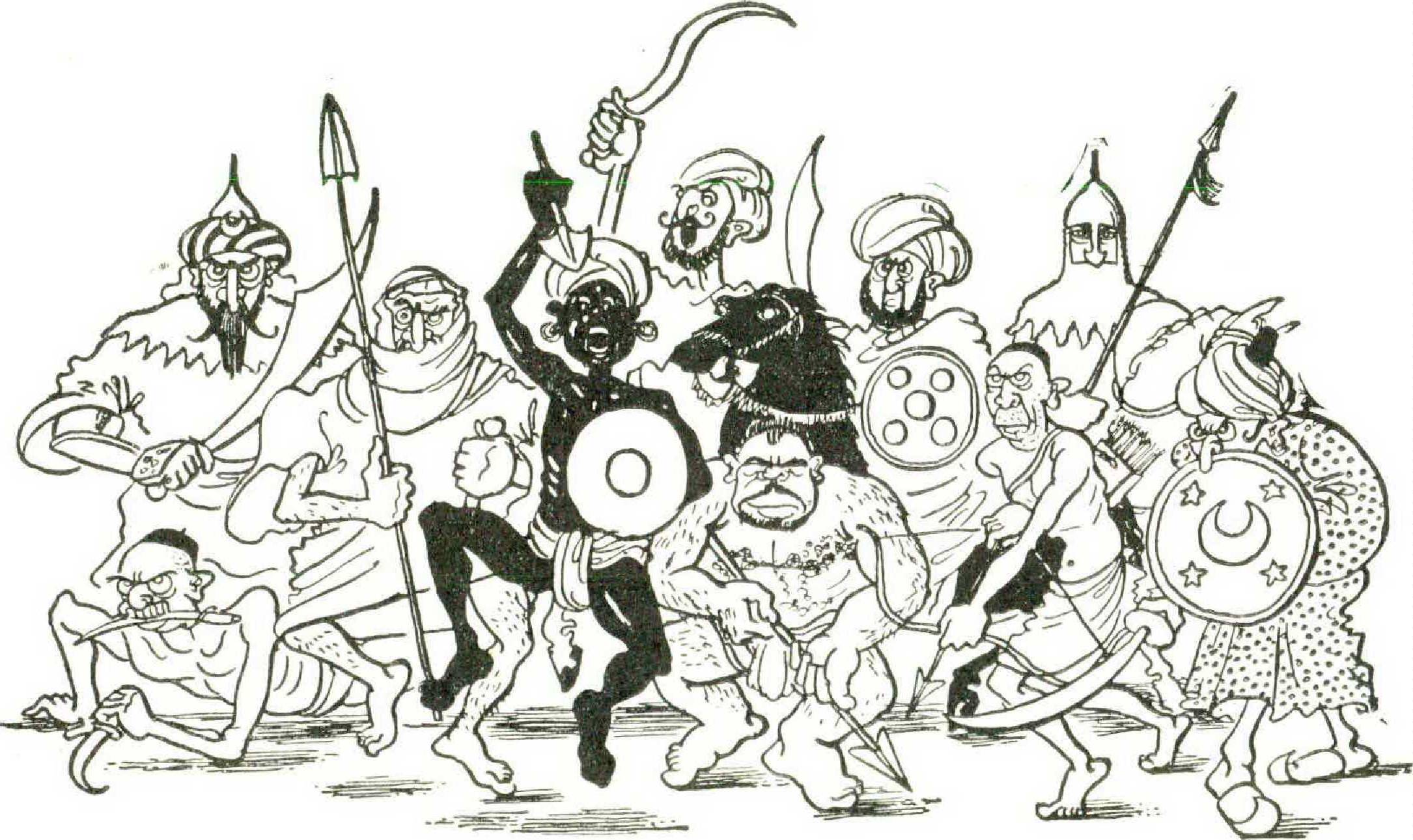
Any anxiety which the Crusaders may have felt at being faced with what was still a considerable force was soon dispelled by the behavior of the Infidel host, who ever since they had realized that their leader was laid permanently low had been howling and yelling fit to burst. Now on seeing the approaching line of horsemen they broke and scattered in all directions, some galloping away towards the mountains as fast as they could and some flying back to the fortress, while others followed the example of Hercule and came rushing forward to throw their arms at the conqueror’s feet.
On arriving at the great gates of the stronghold the Christians were surprised to find them open, and no single warrior prepared to make any resistance. Accordingly — the Baron having taken suitable precautions against ambush and secured a number of hostages who, he caused Hercule to announce in Arabic, would be immediately beheaded at the first sign of treachery—the whole force entered the city. Their first action was immediately to requisition the largest available palace, naturally El Babooni’s, and as much food and drink as they could lay hands on. This done the Baron, having posted a full quota of sentries, dismissed the parade, announcing that all would assemble in the great court of the palace at seven o’clock sharp, when a magnificent banquet would be held to celebrate the happy events of the day.
That evening proved to be one of the most memorable in William’s life. Having lived for the past two months on ship’s biscuits and salt pork, he had looked forward eagerly to the banquet, but little dreamt how rich and varied the dishes would prove. There were lobsters cooked in wine, red mullets fried in butter, lark pies, fricassee of nightingales’ tongues, the tenderest kidneys wrapped in vine leaves and eaten on spits, young gazelles’ trotters stewed in honey, mangoes, grapes, little figs, cakes made with almonds, and any amount of wine of all colors cooled with snow. But perhaps the most splendid dish of all was a roast flamingo stuffed with a whole turkey, which was stuffed with a whole goose, which was stuffed with a whole duck, which was stuffed with a whole chicken, which was stuffed with a whole partridge, which was stuffed with a whole quail, which was stuffed with a whole snipe, which was stuffed with a whole lark, which was stuffed with a whole nightingale, which was stuffed with a locust.
None of the Crusaders had ever eaten such a meal before; but for William, whose mother had never approved of fancy, “Frenchified” dishes and had always insisted at Courantsdair on what she called “good plain English cooking,” it was a revelation.
After they had all eaten so much they could no longer move, there took place a series of splendid and varied entertainments. There were dancers who whirled round so fast that their limbs seemed about to fly off; there were acrobats who balanced on the tips of their noses on spears; there were contortionists who tied their legs in knots behind their ears; there were jugglers who kept a dozen oranges, sixteen plates, any number of knives, and a quantity of flaming torches all whirling through the air at the same time.
At last the Baron rose up and announced that as an early start would have to be made in the morning, all should now go to bed.
“However,” he concluded, “before you depart there is one more toast which I would like to propose. Gentlemen, I give you the health of William de Littlehampton!”
11
THE next day was very hot, and as the sun mounted higher in the sky, the Crusaders grow redder and damper, and many complaints arose, especially from the fatter knights, about having to wear armor. But the Baron was very firm and refused for a moment to consider withdrawing his orders. “You are all on active service now, not just going to a tournament,”he said. “Besides,” he added, “this is not really hot — you should have been on the Second Crusade. Now that really was hot! I remember once in the desert the sun was so powerful that I fried an egg on my helmet. The trouble is you young fellows don’t know what real heat is.”
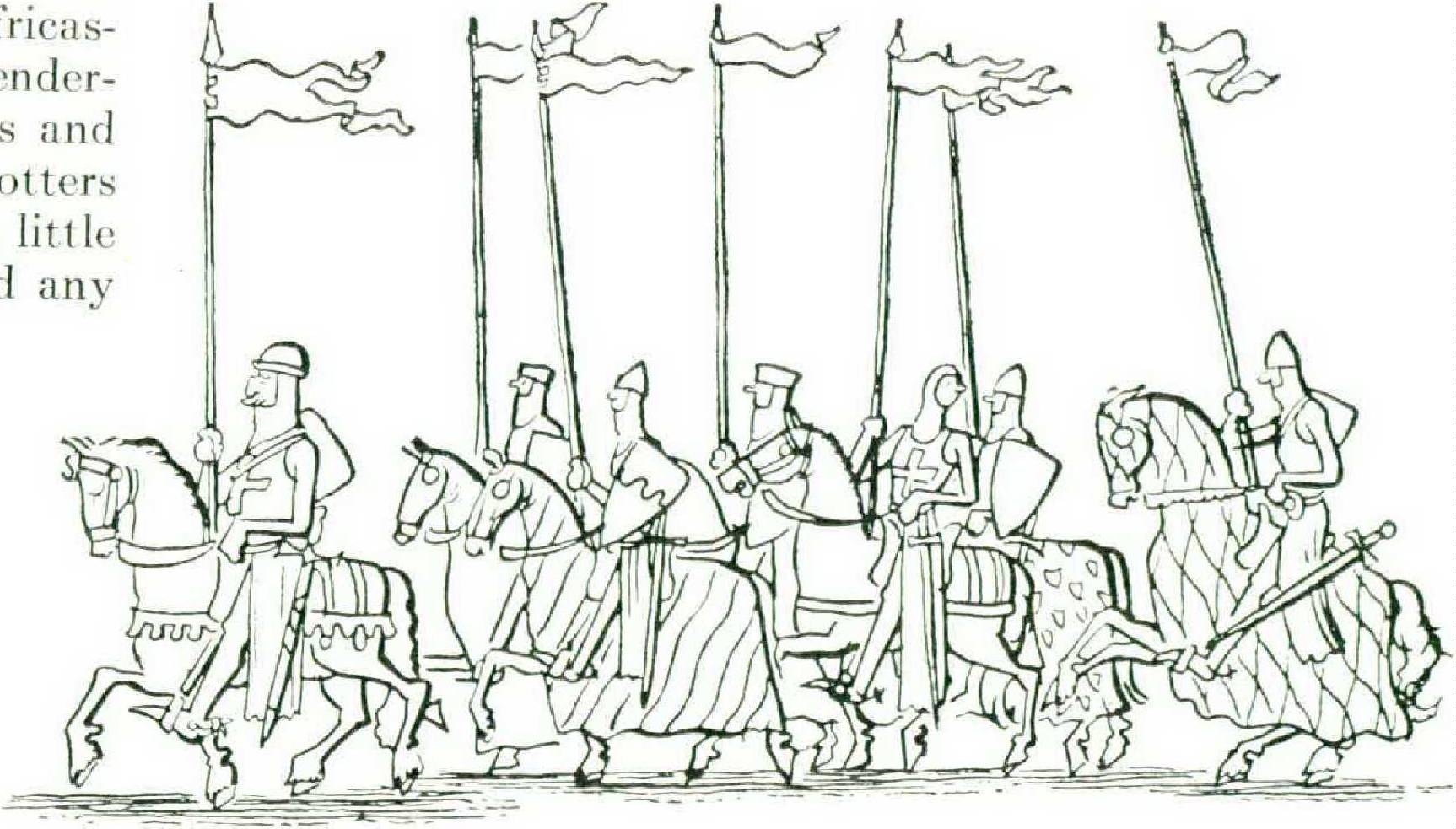
William, who had passed his whole life at Courantsdair, was in no position to contradict and, anyhow, being quite thin he was not suffering unduly. Poor Lillian, however, was in a dreadful state and felt very envious of those horses that were wearing long linen surcoats, tastefully embroidered with their masters’ arms. William, therefore, determined to have one of these coats, which he much admired, as soon as they reached the camp. Hitherto he had felt that were he at once to adopt this fashion, which he noted was confined to the smarter and more experienced knights, he might be considered to be rather bumptious and guilty of a desire to show off, but since the events of yesterday he felt his position among his companions was now sufficiently well established to enable him to do so without arousing any adverse comment.
Shortly after midday the leading knights saw, away in the distance, through a gap in the low hills, a patch of brilliantly blue sea and within an hour they were in view of the towers and walls of Acre with the innumerable tents that sheltered the Allied armies drawn up in a vast half circle in the foreground.
As soon as they had passed the first outposts the scene was one of the utmost liveliness and bustle, and William would indeed have been hopelessly confused and at a loss to understand the significance of half that met his eyes had it not been for the companionship of Sir Cuthbert de Brett who was riding alongside him. This amiable and well-informed young knight was counted the best amateur herald of his generation, and proved a mine of interesting and detailed information.
“Why look, dear boy,” he said, pointing to a large banner flapping above a tent on the left, “there are the three rognons braises on a ground argent of Salamandre de Vichy-Celestins. He, you know, is one of the richest lords in France and owns the best fishing in all Aquitaine. And next door I see the impaled turbot proper of Bobo Sissinghurst, one of the Derbyshire Sissinghursts and uncle by marriage of poor Gutters. And there, I do believe, are the quartered pelicans of Alfredo Frangipani; he, you realize, is Duke of Acqua-Pellegrino and possesses immense estates in Calabria and is directly descended from Romulus’s wolf. Oddly enough,” he added in a casual voice, “he is a connection of mine on his mother’s side.”
William, who had never been very good at heraldry, was profoundly grateful for all this valuable information, although the thought of ihc distinction and grandeur of so many of 1 hese names made him feel increasingly nervous. Sir Cuthbert, on the other hand, seemed to find the atmosphere positively exhilarating and kept on repeating in tones of the greatest satisfaction and surprise, “My dear, the whole world seems to be here.”
The Baron of Barking-West, after many inquiries from friends and acquaintances, at last succeeded in finding the billeting officer, and after a considerable delay, during which this worthy fellow read through a long list three times, then decided it was the wrong one, sent for another, and finally found what he wanted in the first, they were directed, just as the sun was setting, to the quarters they were to occupy for the night.
Quite early next morning, before indeed William had finished dressing, he was surprised to receive a visit from the Baron carrying a large parcel done up in a damp cloth.
“Well,” said his visitor with some satisfaction, “I’ve fixed it. His Majesty, whom news of your remarkable exploit had already reached, has graciously expressed his wish to make your acquaintance and I am to present you to him at this morning’s levee, which takes place in half an hour.”
At first William was too overcome to reply, and busied himself with finishing his toilet and asking Lcofric to give his helmet an extra polish and put out a clean surcoat. When at last he had got over his surprise, he hastily inquired what he was expected to do, how he should address his sovereign, and particularly, what was in the large parcel.
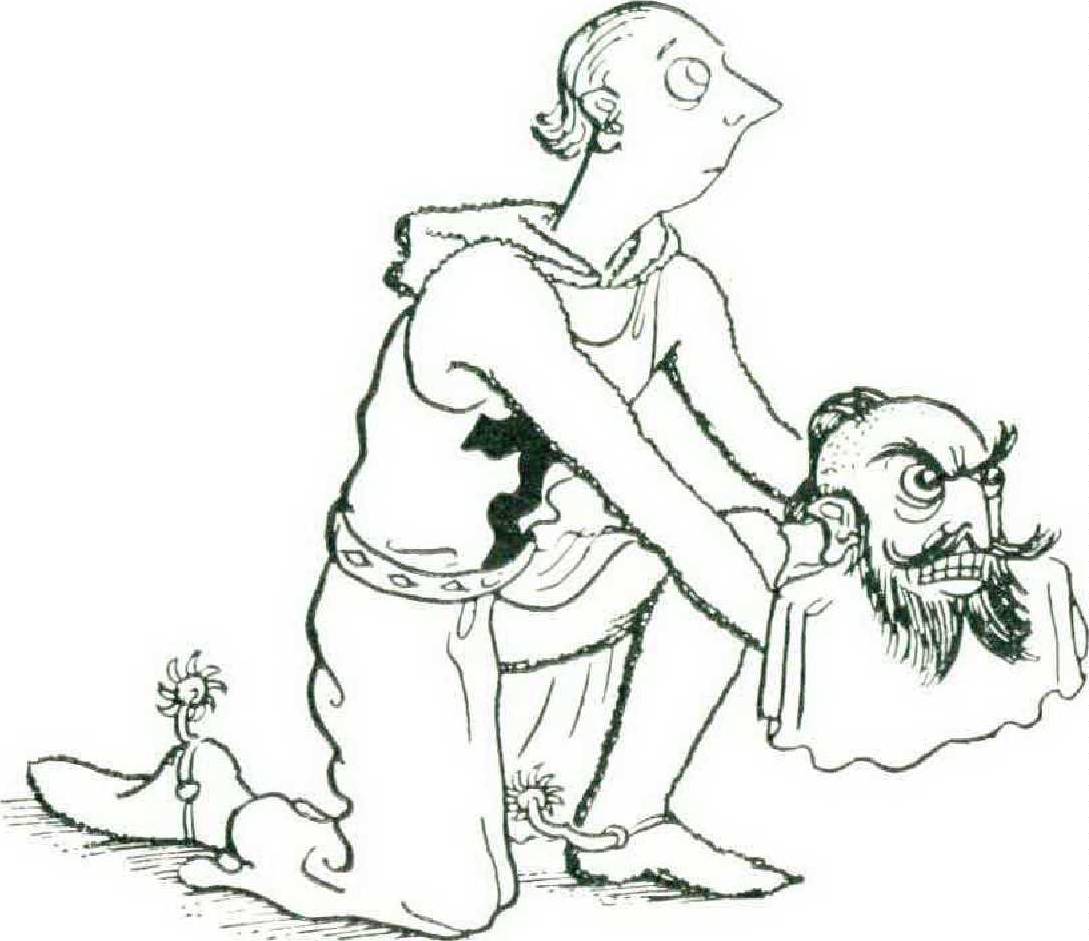
“Ah, yes, indeed,” said the Baron, “that’s a small present for you to give His Majesty. It is always as well on these occasions to have some trifling little memento to offer. And this, I flatter myself, will be much appreciated.” Whereupon, winking broadly, he whisked off the cloth, revealing to the horrified William the severed head of Almanazor-cl-Babooni !
“Yes,” continued the Baron, “I had it cut off yesterday with just this purpose in mind. I think you’ll find that it will give much pleasure to the Monarch.”
William, who had not regarded the face of El Babooni as a thing of beauty during his lifetime and considered that little or no improvement had been effected by death, thought it highly improbable that this grisly relic could give much pleasure to anyone, but could only suppose the Baron knew best.
By the time the Baron and William had arrived at the space in front of the royal tent where the levee was to be held, a large crowd had already assembled. Thanks, however, to the energy of the Baron and the fact t hat he had a friend in the Lord Chamberlain’s office, they were given very good places in the queue and settled down to wait patiently until their sovereign should emerge.
Exactly on the stroke of ten, with a punctuality which has ever distinguished the Royal House, the trumpets: sounded, the guards presented arms, unseen hands whisked apart the flaps of the tent, and His Majesty, King Richard, accompanied by a numerous retinue of chamberlains, secretaries, chaplains, Allied commanders, and others, advanced to take his seat on the throne which had been placed on a dais opposite the head of the queue. His sovereign’s countenance struck William as noble and benign: the blue if slightly prominent eyes formed a pleasing contrast to the red of the beard and hair and the expression was condescending but affable.
A rather less pleasing impression, however, was created by the appearance of His Majesty’s attendants. William was an idealistic young man and found it hard altogether to suppress a feeling of disappointment on his first sight of so many figures prominent in public life. In those days, you must remember, there were no photographs or newspapers to render familiar the likenesses of the leading statesmen of the time, and were you suddenly to be confronted today with the whole Cabinet and the more important permanent civil servants, having received no previous hint of their appearance, you would doubtless be no less shocked than was poor William on this occasion.
But little time was left for reflection on these matters, for William had hardly recovered from his surprise when he found himself at the head of the queue being urged forward by the Baron. As he sank down on one knee, eyes fixed on the ground, he heard the chamberlain read out his name and titles, and those of the Baron, which was followed by a short silence broken finally by a thunderous rasping sound that he did not at once realize was his sovereign clearing his throat. This over, he heard the royal voice, more kindly but hardly less forceful than that of the Dame of Courantsdair, addressing him in the warmest manner.
“William de Littlehampton, We arc doubly pleased to welcome you among us today. First as your father’s son; for the late Sir — the late Sir — urn, ihe late” — at this point William noticed an anxious face pop over the top of the throne and whisper hurriedly in the royal ear— “Sir Dagobert was among Our Royal Father’s most trusted lieges.
Second, We welcome you in your own right as one who has accomplished a notable feat of arms, gaining great credit for yourself and affording much assistance to the Holy Cause we are all sworn to defend. Sometime We would much like to hear from your own lips a full account of your prowess in yesterday’s engagement. Now, alas, affairs of state are pressing. However, Wo cannot take Our leave of so gallant a knight without bestowing some signal mark of Our favor.”
At this a page came forward with a pair of beautiful golden spurs on a cushion. These His Majesty took and, with that gracious condescension which had done so much to endear him to all ranks of his subjects, himself fixed on the feet of the trembling William. Then, taking the immense sword which rested across his knees, he tapped William lightly on the shoulder and said in ringing tones: “Rise, Sir William.”
So overcome was our hero at this totally unexpected gesture that he would undoubtedly have forgotten to present his own gift had the Baron not jabbed him sharply in the ribs. Blushing furiously, and doing his best to conceal both his distaste for the present and his anxiety as to its reception, he mumbled some quite inaudible words of gratitude and loyalty and laid the bundle at the King’s feet.
Sir William need have had no fear about the reaction his gift was to produce, for no sooner had he removed the cloth t han a murmur of t he most genuine appreciation arose on all sides and there at once appeared in the royal eye a look of animation which had up to that moment been quite lacking. Many remarks highly flattering to William’s pride and sadly critical of El Babooni’s appearance were passed by those present, and when the relic was removed by an attendant His Majesty gave instructions that it was to be carefully stuffed and mounted and sent back to hang with other remarkable trophies of ihe chase in the great hall at Windsor.
“Your thoughtful gesture,” said the Monarch, “in presenting Us with this splendid memento of a notable action has deeply touched Us, and as a small token of Our gratitude, We command that you shall have the honor of carrying Our Royal Standard in the great attack which is to be launched tomorrow. Moreover, We graciously permit you under Our Royal Warrant from henceforth to bear as your badge, crest, and ensign a severed Saracen’s head proper, and to transmit the same to all your descendants in the male line from generation to generation.”
Thus saying the King rose, indicating that the levee was now at an end, and followed by all his attendants withdrew into his tent.
Sir William was deeply touched by all these marks of the royal favor. His golden spurs clinked in a most gratifying fashion and attracted much favorable comment from all his companions, and the thought of at last being able to get rid of Sir Dagobert’s old boar’s head on his coat of arms which had throughout his youth proved for him a badge of humiliation, and to replace it with this far more dashing and exotic device, gave him boundless pleasure. The consideration of how much it would annoy his mother did not, I am sorry to say, in any way lessen his satisfaction.
With regard to the honorable and eagerly soughtafter post of Royal Standard Bearer he was less certain. His responsibilities he realized would be very heavy and he was anxious lest Lillian should prove unable to keep up with the royal charger, for he understood it to be his privilege always to be within five paces of the Monarch throughout the day. Moreover, he was distressed by the fear that his sudden elevation to this important post might provoke the jealousy of the previous standard bearer, whom he did not doubt to be one of the immensely distinguished characters of whom Sir Cuthbert had spoken. So seriously did he consider this possibility that he confided his fears later that day to Sir Cuthbert himself. Dawn was still but a faint pinkish glow in the east when William, who had slept very badly, was aroused by sounds of immense activity throughout the camp. Complicated trumpet calls rang out on all sides; the noise of riveting and swearing in half a dozen languages filled the air as hundreds of knights were assisted into their armor; and the ground shook beneath the pawing and trampling of as many chargers being exercised by grooms and pages. Poor William, who seldom felt at his best at this hour of the day, grew increasingly depressed and the eager chatter of Leofric, who was bustling round here, there, and everywhere, did little to cheer him. Only from the freshly painted Saracen’s head glowering from his shield did he gain any comfort. Arrived at the royal tent, William found what appeared to be the utmost confusion reigning. Galloping young staff officers kept leaping on and off horses and dashing away on unspecified errands. Pages and armorers shot in and out with helms, battle-axes, shields, and all sorts of equipment, and no one seemed to have either the leisure or the inclination to tell Sir William where to go or what exactly to do. Accordingly he dismounted, giving his reins to Leofric, and remained respectfully as near the door of the tent as he could get — a position in which he caused the maximum inconvenience to everyone.
“My dear boy, you can set your mind at rest on that score,” de Brett assured him, “for there is at present no Royal Standard Bearer. The last man to hold the post was poor Odo de Basingstoke who was killed last Saturday, his first day in office. Before that there was Etienne du Chemin-dcFer-du-Nord, who died on the previous Wednesday, having taken over from Wolfgang von der Bummelzug but three days earlier.”
“Oh,” said William in a rather depressed tone of voice, “and what happened to Wolfgang von der what d’you call him?”
“ He, poor fellow, was laid low by a bow shot right at the end of the engagement. That was the day when there were no fewer than three different standard bearers in the twenty-four hours, a record for the whole campaign.”
12
AS William lay awake that night brooding on his conversation with Sir Cuthbert, he came to realize for the first time that one of the great drawbacks of a noble reputation is the strain of keeping it up.
At last, just as the first rays of the sun shot above the low horizon, a final flurry of staff officers dashed out to announce the immediate appearance of His Majesty, and a few seconds later the King himself emerged.
Clad in full armor, though modestly wearing on his surcoat the plain scarlet cross of the Crusader, King Richard, having smiled graciously on William, vaulted lightly onto his immense charger that was completely enshrouded in a scarlet saddlecloth embroidered all over with the royal leopards. Whereupon one nobleman dashed forward to hand him his sword and shield, another lifted up his great helm topped by the Crown of England, while a third thrust into the hands of William, who had only just managed to get mounted in time, the Royal Standard. Of all the fearful details of that heroic day, Sir William could later recall but few. Nobly, but only with difficulty, following his sovereign he was throughout in the very thick of the fighting. Swords and battle-axes rose and fell, heads and limbs rolled on the ground, lances shivered and arrows whizzed all around him. Twice an arrow pierced his surcoat, and no fewer than twelve found their mark on his bright new shield. Poor Lillian’s energies began to flag halfway through, but fortunately an arrow in the rump livened her up in an astonishing degree.
Puzzled, still uncertain what to do, and dreadfully apprehensive, poor William was delighted suddenly to notice among the crowd the familiar features of the Baron of Barking-West.
“Well, my boy,” said the latter, “good luck, and God be with you. You know w hat you have to do? Never let the King out of your sight for one moment and never fall more than five paces behind! Don’t worry about killing Moslems; the other fellows will do that all right. All you have to do is to keep the flag flying. Good-bye and good luck.”
On that historic day the English contingent, with their sovereign at 1 heir head, occupied the very center of the Allied line, and even William, nervous as he was, felt his heart beat faster with pride as his eye traveled over the long rows of horsemen, the pennons of their lances stirring gently in the early morning breeze, and the sun gleaming and flashing from their helms and weapons. Immediately in front lay the walls and towers of Acre, but between them and the ramparts was already drawn up the main body of the Saracen host. After an extended study of their position King Richard turned to his trumpeter, who blew a long warning blast on his horn that was reechoed by trumpeters all through the army, and standing in his stirrups raised aloft his great sword.
After what seemed to William an age but can only ha ve been a few seconds, he waved it three times round his head, the trumpets sounded once more, and the whole line moved forward at a brisk trot.
It was not long before the King himself had drawn slightly ahead of the line; and when the pace increased from a trot to a canter and then to a gallop this distance steadily increased. Poor Lillian, who had no great turn for speed, was hard pressed but seemed fully to realize her great responsibility and, puffing but indomitable, succeeded in keeping the regulation five paces behind. William, recalling the fact that, encumbered with the great standard, he would have to look to others for his defense, felt this isolation from the main body very keenly. However, he had little time for such somber reflections before he found himself, as it were in a flash, in the midst of the tumult. One moment the ferocious Moslem soldiery seemed to be a good quarter of a mile ahead; the next they were all around him and on every side.
At last quite suddenly they found themselves at the foot of the walls and all the great host, which a short time before had been drawn up below, had vanished away leaving a trail of dead and wounded behind them. Whereupon the King, regardless of the arrows and stones which were still whistling down from the battlements,gave the order to dismount and called in a loud voice for scaling ladders. As soon as these had been set against the walls he advanced briskly to the nearest, closely followed by William, and started to mount.
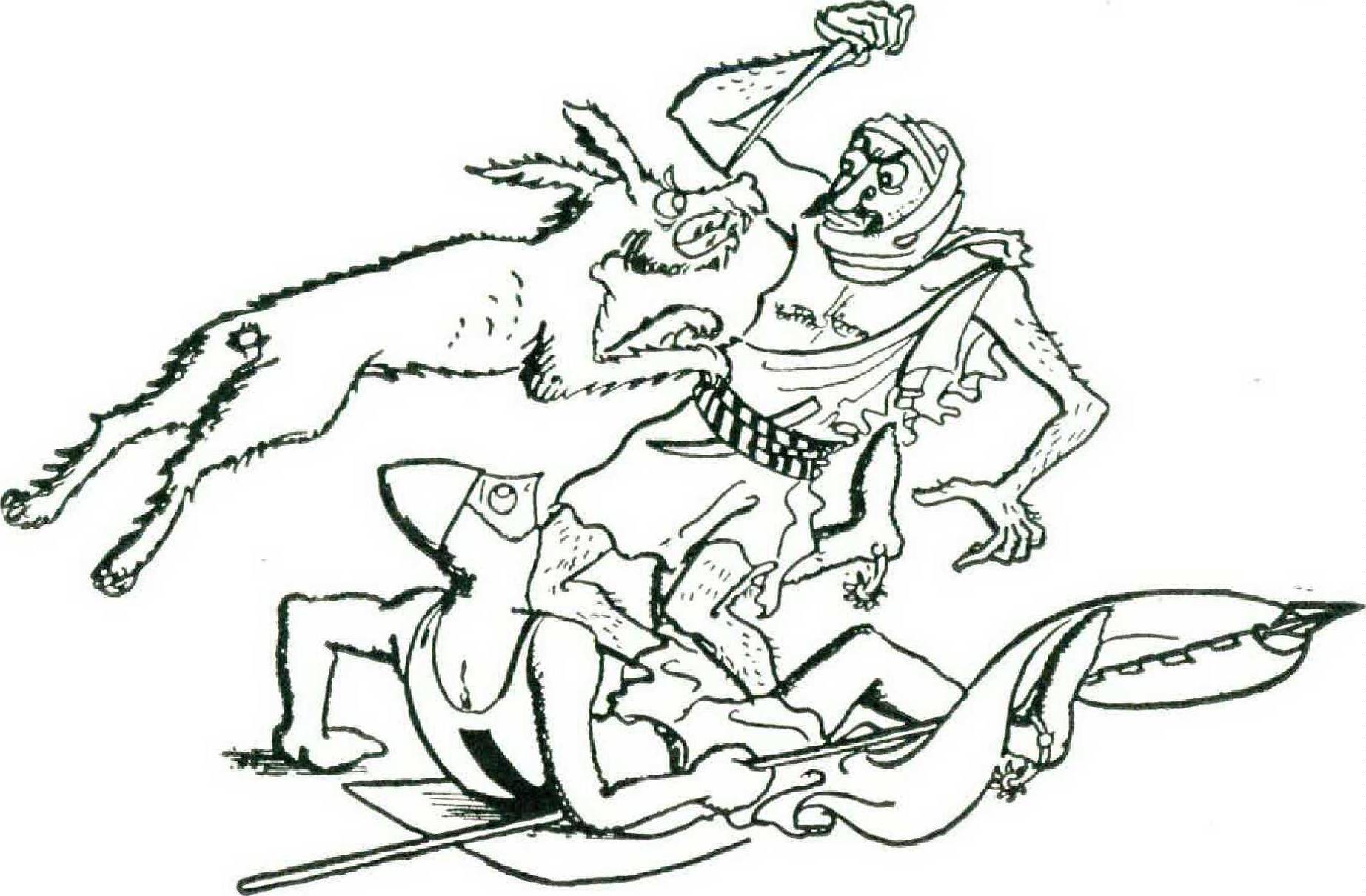
While the royal foot was yet on the lower rungs a terrible thing happened. William, in his fear of being left behind, dashed heedlessly forward, slipped in a pool of blood, and fell flat on his back. At 1 hat very moment there leapt from the ground, where he had been feigning death in the hope of just such a chance as William’s mishap now offered, a repellent Arab clutching a long knife which he raised, snarling with savage glee, high above the prostrate standard bearer. William had given himself up for lost and was fumbling desperately for his shield, on which in fact he was sitting, when suddenly there was a growl and a dirty yellow flash, and Charlemagne, tailless but unhesitating, flung himself at the Infidel’s throat. Regretfully, but knowing well his duty, William scrambled to his feet clutching tight the standard and dashed up the ladder after the King, leaving poor Charlemagne to his fate.
How William ever reached the top of that ladder he never knew. He had never had a good head for heights, and quite apart from the shaking and quivering caused by the weight of two knights in full armor hurrying up it as quickly as they could, there was a hail of stones, arrows, and humble but familiar pieces of crockery hurled down by the defenders above.
Somehow, however, he managed to survive, and in what seemed a remarkably short space of time the Christian watchers below sent up cheer upon cheer. There, silhouetted against the bright blue sky, on the very highest section of the walls were visible the stalwart figure of the Lionheart waving his sword in triumph alongside the Royal Standard firmly planted on the battlements and guarded by Sir William de Littlehampton, while round their feet there gamboled, barking triumphantly, a tailless wolfhound whose unattractive appearance was for once redeemed by a justified self-assurance.
(To be concluded)