This Month
Statisticians pay a fair amount of attention to marriage and divorce but they seem to have learned little about engagements. Nothing is known about the seasonal incidence of engagements, whether the dog days of August or the stresses of the winter are what lead to that sort of thing. For the purposes of the December Atlantic, it seems reasonable to expect a certain number of engagements to reselt from the Christmas holidays, Just as the National Safety Council can tell you how many people will get killed on the Labor Day week-end, statisticians ought to study the engagement risks of Christmas afternoon and New Year’s Eve.
Transition to the married state from a condition of not being married at all is necessarily abrupt. A girl of twenty has rarely any previous experience in wielding absolute authority over a man (although some girls with younger brothers may have developed early the techniques of command). The man, in turn, untrained in the principle of complete obedience, must be conditioned gradually to this unexpected change in his own place in the world.
The girl should use the engagement interval, therefore, to test out the mechanics of control; that is, to plunge the man into a state of dismay, to note carefully his reactions to catastrophe, and to twitch him back into his normal state of fatuity. She is much like an anesthetist in such tests, knocking out the patient with a gust of tears, keeping a finger on his pulse for any sign of organic failure, and letting him have a whiff of oxygen whenever his vitality is actually threatened. The girl should never forget that she is only testing during the engagement period and not trying to play anything for keeps. She will confine her tantrums to the sure thing. There is no need to risk even a minor failure if the fundamental relationship of the engagement period is kept in mind and the man is allowed to win.
A typical test run should be made fairly early in the contest, on what the man might have devised as a gala evening. He has started the day by sending a long telegram of an ardent nature, flowers and gewgaws later on, with dinner and the theater to follow. He arrives, beaming, at seven P.M. in a dinner jacket. The girl bursts into tears. What’s the matter? Sobs, tears — go away! What can it be? Near hysterics; girl disappears to bedroom. Short pause. Girl reappears, after what he believes was emotional struggle but what was in fact restoration of make-up. She is aloof but composed.
The girl must decide whether the man has had enough or whether the row shall spin along until she gets too hungry to keep it up. She should have decided, early in the day, that the dinner reservations and theater tickets would have to go by the board, for there is no use in pulling off one of these demonstrations on an inconclusive scale. Eventually the man is allowed to seize her and pillow her head on his shoulder. She is dry-eyed, strangely enough, but permits herself a delicate sniff or two. Just his physical nearness, he realizes, has helped matters, and the girl is soon looking up at him with a twisted little apologetic smile.
His curiosity is insupportable. What could it have been?
In a small voice, haltingly, the girl confesses: it was the dinner jacket that ruined everything. Oh, of course, she was just being silly about it, but she loved him so in those rough old brown tweeds! She knew, too, even though he was too modest to have thought of it, that other women all envied her when he wore his tweeds, and somehow she had just been expecting the tweeds. She liked their scratchy feeling when she put her cheek on them. But heavens — what a foolish way for her to have carried on and what would he think of her!
All this hits the man hard. He is astonished by the depth of the girl’s feeling for him, and surprised at what trifles can possess the female mind. Of equal importance is his discovery that the girl prefers informal, homely ways and that, once they are married, he will not have to rig himself out in a dinner jacket unless he damned well feels like it. This is going to be better, he tells himself, than even his fondest hopes.
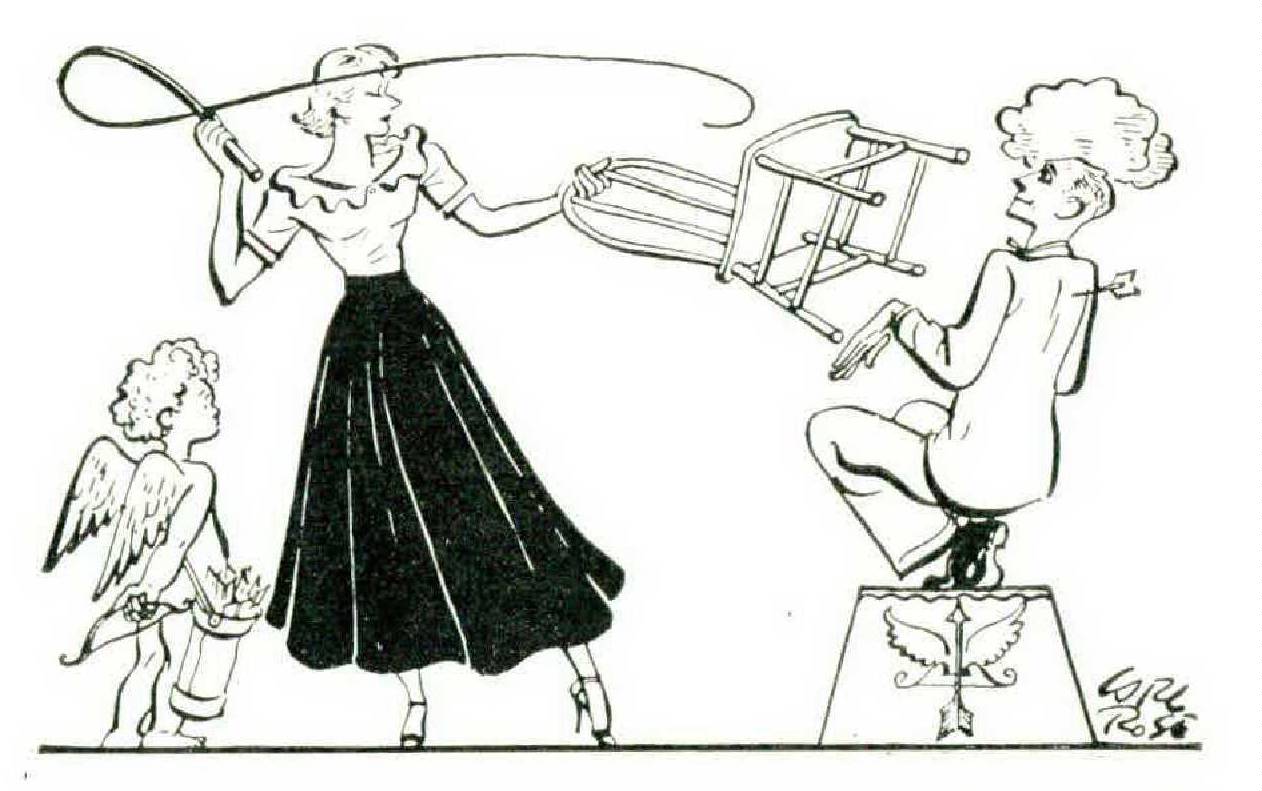
He has no way of foreseeing that in years to come he will shift into a dinner jacket like a quickchange artist at a lift of the eyebrow and the words “black tie" from his wife.
The brown-tweeds routine makes a perfectly good beginning. Carried on with reasonable artistry, it will put the man in the Wrong. The woman becomes the injured party, and forgives the man for something he has not done, does not understand, but somehow enjoys. Ending on such a note, the test tantrum may be said to have been a success. The duration of the engagement period will depend on the speed and ease with which the girl can run off these simple tests.
C. W. M.