Road Race
AUTOMOBILES
JOHN W. VANDERCOOK is widely known as an author, world traveler, and radio commentator.
by JOHN W. VANDER COOK
AUTOMOBILE road racing in the United States was revived last fall at Watkins Glen, New York, after a hiatus of thirteen years. Some ten thousand spectators distributed themselves along 6.6 miles of road of a studied nastiness to watch cars as strange to most of them as pterodactyls.
They saw an Alfa-Romeo roadster streak along a winding hill road at 110 miles per hour. They watched Bugattis, Maseratis, and MG’s (signifying Morris Garages) defy all reason and experience by approaching right-angle turns at a mile-a-minute clip and smartly making them, as if the law of centrifugal force had been repealed. As inhabitants of the most mechanically-minded nation in the world, they did not fail to note — and to be puzzled — that only one of the entries in the race was of American make, a Stutz twenty years old, and that it was at the tail of the procession.
That spark at Watkins Glen of possible rebellion against motorized overstuffed sofas was lit and vigorously blown upon by four hundred members of an organization which styles itself the Sports Car Club of America.
The members of the S.C.C.A. admit a difficulty. They are not sure what a sports car is. They are only emphatic about what it is not. It isn’t, certainly, a “family car.” None is broad of beam. And in the whole wide range of the sports car category, springs, brakes, and engine command more respect than the upholstery. None is cheap, and all are fast.
A sports car, however, is not simply a racing car of the fire-belching, outside-plumbing sort driven in automobile track races. Such mutations usually have no claim to nattiness. The lines of sports cars, if not always graceful, are at least arresting. Above all else they are not “hot rods.” Part of S.C.C.A.’s distaste for these homemade conversions, one suspeets, is that many a hot rod will vie successfully with even the hottest of the British and Continental offerings. If Henry Ford II, in other words, were to open up a hot rod division, the proprietors of the imported cars might find themselves obliged to begin all over again.
The owner-drivers of sports cars are more easily identified. They are in love. Their vehicles entrance them. They can talk exotic makes, good years, cylinder capacities, gear ratios, and standing quarter miles with the encyclopedic knowledge of an elevator starter reciting batting averages. They are usually rich. In private life many are apt to engage in such pursuits as aeronautical engineering or the manufacture of precision tools. All unite in scorn of most of what, among automobiles, is accepted, usual, and native.
The country about Watkins Glen, at the head of Seneca Lake, is varied. It goes steeply up and down. Some of the turnings of its lesser highways would test the agility of an iguana.
It occurred to the enthusiasts that no better site could be found for an attempt to restore to its just place in the United Stales the neglected sport of road racing. In Europe automobile road racing, with time out for war. has been both fashionable and popular since 1894. In America no road race, strictly speaking, has been held since 1935.
Watkins Glen agreed, and it was done.

A roughly circular course was chosen. It began and ended on the long, straight main street of Watkins Glen. In the space of 6.6 miles the contestants would climb and descend 900 feet. They would navigate approximately fifteen blind turns, an underpass, two right angles, and one sharp U-turn involving a narrow stone bridge. Road surfaces included macadam, one descending stretch of concrete, rough dirt track, and a remorselessly bumpy passage over a grade crossing.
On an early morning before race day a local citizen drove a new 8-cylinder Detroit-made car oyer the circuit in 9 minutes and 30 seconds, and sett red himself so badly he had to drink restoratives.
The winner of the First Watkins Glen Grand Prix, as they called it, driving a 1939 Alfa-Romeo, completed one trial heat of the course — a feat which included passing some ten other entries — in 5 minutes and 16 seconds, and did the race of 8 laps, a distance of 52.8 miles, in 48 minutes and 41 seconds at an average speed of 63.2 m.p.h.
The Alfa-Romeo was followed over the finish line 11 seconds later by a hybridized Bugatti-Mercedes called a Bu-Merc. The next eight finalists out of an original field of twenty-four makes which included Bugatti, Duesenberg, Jaguar, Vauxhall, Bentley, Lagonda, Maserati, Merlin, Delahaye, and BNC were all MG Midgets, tiny post-war sports roadsters with cylinder capacity of less than 11/2 liters, manufactured in England, and modestly rated at 30 horsepower. Five of the successful MG s had sustained the mile-a-minute average. Over a course of such variety and hazard, all had repeatedly to top 85 m.p.h.
It is at once evident that steering an AlfaRomeo, a Bugatti, or a Mercedes is an exact science. The driver of a stock American car of any current make can, it is true, with proper care avoid a Fruehauf trailer. The driver of a European-made sports car can avoid a pebble.
It requires, on the average, five and one-half turns of the wheel to coax our front tires from extreme port to extreme starboard. The driver of an MG or a Maserati can perform the same operation with one and one-half turns.
Our heavy cars grow perceptibly heavier on corners and tend to yaw. The sports types, because of a lower center of gravity, more rigid springing, and a far sharper control of the steering process, can effect even tight turns at a speed and with a total absence of out-swing which anyone who is not used to them finds downright unbelievable. As an un-hooked-in passenger I nearly departed the open car and this life on several corners when I was driven over the Watkins Glen circuit — not during the race but nevertheless at a clip which felt as if it blew loose whole chunks of hair. If I had, there was the melancholy reflection I would have been alone, for the car held as rigidly to its course as if it had been on tracks.
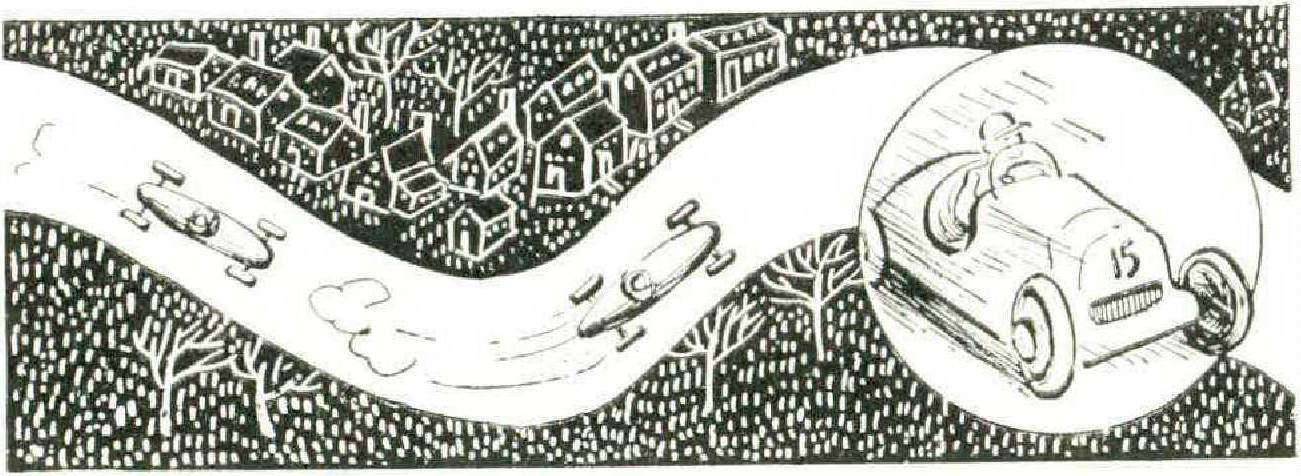
In spite of the raking look of many of them, their drivers can in most types clearly see the outer edges of both front fenders. Passing requires no guesswork. No sixth sense of space, like a bat’s, is demanded, as it is of all American stock car owners, to go in or out of a garage.
There are catches, of course. Some are serious. The first is cost. The smallest of such cars at present available, the MG, is priced around $2400. Before the war an Alfa-Romeo roadster cost $8000. Even the enthusiasts admit that few are comfortable for long drives. The open models are not easy to enclose. In bad weather love may turn to hate. Foreign sports cars are still rare — though the growing number of dealers in the United States who handle them now have long waiting lists.
But like those other invaders, foreign movies, they do, undeniably Have Something. When the exotics began to be box office, Hollywood showed itself not averse to learning. Detroit, it is conceivable, may have the same experience.