Creole Fiasco
GRACE HEGGER LEWIS is the author of Half a Loaf. She lives in New York and counts cooking as her third interest, after writing find travel.
FOOD
by GRACE HEGGER LEWIS
I AM no debunker, but rather a sentimentalist who likes to retain her illusions. I believe everything I am told, especially that all publicized recommendations of food and drink spring from an ecstatic gastronomic urge which must be expressed. So I go and cat, and often — too often — turn sadly away. But recently, as I left Mobile by car, I was confident I was heading for a city where the food simply could not disappoint me. I drove fast, for was I not lunching in New Orleans?
“Please, where is the Vieux Carré?”
“Dunno, lady, I’m a stranger here myself.”
“Where’s Gaston’s?” I called to a lounging Negro.
He shook his head. I looked up. The sign of Gaston was directly above him.
Fairly trembling, I entered. After the ForeignParts-and-Decoration of the latest New York restaurants, the place seemed bleak. Bleak with the bleakness of a provincial French café, plus the sadness of a summer room in winter time. I sat down beneath the stilled electric fans and asked for the menu. The waiter was huge and worn, and so was the menu. The names were strange and exciting, I hardly knew what to choose. But the waiter, he knew. Without a word he started laying my place with oyster forks and other cutlery, and then announced: —
“Zazerac cocktail, oysters Rockefeller, creole gumbo or turtle soup, pompano en papillote, soufflé potatoes, any dessert, café brûlot.” I was hurt, angry. Did I look like a woman who could not order a meal?
“I wish none of these things. Bring me first a very dry Martini, and then return in five minutes.”
I really wanted everything the waiter had commanded, but — I’d show him!
Crawfish with green mayonnaise —or better, a warming crawfish bisque. A deliciously seasoned entrecôle, au point, and I’d concede the pommes soufflées. Fresh peas cooked with onion and lettuce; cheese, a lovely, strong, swimming Camembert, with toasted French bread; and Louisiana coffee.
The waiter returned. Resentfully he took my order. “Crawfish not in season. You can have shrimp bisque.”
‘Very well. But I don’t see any vegetables.”
“We have broccoli, spinach, carrots.”
“But I want peas.”
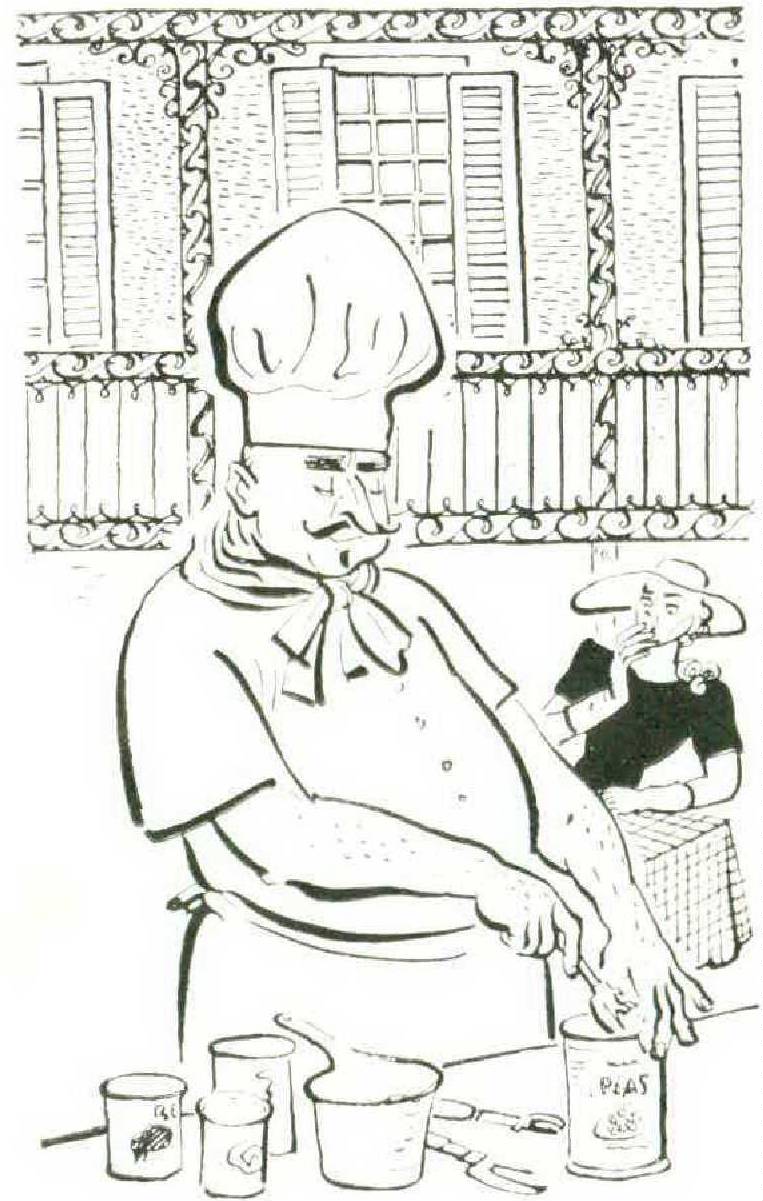
“We have nice canned peas. . . .”
Thu soup was a beautiful soup. The steak was recognizable as meat. The potatoes, tough greasy shells. The cheese, a frozen segment not from France, with stale crackers. The coffee was marvelous. And the hill was high.
After a week of trying big and little restaurants, tearooms, and grills, I found that except in the most expensive restaurants, the French fried potato accompanied all orders from the breakfast fried egg to the dinner fried fish, The tearooms added cauliflower with library-paste sauce to the tinned peas and candied yams and ladylike salads, and their table d’hôle meals were generous if not distinctive. I learned that those vast menu cards were mostly swank when you dared to choose from them a pot age paysan instead of the inevitable turtle soup, creole gumbo, bisque, or consommé. I discovered that there were dollar dinners, but the soups were watery, the other items oversteamed, the spinach canned. So one ordered à la carte and fared better — sometimes.
The restaurants say: “There is no tourist demand except for certain famous dishes, so why bother — and lose money.”
The young natives say: “Of course we eat fresh vegetables at home, but when we go to restaurants it is for ravioli or spaghetti or jam ha lava, which we can get quick.”
I he old native says: “Don’t quote me, but creole cooking is not what it was. The young Negro cooks don’t take the same interest, and perhaps Prohibition ruined our palates. Some of the restauranls have ceased to be owned by men who are personalities and great chefs, and of course the drugstore habit has got us. Even the famous gumbo filé powder no longer comes exclusively from the ground sassafras leaf; it is mixed with wild bay. I remember when a civet do lièvre took three days to prepare. Alas, now it ‘s just a rabbit stew.”
The distinguished visiting firemen, for whom special effort is made and whose ecstasies are quoted in the restaurant advertising, say: “Yes, do quote me. . . . Mention New Orleans and you mention Edouard’s. . . . What Gaston can do to oysters and fish is what cooks must do to them in heaven. ... As a poet blends words to produce a sonnet, Alphonse blends ingredients to produce a sauce.”
I say: “ Mebbe.”