Blarney
TRAVEL
W.IHVIN BRENNAN, who lives in Los Angeles, was an artist, a graphic arts specialist, and then a sales manager in printing and book publishing. He is now an advertising agency executive and free-lance writer.
by W. IRVIN BRENNAN
EGGARS!" The government official raised his eyebrows in puzzled surprise. “We have no beggars here in Dublin that I know of,” he stated firmly.
We looked hard at each other for a long moment while I tried to make up my mind whether or not this was another bit of the famous Irish humor; then he added, “We have no beggar problem here because the law of Eire does not permit begging.”
“Then what do you call those characters who are continually asking for money in the streets?” I countered.
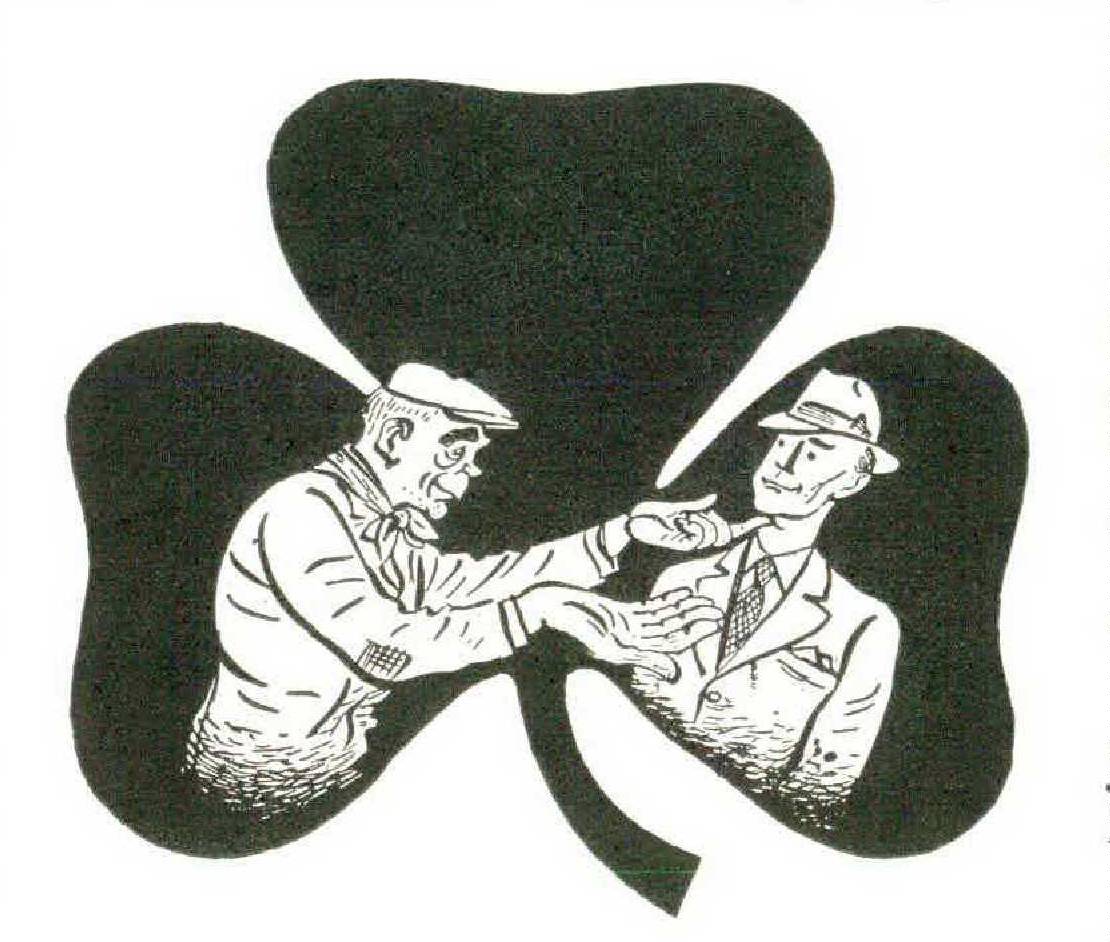
“Oho! Those!” he said as though I had shown him the light. “Those are not beggars at all, any more than you or I would be if f’rinstance one of us said to the other, ‘Have you got half a crown you are not using?’" I must have looked baffled by this reasoning, because he continued, “The law of Eire does not permit professional begging, but this is a free country — a republic like your own — and we recognize the right of one citizen with less to ask another with more to help him.” He paused, grinning mischievously. “I will admit,” he added, “that many of those fellows be rogues.”
My questions had been prompted, not by the occasional man out of work who approached me on the street, but by a teen-aged girl, carrying a baby in the sling of a ragged and filthy shawl. It was a rainy day, and a cold wind was sweeping across St. Stephen’s Green, blowing her uncombed red hair into a wild tangle, out of which her wind-burned and freckled face peered like that of an animal. As I hurried toward the Shelbourne, she glided quickly from the shelter of a building and walked beside me, muttering an unintelligible plea for help.
I thrust a coin into her hand and hurried on. Inside the hotel I was disturbed enough to ask the elevator operator, somewhat indignantly, why such things were permitted in a well-governed country like Ireland.
“I think you will find, sor, that the baby is a borrowed one,” he said. “I wouldn’t worry too much about it.”
“You mean that all that was an act, and the child was a prop?”
“Something like that, sor,” he answered.
Two days later, the same girl approached, crossing to intercept me in the street before the Lord Mayor’s residence. This time I stopped. She certainly looked healthy enough in a close-up. Farther down the street two other ragged women, one of them also carrying a baby, hurried toward us and crowded forward expectantly.
“We are traveling tinkers,” they said with a touch of pride in answer to my question.
“You mean that you are gypsies?”
“Oh no, sor! Gypsies tell fortunes.”
The tinkers of Ireland, like the gypsies of other lands, are nomads, but they have the distinction of being skilled workmen in addition to being horse traders. Traditionally they are tinsmiths, and on occasion they do odd jobs of pot mending while moving about the country from place to place.
These tinker women posed for a photograph and gave their names, asking if they might have a print sent to General Delivery at a country post office. The babies, upon examination, were chubby and healthy-looking as well as warmly dressed.
“Whisht! ” muttered one of the older women, and suddenly they were hurrying around the nearest corner with an elaborate show of nonchalance but considerable haste.
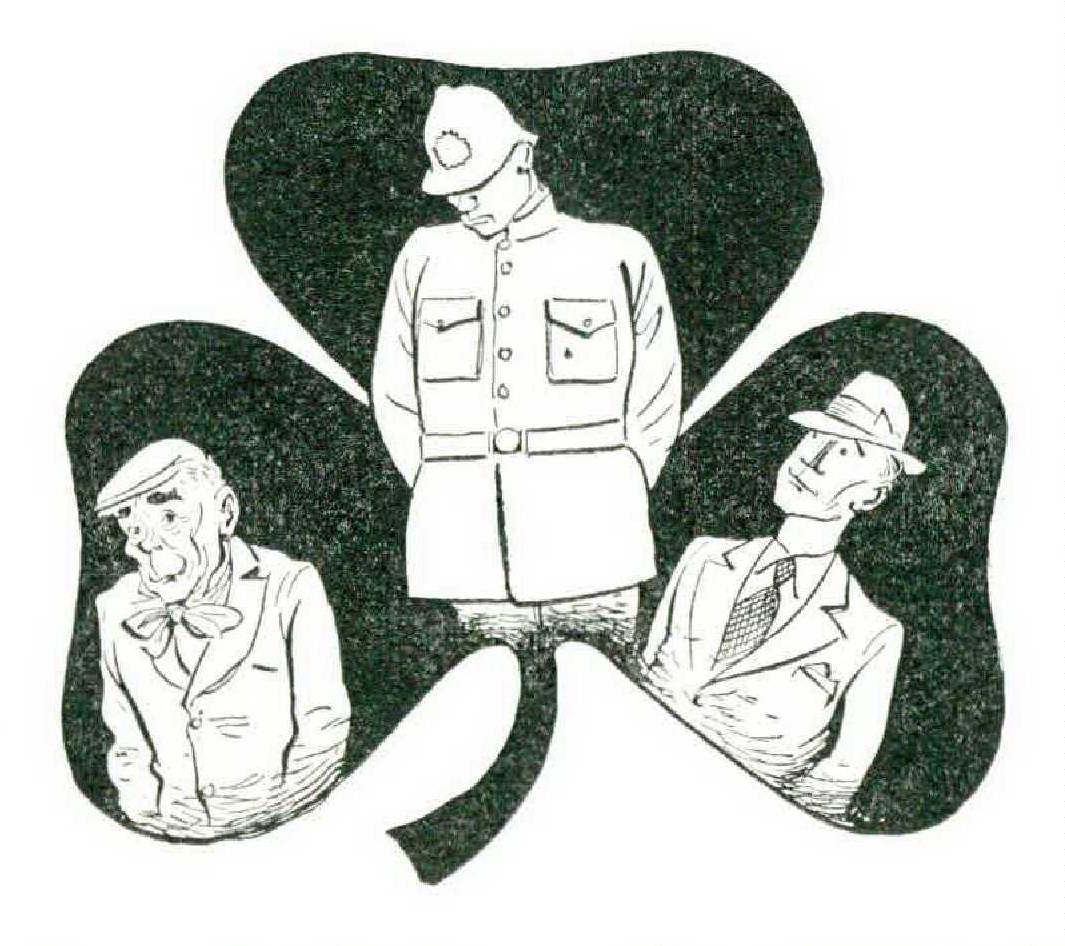
I looked behind me and saw the cause of the departure. A big policeman was bearing down under full sail. He asked, “Did thim tinkers beg you for money, sor?”
“Yes, they did,”I answered. “Anything wrong?”
“They’ll get thirty days in jail — if they are caught at it,” he said.
“But the law recognizes the right of one citizen who has less to ask another who he thinks has more to help him. Am I right?”
He looked hard at me for a moment and sauntered away without comment, but grinning.
Perhaps beggar is a harsh name to apply to people who ask for alms in Ireland, because there is certainly never any suggestion of the servile “for the love of Gawd, kind sir,” technique in their approach. The government official had put his finger directly on the difference in their status when he cited the right of one man to ask another for help. They ask and accept with dignity, and nearly always there is a laugh in the transaction.
As an example, I was sitting on a bench below the monument to Daniel O’Connell, giving my weary feet a short respite from Dublin’s pavements, when a young man sat down beside me. He was hatless, but at least warmly dressed in a windbreaker and tweed trousers. He had spotted me for an American.
I waited with interest to see how he would handle the “touch" which was obviously coming. He began by asking me how I liked Ireland. Then he remarked that I must be an American. He was from Sligo and had served in North Africa next to some Yanks; a fine lot of men, if he ever saw one, bedad.
“Great foighters, they were, the Americans. And what outfit were ye in yourself, sor?" He asked the question with a perfectly serious face, and I did not have the heart to ignore the obvious cue and spoil his lines. This was the act I had been waiting for-colossal flattery — the good old blarney.
I assumed a patriarchal air and said, “Thank you, my boy, but the army had no place for a squeak-kneed old century plant, like me.”
He reared back with an elaborate show of surprise and looked at me incredulously. “Ye mean that ye were too ould! Why, sor, I would swear that, ye were not a day over thirty-two, at all. Well, glory be!” He then mentioned in passing that he was trying to get work. He was sure to get work...but in the meantime . . .
He accepted the money I gave him with the casual thanks of one old friend to another, shaking hands cordially as I started to leave.
“Hope ye enj’y your visit,”he said sincerely. “And try to get up to me ould home, Sligo. The country is beootiful.'
“Thanks, old boy,”I answered, falling easily into the spirit of his infectious comradeship.
Rosie Houlihan, who stood daily in the shadow of the Club, was no beggar, at all, at all; but she was equipped with a technique for persuasion that only an Irish flower-seller could have — and with it was the inevitable laugh that was worth the price of admission to her show.
Walking along St. Stephen’s Green on the north, one evening, I was stopped by a man who said he was a waiter out of work. Would I help him? I refused at first, but he took it so courteously that I turned back and gave him some money. I had onlygone half a block further, when Rosie darted out from the wall of the building and thrust a bunch of tiny flowers in my face. I gently but firmly put them aside and walked on, but she stayed with me, walking shoulder to shoulder, talking persuasively in a soft Dublin brogue, without a letup.
“Look,” I said patiently, “I’m on my way to the theater. I can’t use flowers like these. I . . .”
Like a flash, she whipped forth three withered and blighted rosebuds which she had been holding in the other hand. She held them up triumphantly for my inspection and admiration.
“Ain’t they beautiful?” she asked rapturously. “Come on, take a chance . . . just fer ould toimes’ sake . . . chance . . . sake . . . beautiful . . .” The words tumbled over one another in a soft melodious patter that was positively hypnotic. Meantime, we had never slackened pace but were walking shoulder to shoulder down the street. The thing was getting ridiculous.
I started to laugh; so did Rosie.
“Now listen,”I said firmly when I could get myself in hand. ” I have just been braced by a man up the street to whom I had to give money. He said that he was a waiter. He is working this side of the street.”
She leaned back and struck an attitude like an actress of the nineties and said, “Is he now, Gawd love him? So . . . he’s a waiter! Well, ain’t that funny-because I . . . am a waiter . . . ess.”She leaned forward again towards me. “Okay, then! So ye won’t buy me beautiful flowers, at. all! Well then, I’ll give ye one, and the divil can’t shtop me!”
She selected a less desiccated carnation from a sorry-looking bunch, and I stood obediently while she fixed it in my lapel. Then she stood back and registered speechless admiration.
“There now, ye’re a handsome broth of a b’y, that must be the ruination of the ladies’ hearts, no less . . .”
Wearily, I pressed a coin into her outstretched palm. I knew when I was beaten.