Egyptian Magician
MALCOLM LAPRADE is a New Yorker who has traveled in all parts of the world. His “Mexican Guide” appeared in Accent on Living in the October, 1918, Atlantic.
TRAVEL
by MALCOLM LAPRADE
GALLA galla galla galla! Chicken become, chicken he go, chicken he come, chicken he go!” So runs the chant of the Egyptian Magician, known as the “Galla-Galla Man” and found in all parts of Cairo frequented by tourists.
He may meet you on arrival at the railway station, ready to compete with porters, cab drivers, assorted dragomans, and touts for the coins of whatever realm you carry in your pockets. He requires no platform for his show, no black velvet curtains, mirrors, or trick lighting effects to accomplish his illusions. He carries no visible properties except the dirty cloth bag slung over his shoulder. The streets of Cairo are his stage, the bright sunshine his spotlight.
When sight-seeing is the order of your day, the Galla-Galla Man orders his movements accordingly. You will find him at the gateway to the Citadel of Saladin, at the Mosque of Sultan Hassan, or beside the garden wall of the Mena House in the shadow of the Pyramids. And if at these vantage points he fails to hall your progress and capture your piasters he will surely gain his objeetive at teatime, on the terrace of Shepheard’s Hotel.
No visitor to aim can long resist the blandishments of the GallaGalla Alan, for his knowledge of tourist psychology is as profound as the smile on the face of the Sphinx. Well he knows that you are a seeker of local color, an amateur of the exotic. So he plays his part to perfection, coming to Shepheard’s terrace as one from the pages of an Arabian Nights story: bearded, brown-skinned, and clad in Biblical costume.
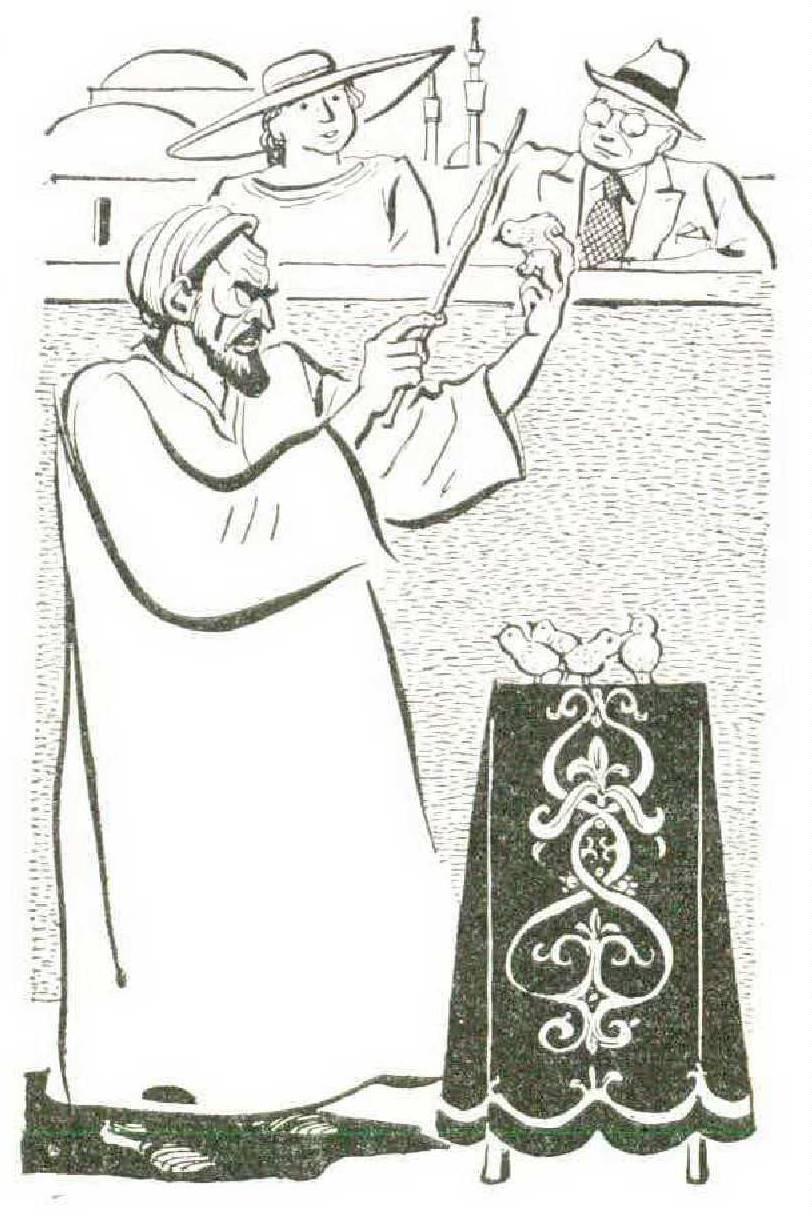
He squats before you as you sip your tea, and dedicates his art to Allah, the Merciful and Compassionate. Then, pronouncing strange incantations, he extracts live chickens from his mouth. “Galla galla galla galla, one chicken he come, two chicken he come, three chicken he come,” and so on until this human incubator has produced a dozen fluffy balls of feathers. “Galla galla galla galla, chicken he go!” Snapping them up with deft lingers he crams them back into his mouth, one after another, and not a chick remains in view. Allah is pleased. The lady and gentleman at the tea table are delighted and give their piasters freely.
The Galla-Galla Alan has other astounding magic up his sleeve. He will cause a baby crocodile to appear on the pavement and then suddenly to vanish in thin air, reappearing as a swagger stick. If the lady and gentleman do not believe this crocodile was real, he will bring it back again. “Galla galla galla galla, crocodile he come!” And there it is again, squirming on the pavement. This time the baby crocodile is for sale if the lady and gentleman wish to have it as a pet.
The Galla-Galla Alan is a public entertainer — and, as such, an expert in his field; but the Serpent Alan of Egypt is a public benefactor. His is a much higher order of magic, with no relationship to legerdemain. You are not likely to meet the Serpent Alan in the streets of Cairo. The villages along the Nile are his preserve, and here he renders essential services to the community.
As you or I might send for the plumber to repair a leaking water pipe, so the Egyptian villager sends for the Serpent Man to remove a snake that has taken up its lodgings in the walls or ceiling of his house. The Serpent Man will call the unwelcome visitor forth and then dispose of it in accordance with the traditions of his ancient profession.
Ordinary snake charmers, so I am told, anoint their bodies with snake fat to acquire an odor pleasing to reptiles. They inoculate themselves with venom, gradually increasing the doses until they can endure the bite of the most poisonous snake without serious consequences.
But the Serpent Alan of Egypt is no ordinary snake charmer. The villagers whom he serves will tell you that he belongs to the tribe of the Rifai dervishes, and that Allah has given him a magical power over the reptiles of Egypt so that he may best serve the Faithful. But there is a bond between the Serpent Alan and the Snake that must not be broken. Allah decrees that a snake may be removed from the villager’s house or garden, but then the Serpent Alan must lake it to the desert and release it in the name of the Merciful and Compassionate.
In the village of Luxor there is a Serpent Alan of high repute who on special occasions and for special inducements, offered with appropriate dignity, will consent to exhibit his skill to tourists. Happily there are no snakes to be extracted from the walls of the Winter Palace Hotel, but the Serpent Man knows where to find them on the edge of the desert.
Singing softly he moves through the underbrush. Now, sensing the presence of a snake, he pauses, squats down with his right hand extended. His song continues, and soon the snake glides out, raising its head for a moment as if to strike. But the singer’s voice grows more caressing, and the snake, lowering its head, lays it in the Serpent Man’s outstretched palm. Gently the Serpent Man lilts the snake from the ground and places it in a large earthenware jar, the one tool of his trade. This Serpent Man of Luxor has long been known to winter visitors at this famous resort, and thereby hangs a tale that bears repeating.
A few years ago an English scientist, residing in a villa at Luxor while pursuing his studies in zoology, wished to examine a rare species of snake found in the Nile Valley. What could be more logical than to send one morning for the Serpent Man and offer him two pounds to secure the desired specimen? Why this eccentric Englishman should wish to acquire what any villager in Luxor would gladly be rid of was a mystery to the Serpent Man. The ways of the Infidel passed all comprehension, but if snakes were wanted in this foreigner’s house, he would go and fetch them.
Towards sunset the Serpent Man returned with a heavily laden jar, and found his client in the garden of his villa. “Gentleman, I have brought you many fine snakes. You have asked for one, but Allah is bountiful. You shall have ten.
With a pair of tongs the scientist examined the contents of the jar. To his joy he found the desired specimen, and lifted it out with triumph. “This, my good man, is the very one, and here is your money. You have well earned it.”
Taking the pound notes, the Serpent Man stood for a moment, a puzzled expression on his face, then said, “Gentleman, these other snakes. You do not pay for them?”
“Of course not! I don t want them.
“You not want them? Me, I not want them.
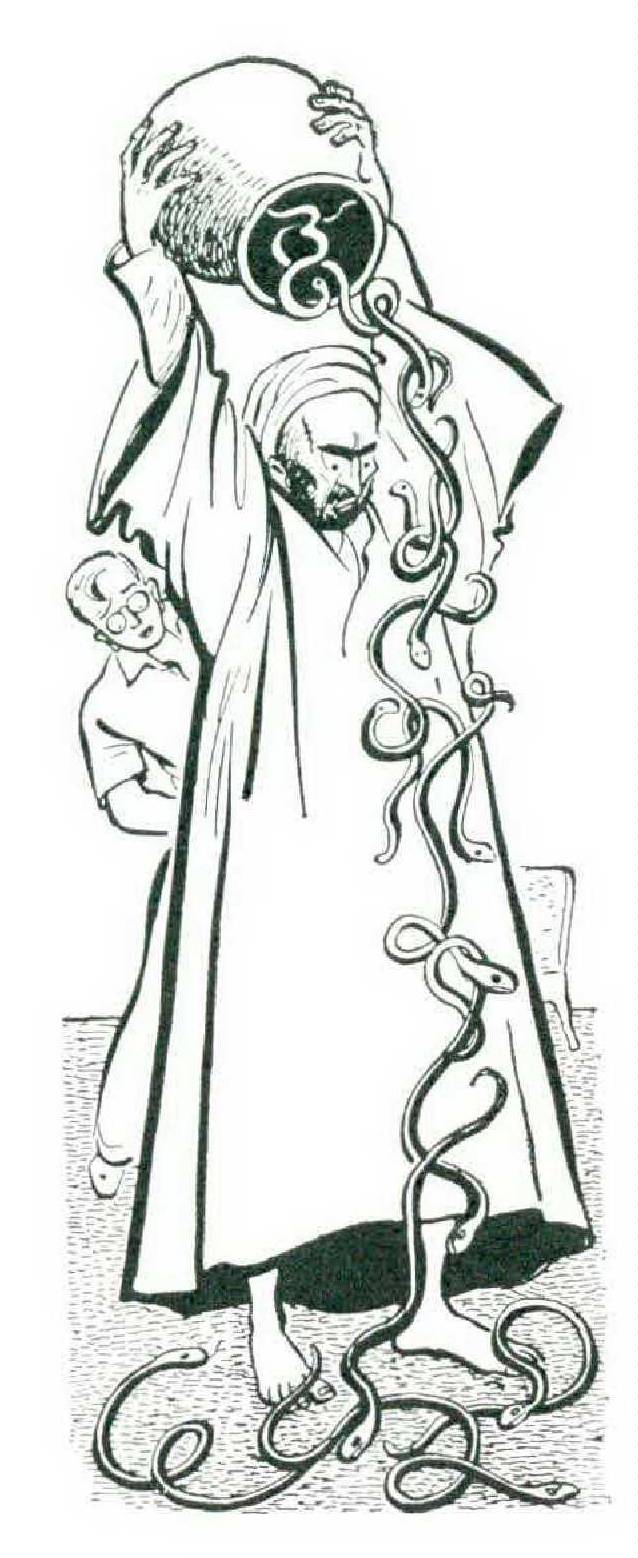
Lifting the heavy jar, the Serpent Man tossed its writhing contents on the ground. Then, cloaked in the dignity of his high calling, he strode from the garden. Even though this Infidel refused to pay, Allah, the Merciful and Compassionate, had decreed that he should have not one but many snakes in his house.