So What?
JAMES COLVIN was for eight years on the staff of the Chicago Daily New. After completing a Nieman Fellowship at Harvard, he served in the Navy during the war and is now associated with the Encyclopœdia Britannica.
SCIENCE
by JAMES COLVIN
PSYOHOLOGY’S experiments are clever no mistaking that. But they never seem to develop any conclusions.
“Experiments show that a frog will strike repeatedly at a fly that is surrounded by sharp points, even though the frog’s tongue be impaled,”we read. Breathlessly we proceed to the next sentence to discover what science deduces from this odd behavior. But there isn’t any deduction. There isn’t even any more to the story.
The next sentence reads: “Toads simply refuse to snap at a motionless mealworm.”
It’s like a mystery story in which nobody ever finds the body. Clues bob up in every other line, but we’re never sure there’s been a crime.
Are these findings good or bad for you and me? Should we cheer the frog and deplore the toad, or vice versa ? Psychology doesn’t say. The whole subject is summarily dropped in favor of “Social Facilitation among the Sumatran Great Apes, or “Speed of Problem-Solving among Stingless Tropical Bees.
We may not be able to figure out the Hidden Implications, but Psychology Can. It appears to be from the sum of such experiments that it eventually develops the ground rules for Rearing a Child of Six, or How to Get Ahead in Business.
Perhaps there is a code book for psychologists that gives the key to interpreting behavior. But I prefer to believe that there somewhere exists a Psychologists’ Committee to Coördinate Otherwise Disassociated Facts, which eventually will piece together these accounts of the behavior patterns of lower animals, and then tell us of the profane laily what we should do about them.
Pending the Committee’s report, we cannot be sure of what Psychology’s experiments to date really mean. It is difficult to derive from the reactions of lower animals the rules of behavior that will help you and me. But if we wish to lead fuller lives, the least we can do is try.
CASE 1. Dr. P taught Dog A to associate “pink” with “food.”Every time he showed Dog A a pink, circular card he gave the dog a hamburger. Before long Dog A would drool, champ, and lick his chops at the sight of anything pink and round, including Dr. P’s bald head.
Simultaneously, Dr. P taught Dog A to associate “white” with “danger. When he showed the dog a white square card, he blew a blast on a fire siren, an experience Dog A from the first despised.
Soon Dog A would cringe from anything white. He would, for example, snap with delight at a pink carnation and howl in dismay at a square cake with white icing. We are now ready for Dr. P’s crowning touch: he showed Dog A a pink circle and a white square at the same time.
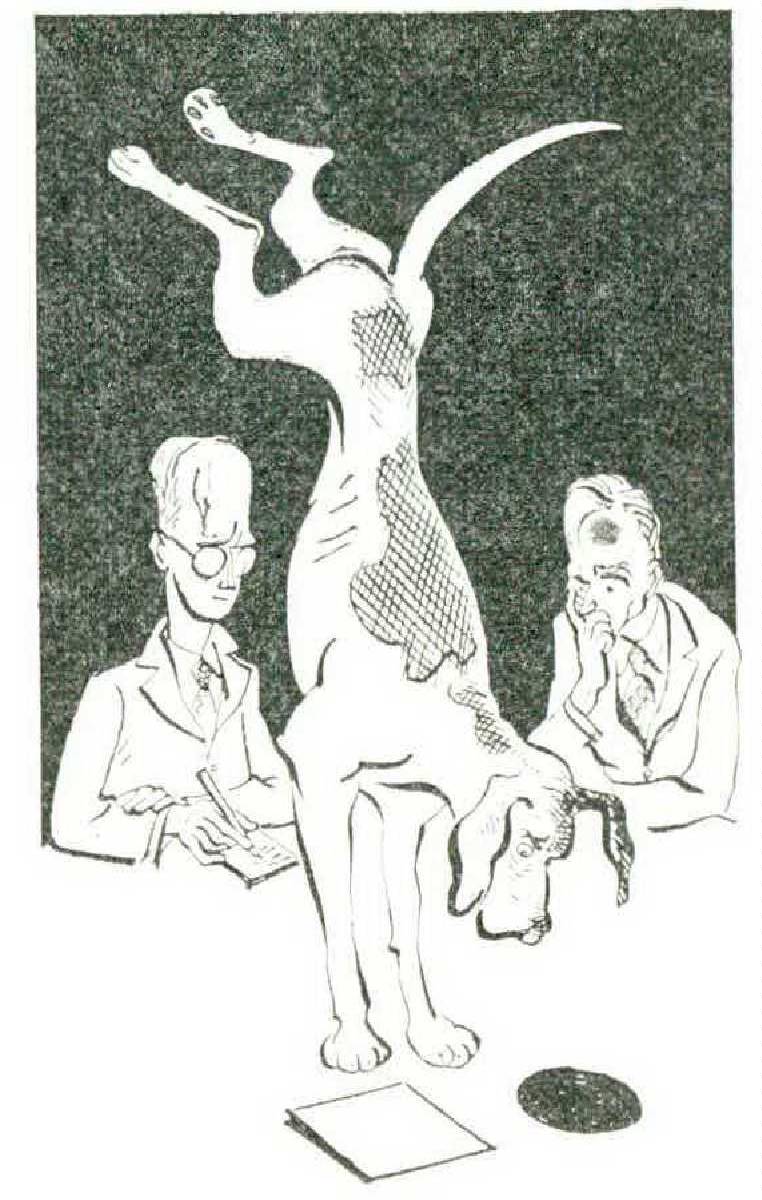
Unable to respond simultaneously to both stimuli, Dog A quaked violently, slowly rose to his forepaws, and for four days balanced there motionlessly, staring at a spot on the floor.
That concludes Psychology’s account of the case history. Having given Dog A a fine neurosis, Dr. P presumably moved on to bigger things. But that will not satisfy you and me. If we are ever to draw any conclusions from Psychology’s experiments, now is the time to begin.
Conclusions: This experiment has a direct bearing on our daily existence. In Dog A we recognize ourselves. For what Dog A was trying to react to was the admonition “Lookout! Mealtime,” or “Goody! It’s loaded!” You have the same experience on catching your wife’s eye while conversing with a handsome blonde. The situation may be paralleled by looking simultaneously at a new convertible and at your bank balance. The rule of behavior is: If you haven’t learned to live with your frustrations by now, Psychology can’t help you.
CASE 2. — Noodla, a cinnamon bear, is being tested for length of memory. She is permitted to see Professor G put a banana in a box. Then she is taken away for several hours. The question is, How long can Noodla remember that there is a banana in a box? In the testing routine, Noodla shows she can remember for as long as twelve hours.
We thus have the tentative psychological rule: Cinnamon bears can remember that there is a banana in a box for as long as twelve hours.
If that were all of the story, the implication would merely be that our memories should be better than the memory of a cinnamon bear, and accordingly you should readily recall how you happened to spend $1.65 between dinner and bedtime last, night without getting out of your chair. But this is not what Professor G has in mind at all.
Because now, for reasons that are somewhat obscure, Professor G again lets Noodla see him hide a banana in the box, lakes her away — and in her absence substitutes some pebbles for the banana. When Noodla is returned, she proceeds to the box, registering banana-hunger in every furry movement. On opening the box she stares in disbelief at the pebbles, executes a slow burn, then swings around and hangs a haymaker on Professor G’s chin.
Conclusions: (1) Cinnamon bears like bananas more than they like pebbles. (2) A cinnamon bear has an excellent left hook.
Neither of these conclusions is startling. But there is a further lesson in personal behavior here as well. It is simply that when you are asking for it, you should always be prepared to duck.
CASE 3. — Kitten X, a male, was encouraged from an early age to catch mice. Kitten Y, a female, was also shown mice, but every time she made a pass at one she was given an electric shock. Before long, Kitten Y would run like crazy from every mouse she met. One day Kitten Y was permitted to watch Kitten X give a mouse the coup de grace. Kitten Y watched the slaughter with initial alarm that turned to forthright admiration. From that moment, Kitten Y adopted Kitten X as her protector, and went around telling all the other cats what big muscles he had.
Conclusions: In this experiment we can also see a human analogy. Female cats, like female humans, use the “I’m so weak and you’re so strong ” approach. Thus Psychology has learned something about cats from watching women, though I should have thought the plot was to learn something about women from watching cats.
CASE 4. — A cricket, with its left eye covered, turned persistently to the left when subjected to a strong light.
Conclusion: Again we learn something about human behavior from watching the cricket, though the humans about whom we learn are the psychologists themselves. The rule of psychological behavior is: When you can’t figure out anything else to do with a laboratory specimen, blindfold it.
The next experiment we shall note has even more substantial bearing on human behavior.
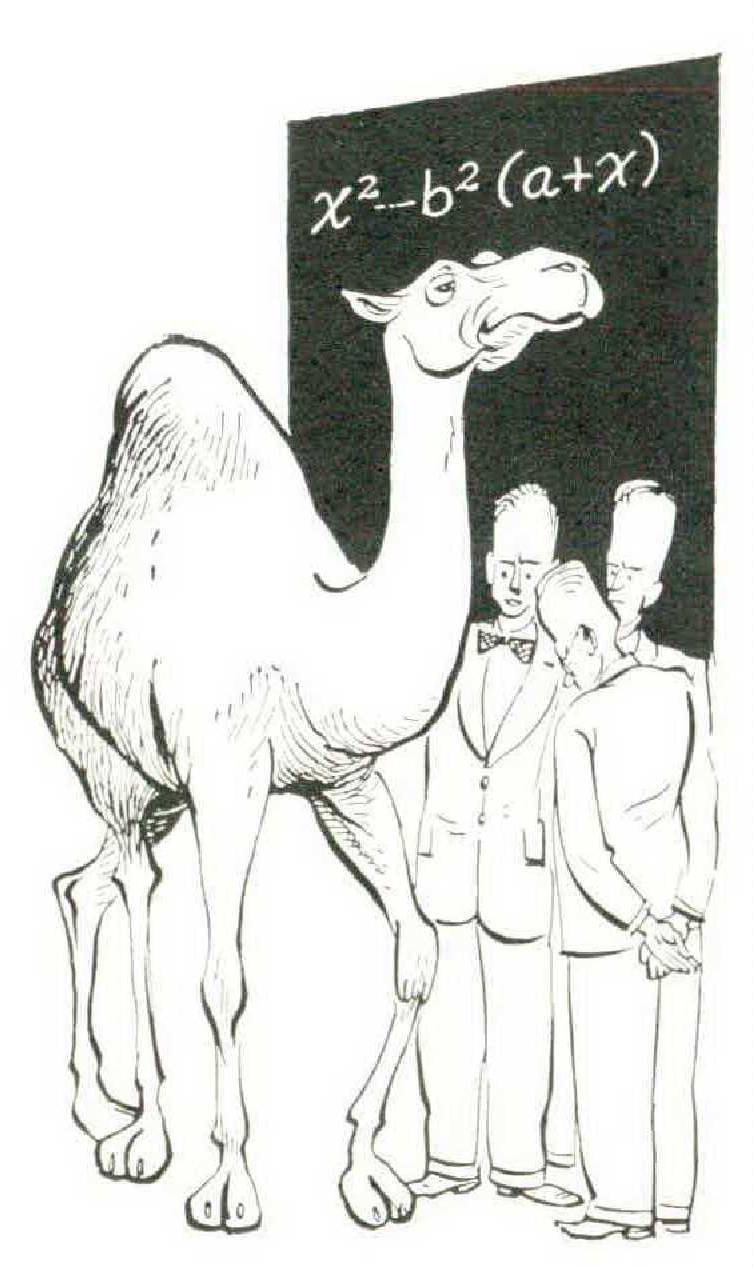
CASE 5. — Max, a camel, could count, He could also add and subtract, and finally he got around to giving the right answers to problems in higher mathematics. When a problem was chalked on a blackboard, Max would tap out the answer with a forefoot.
“Herr Schneeburger is giving him signals!” the attending psychologist protested. (Max belonged to Herr Schneeburger. They were doing three a day in Vienna at the time, and laying ’em in the aisles.)
But when Herr Schneeburger went away Max could still tap out the right answers. Then they made the problems tougher— and pretty soon they chalked up a calculus problem that none of the human observers could solve. And neither could Max.
Temporarily slumped, the psychologists chalked up a new problem, gave Max a moment to study it, then blindfolded him. While he was blindfolded, Max couldn’t tap out one-two-three.
So they took off the blindfold, chalked up a simple little trigonometry problem, then watched again. It was then that they solved the enigma of the counting camel. For they found that the human witnesses, when they had solved the problem, turned to stare at Max’s forefoot —and Max would begin to tap. When Max reached the proper number, the witnesses straightened up in surprise, and this was Max’s cue to stop tapping. Herr Schneeburger, though no psychologist, knew human nature well enough to anticipate that anyone testing Max’s ability would react the same way, and had taught him these cues.
Conclusion: Don’t let in a bunch of strangers or they will louse up your act. Ask Herr Schneeburger. Max is now doing a caravan run in Central Asia.
The same procedure of learning about human beings by analogy from the lower animals may be employed in interpreting any other psychological experiment you may encounter. Thus you may profit by these experiments, and develop your own rules for better living, pending the lime that the Psychologists’ Committee to Coördinate, etc., publishes its findings.
Here is another case history on which you may begin practicing: —
CASE 6 — A certain starling was kept without food until it was good and hungry. Then the laboratory chieftain presented it, not with food, but with little pieces of paper of varying shapes. There were circles, squares, Maltese crosses, and an occasional outline for a game of ticktacktoe. The starling invariably pecked at the circles and left the other figures alone. Even when fresh worms were hung on the other figures, and the circles were left bare, the starling continued to peck at the circles.
Now all you have to do is figure out how this experiment helps you to make your first million, or get a better job, or keep a happier home. If you cannot, then von will never be much of a psychologist, and you might as well wait for the Committee’s report. So shall I.