Three Dollars a Day
T. E. DOREMUS is a former newspaperman, author of various travel articles, who is summering in France. His novel, Flaw Dexter, was published in 1947.
by T. E. DOREMUS
IF I were forced to make the decision of where to live in the country in France, I would choose as the Frenchman chooses, reluctantly because it is hard for him to recommend one place over another. In the end, however, it would be the provinces bordering the river Dordogne. But I would go a bit further than that and settle for Carennac and its population of 250 in the district of Lot.
For Carennac you must take a train from the Gare d’Austerlitz in Paris, a not very good train which wanders southward for ten hours until, after Brive, it is on a single track coasting through vineyards and diminutive orchards, slower and slower, stopping more frequently at hyphenated towns over which there is some dispute in the Paris ticket offices as lo pronunciation. If you have traveled through the night, as I have done, you must be up and wide awake by six o’clock in the morning, for no porter will be ready at that hour to inform you of your destination or care if both you and your luggage remain on the train after the briefest of halts at a station called Betaille. From Betaille it is only minutes by car to Carennac across the river.
When I first came from Paris two months ago I went to St, Céré instead, where I had friends and where there were a casino and a commercial hotel and inaccurately steep prices. After discovering Carennac, I began to feel ridiculously ashamed of myself for not having been able to reconcile the Towers of St. Laurent and the Château de Montal, legitimate attractions at St. Céré, with what was essentially an unhappy atmosphere in my hotel (where the novelist Pierre Benoît once worked and became old and famous) and in the town (where there were as many plaques commemorating executions during the Resistance as there were reminders of World War I fatalities).
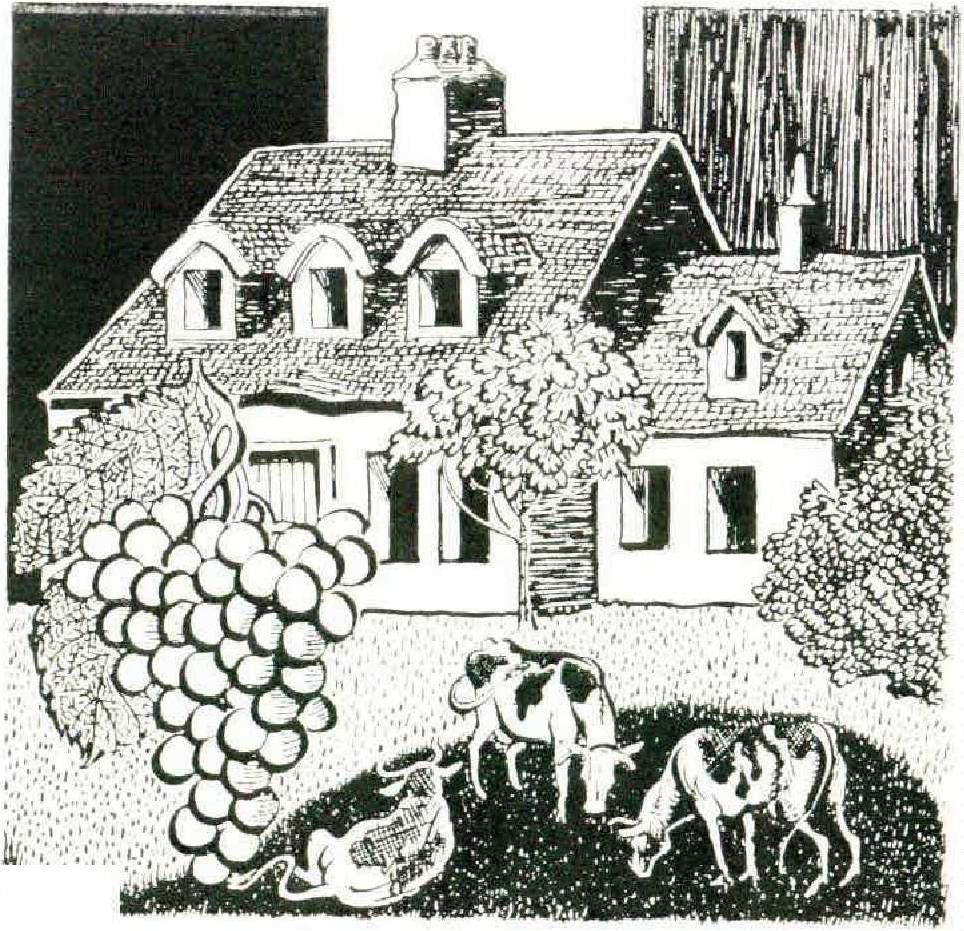
My friends hoped I would write them from time to time (Carennac is seven miles away) and I have since managed to keep up a fairly regular correspondence by letter and picture postcards featuring the chateau-pension where I am the only guest and am intelligently guarded from the world by Robert Jacquet and his wife. Madame Jacquet is descended from one of the very few French Quaker families and her husband is an ex-big-game hunter who, in a bilingual flurry, has retired himself and his rifles to this ex-Prieuré historique de Fénelon where he indulges his clientele in an endless variety of good food and heartbreaking views of the Dordogne.
When I am tired of working in my tower room, I descend with my typewriter through a labyrinth of stone stairways and a fantasy of the twelfth, thirteenth, or fifteenth century, depending on the route; through a reception hall with a painted Renaissance ceiling; through a dining gallery hung with Ivory Coast musical instruments and once-poisoned hunting spears, which leads to a walled-in garden planted in fig and pine and carnations. Here, in any number of spots, I choose another location for work.
The noise of the typewriter, however, has angered the garden’s most prominent inhabitant, a raven with a clipped wing who rushes lopsidedly across the grass in an interrupted search for worms and finally, with a tremendous show of impatience and handicapped skill, manages to hie himself into an adjacent tree where he will remain for the rest of the afternoon flapping his left wing reproachfully and spitting out cherry seeds at my feet. I have heard that there are snails living in the garden and that Robert Jacquet has painted their shells in various pastel shades.
I have never seen them. Perha ps they are equally resentful of my noise.
Later on in the season, we expect the President of France, who will be making a tour of the region accompanied by representatives of other countries in a cavalcade of motorcars that will pass through Carennac on the way from Padirac and Rocamadourlo Lacave, St. Céré, Muntvalent, Castlenau, and other towns. He will then know more about this part of France than many Frenchmen do, and certainly more than I who have been content to stay within these fortifications except for swimming in the river and the purchasing of tobacco once a day.
Like the other young men in the village, I have no desire to travel on.
Unlike them, I am able to delude myself into believing that the disciplines of a domesticated life are not snapping at my heels too closely. Bachelors in Carennac regard the time before this inevitable state of affairs as a kind of reprieve which is devoted to sitting on the embankment wall below the chateau, expressing those male, predetermined sentiments toward love which make the chill spring evenings seem somehow more warm and lenient.
Toward suppertime they will disappear to their homes, where they change into freshly creased brown flannel trousers, reappearing just at dusk for more conversation. They rarely disagree above a whisper. At times, if the chants which emanate from the church beyond sound overassertive or if there is too much careless laughter in the château garden above, they may equalize the odds by producing extremely heavy, though not very large, iron balls which are rolled forward and backward on an improvised playing field in a game of which the over-all intent has so far escaped me.
I have no doubt it is as much a part of the community life as are the drum and the drummer boy who wears a military helmet au courant on some romantic battlefield of a hundred years ago and a pair of sunburned pink corduroy irousers while drumming news of the arrival, within the town limits, of a vegetable salesman from an outlying district.
Carennac is peculiarly adapted to echoes, and the drum sounds like a regiment, the church bell like Notre Dame, my typewriter in the garden like woodpeckers at work in a sycamore grove. After listening to it in rancorous silence, the raven has fallen straight down out of the cherry tree and, abandoning the pretense of imagined threats to his security, is off to look for food again under the grape arbor. This is a country of grapes that produce plain, outspoken wane which the farmer likes to liberally color his soup with at the dinner table. It is also the district for pigs and green prune brandy and truffles, each of which Madame or Monsieur Jacquet knows how to handle at the proper time.
After a dinner of pig and prune I am reluctant to discuss the cost ol living, but here it is. In the last seven days I have spent approximately twenty-one dollars lor room and board which included taxes and tipping and a fireplace in my room. During this period, according to the management, I had laundry done and consumed fourteen cocktails, two brandies and coffee, three bottles of wine and one of Vichy, and two afternoon teas. I here was also a three-minute telephone call to Paris explaining that I would be delayed for a while longer in these parts.