Saucy Diatribe
by RIXFORD KNIGHT
Readers will remember RIXFORD KNIGHT for his findings about goats and hens in recent issues of the Atlantic. He is a farmer in Jamaica, VeVermont.
THE man sitting beside his cow on a three-legged stool can occupy his mind with counting the strokes or he can encourage less connected thoughts. An enormous amount of such thinking must have been done since the first milker sat beside a cow, and some of it ought to be recorded and preserved, because soon all cows will be milked by young men in professional white, calling down long rows of identical hindquarters, “All set, Bill. Throw on the switch.”
No doubt these young men will have thoughts, and perhaps they will be worth recording. But they won’t have the same kind of thoughts that a hand milker has. Probably none of them, borrowing a lead from that frustrating Ten Books on a Desert Island question, will ask himself, “If I expected to be hurled back to the Stone Age by some great disaster, what ten products of my present civilization would I choose to take with me?”
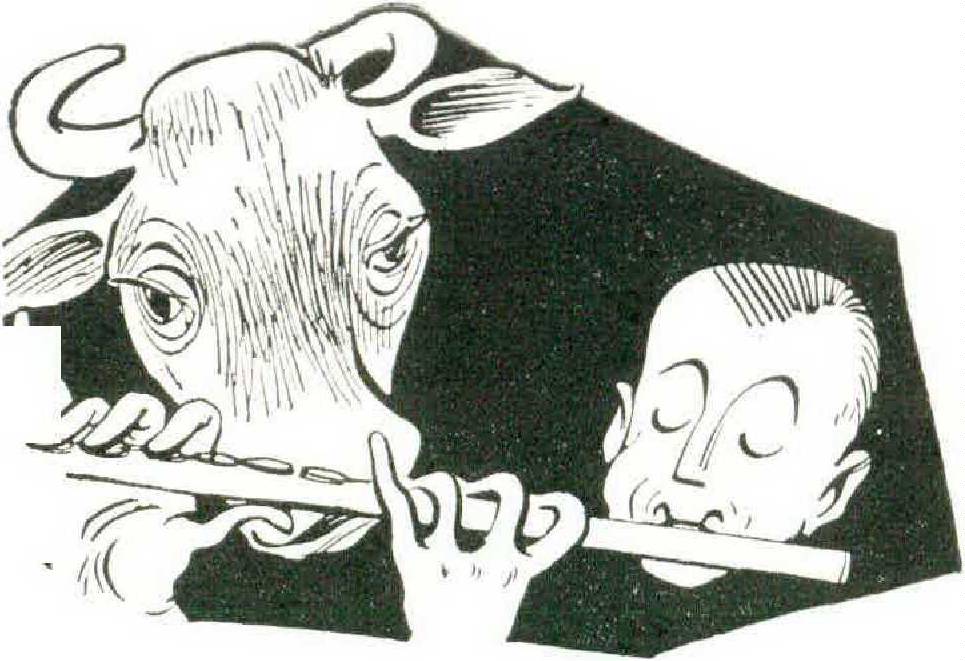
The hand milker sitting beside his cow thinks about such things. He would take with him four axes, three jackknives, and two heavy cooking pots. This leaves one choice open — a kind of Christmas check to be used for something you really want. It won’t be used for an electric milking machine, but it might be spent on a book or, if it won’t impose on the good fairy too much, a shelf of books. With the store of knowledge contained in books we should be able to climb out of the Stone Age and back to our present civilization in a comparatively few generations. My own choice for the tenth item on the list would be a flute.
This must seem an unprogressive selection, but the truth is that I don’t like progress. Progress is where you no sooner get used to one way of doing things than you have to start right off getting used to a better way. Progressive people don’t mind that. They even seem to like it, but that doesn’t mean I am wrong. All it means — move over and stop switching your tail — is that I don’t like progressive people. The trouble is that this puts me in a class with the reactionaries, and since I don’t like them either, I have had to turn for companionship to the two-toed ungulates, particularly the cow.
More Christian virtues are to be found among the ungulates than among any other fauna, including man, whom I would place below the birds in this respect but probably above the dog, and certainly above the cat. One of the ungulates, the East African klipspringer, has an especially admirable character and is strikingly beautiful besides.
But the trouble with ungulates as companions is that they don’t like me. When they see me coming they move to a far corner of the pasture, and if sworn at in a loud voice they roll their eyes as if shocked and move away faster.
However, my reason for choosing the flute is not to woo the ungulates, but in hopes it might offset the jackknives, because — set a Yankee down in the Stone Age with a jackknife among his artifacts, and in no time at all he will turn up in a television studio rooting for progress.
Progress is natural to man and it comes from his extraordinary ability to adapt himself to his environment. The faster a new environment comes along for him to adapt himself to, the happier he is; and if they don’t come fast enough to suit him, he makes one by adapting his environment to himself. Since each reacts on the other, it is sometimes hard to tell which is adapting itself to whom or what — and of course, why. But that is progress and man is well suited to it. He can get used to anything. Cannibalism, infanticide, life under the equator or above the Arctic Circle — man can get used to it. There are only two environments to which man cannot accustom himself. These two involve the absence of food, and immersion in boiling water. Except in these two directions man’s capacity for progress is unlimited.
This does not mean that any movement in any direction may be called progress. Retrogression is not progress; but a social ratchet device keeps you from slipping backward anyhow; so once you’ve got progress you are stuck with it. The term progress is usually associated with inventions or processes that save time or labor, such as subways, quick-eats establishments, and pictorial magazines. A promising new development along this line is artificial insemination.
But when we study the ungulates in order to determine their capacity for progress, we have to admit that it is limited to grass. They have no future apart from grass and they do not seem to see the need for any. This is one of their most irritating characteristics. Man has spent thousands of years perfecting devices which will save him time and labor; and when he is in a rush to get done with the milking so that he can hurry off somewhere, it is very annoying to have those unprogressive ungulates gawp at him as though they had all the time in the world.
It is too bad that so admirable an animal as the East African klipspringer cannot progress, and that the one who can progress in all directions except two is not particularly admirable. Before the foam slops over the top of the pail, I want to offer the idea that if man’s capacity for progress could be directed and guided by the Christian morality of the klipspringer, we could make this a very good world. The ideal hybrid would be a klipspringer with a brain case as large as man’s and with fingers for playing the flute.
In this form we should be able to make the world a fine place to live in. No wars; no electric milking machines. The danger is that we might make it such a wonderful place that we couldn’t bear to leave it and would use our capacity for progress to get rid of our habit of dying. I would certainly hate to have to get used to the idea that I was going to live forever. However, time would be on my side.