Irritable?
“Writing is my seventh career, and the one I’m going to stick to,” ANN GRIFFITH tells us. She has been at it a little over a year, and has already had several articles published.
by ANN GRIFFITH
OF ALL the phantasies created for us by American industry, the most satisfying to me are those presented in the advertising comic strips. These tight, colorful little dramas appear each Sunday down at the bottom of the pages of the comic sections. Their superiority to the run-of-the-mill, undramatized advertisement can be easily demonstrated.
Recently, in the straight ads, there has been an attempt to suggest that the housewife is in love with her box of soap powder. She seems not only to like to wash clothes with the contents, but also to have a strong attachment to the box itself. She fondles it, rubs it against her cheek, hugs it, and whispers its praises into its ear. But what a deaf ear! For the box does not respond to any of this flattery, and the relationship between housewife and box is wholly unsatisfactory.
In the comic-strip version, however, this relationship comes to life, as it were. Soap powder is represented as a half-naked, handsome young man, reminding one vaguely of the iceman of olden times.
Like Superman, he arrives from out of nowhere just when things look blackest. The usual pattern is for a husband to storm out of the house, leaving behind a wife reduced to tears by his harsh words on the subject of improperly washed shirts. Instead of the cold comfort of a soap-powder box, rescue comes in the form of soap powder personified. He washes the shirts in a trice, getting them so clean that the wife can scarce credit her eyes, and then flies off. At the end of the day, when the husband comes home, his shirts please him with their new, snowy whiteness, and he can love his wife again.
Dagwood, in the authentic comics, remarks frequently that “husbands are a sorry lot" - an opinion that is supported over and over in the advertising comics. What tempers! But every tantrum has its antidote.
The Flynn family, in the first three panels, seems to be in a pretty bad way. Dad is trying to fix Junior’s train but clearly is only making it worse. “Gee, Pop,”the little boy nags, “can’tcha make it work?”
“No! Blast it! And I’m tired of trying!”
Mom, on edge like everybody else in this touchy household, flares up at this indirect slur. “Don’t glare at me. I do everything else around here. I can’t fix trains too! Other men can put electric trains together -why can’t you ? ”
That’s all it takes to send Dad from the house, yelling as he leaves “Other wives don’t nag their husbands, either. I’m going for a walk.”
Junior, evidently all too used to such goings on, merely shrugs, “Guess I’ll go to bed.”
One breakfast of dry cereal transforms this domestic hell into the happy home that appears in the last panel. Thanks to “wheat energy,”Dad is able to fix the train the very next night. Junior is proudly showing it to a friend and telling him, “My dad’s terrific! He can fix anything! ” Dad is holding Mom’s hand and saying, “I don’t know what’s happened. I feel like a new man, honey!” To which she is replying, “And you’re going to go on feeling that way. From now on, the Flynns are going to have fun out o’ life.”
The more outrageous the behavior of the husband in the first panel, the greater the satisfaction in seeing him become a decent fellow again in the last panel. After another sleepless night due to you-know-what kind of nerves, Peggy peers desperately into her mirror and exclaims, “O-o-o-o . . . I look a wreck this morning.” Husband John, a boor if there ever was one, answers, “I’ll say you do!" Worse than that, we learn from Peggy in the next panel that “John left for work without even k-k-kissing me — my l-l-looks don’t attract him any more! ”
They both turn to wheat tea and the results are all anybody could ask. Peggy blooms once more. John looks gay and gallant and is sufficiently reattracted to propose this toast — in wheat tea of course: “ To my wife — the best-looking gal in town!”
In another beverage strip, Neddy and five of his little friends are gathered at his house to elect a president for their new club. The vote is three for Neddy and three for Sandy, a hot contest - almost as hot as the steaming cocoa that Neddy’s mother serves. After the six hungry boys down their hot chocolate, a new vote, is taken and Neddy is unanimously elected. This is a positive result — serve hot chocolate and be elected president.
Changing one’s brand of cigarettes will not do that sort of thing, but it will get. one out of a peck of trouble — on the home front or in any other walk of life.
A tugboat captain almost rams into a cruiser. Reason: “Smoking irritates my throat so much I feel awful and you can’t do your best when you’re not feeling up to par.”
A trapeze artist misses her partner. Lucky it’s only a rehearsal and there’s a net to save her! Like the rest, she has a ready explanation: “My timing is off. Maybe it’s because my throat feels so parched and irritated from smoking, I can’t keep my mind on the job.”
To none of these characters, so irritated by parched throats as to jeopardize life and limb, does it occur to stop smoking. They make the “nose test,”change their brand of cigarettes, and return to happy, useful lives. One of them speaks for all when he says, “I’ll admit I’m doing a better job now that there’s no cigarette hangover to make me irritable and out of sorts.”
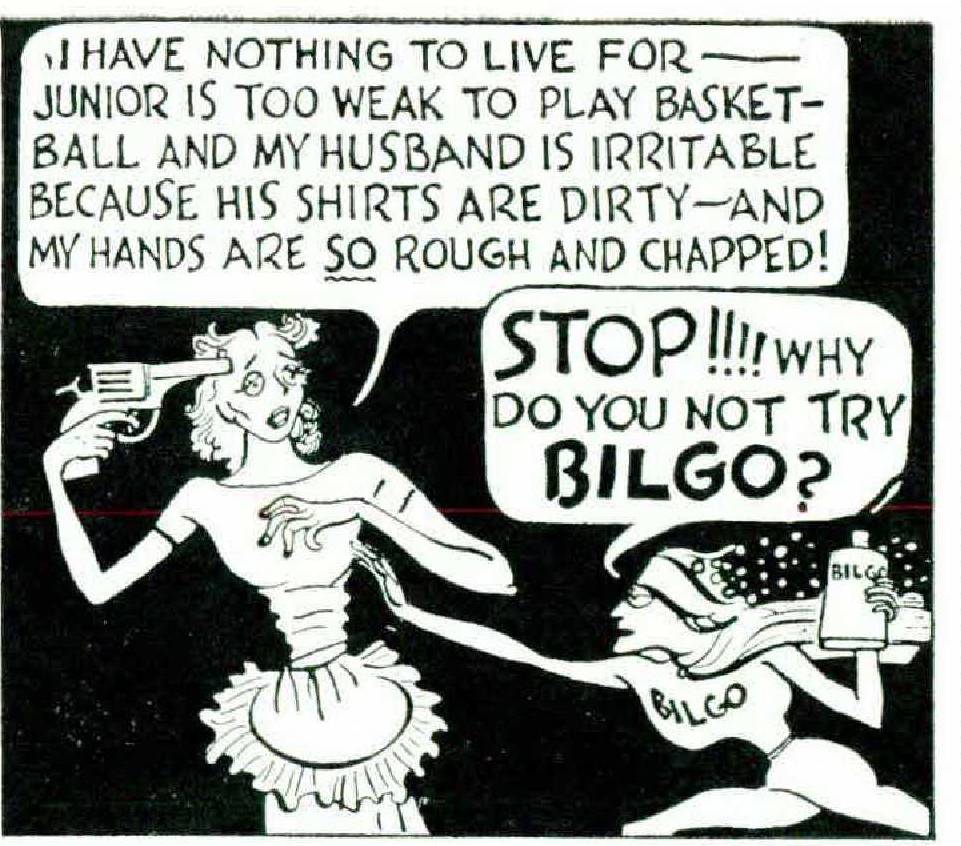
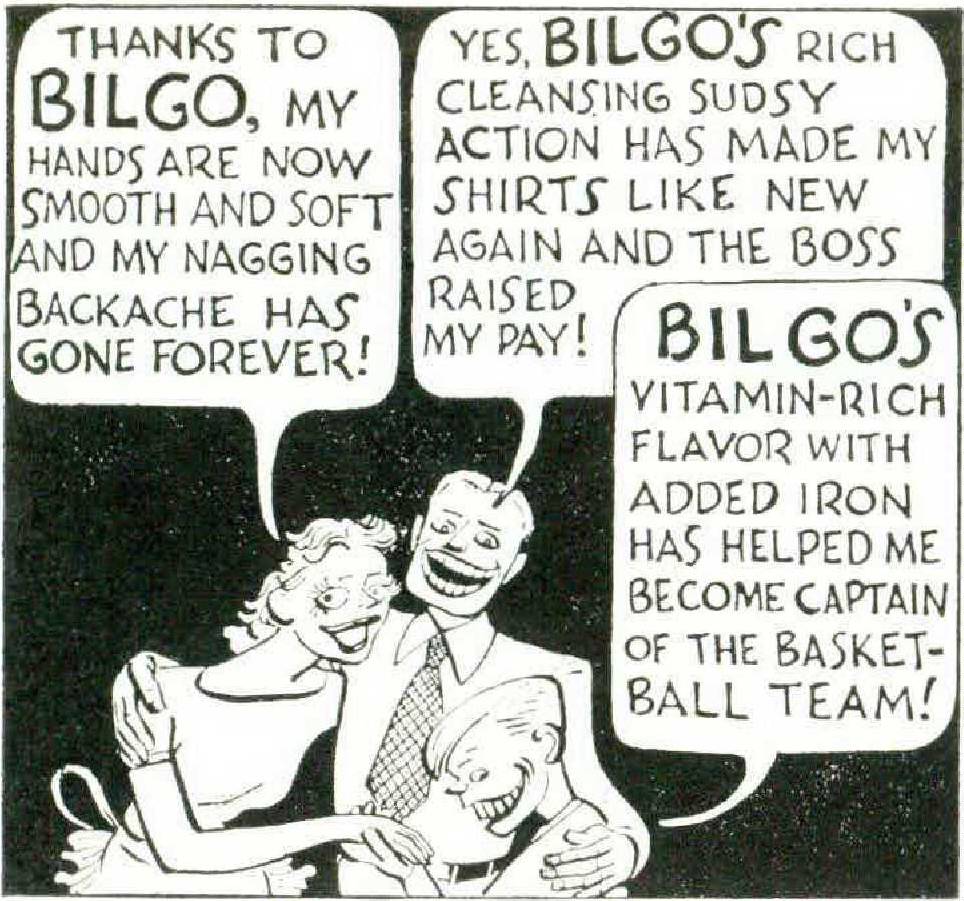
There is no demand that the advertising comics be logical, and no effort need be wasted in thinking up subtle ways to bring in the commercial. Just bring it in, that’s all. A brand-new mother is being presented with an adorable pink baby in an adorable pink blanket. Her reaction? “I’m almost afraid to touch her little face. My hands are so rough!” Instantly the baby is forgotten, for we have arrived at a subject which everyone knows is dearer to a woman’s heart even than a newborn babe — rough hands! The rest of the strip is given over to a spirited and clinical discussion between mother and nurse on this timeless topic.