Did You Write That?
by coREY FORD
COKEY FORD, whose touch as a light writer is anything but middle-aged, simply wrote too well when he described recently the symptoms of being fortyish. The consequences should be a warning not only to light writers but also to light plagiarists.
A YEAH or so ago, as I was walking upstairs, it struck me that the steps were getting steeper than they used to be. What’s more, they seemed to be using finer print in newspapers lately, and the materials they put in these modern suits had a tendency to shrink, particularly around the waist and in the seat of the pants. So I jotted down some of the changes taking place around me, and Collier’s published them in a little essay entitled “How to Guess Your Age.”
My life hasn’t been the same since. Everybody who read my piece seemed to feel that it applied to him personally. He felt it was so personal, in fact, that he made several typewritten copies of the essay and mailed them to his friends. Whereupon his friends were so amused that they all made carbon copies, and mailed them to other friends, and these friends made mimeographed copies and sent them along to still other friends, I began to feel like the author of the original chain letter. I was the President of the Pyramid Club. I was becoming the most widely quoted author in America. I was also the most anonymous.
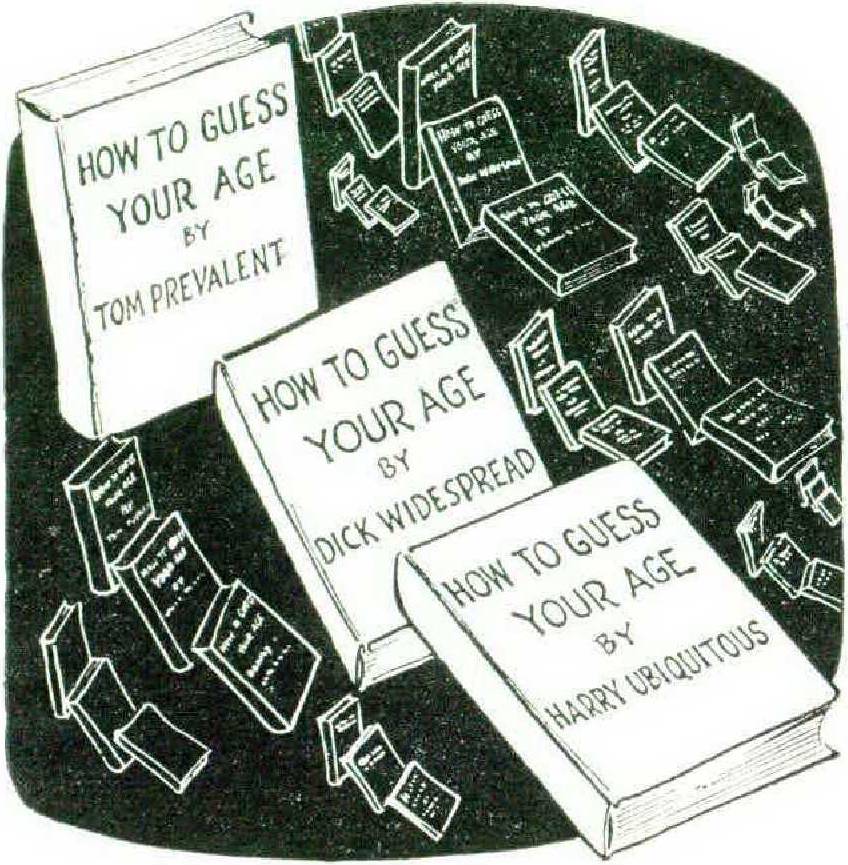
Somehow, in the process of copying the piece, my name got lost. People would leave off the by-line, or else they would substitute their own names and send it along with a little card: “Compliments of the J. S. Printwhistle Rutabaga Corp.” I began to get copies of my essay, signed by somebody else, usually with a sneering note: “Why dont’ you write something as funny as this sometime?” Several hopeful authors submitted the article to the reader’s Digest, and my agent had some difficulty establishing my ownership when the Digest printed it. On the day that Doubleday and Co. decided to bring it out in book form, the editorin-chief found five other copies in his morning mail — under five different names. I barely got under the wire with my own book.
To make matters worse, the thing began to pop up in trade journals, business house-organs, and advertising publications. It was published by such varied media as the Juneau (Alaska) Empire, the Automobile Old Timers Club of Gary, Indiana, the Bodine Automatic Tapping, Drilling and Screw-Inserting Machinery Corporation, the Harvard Class of '17, the Ordnance Department of the Frankford Arsenal, the Journal of the American Medical Association (I think they called it “How to Guess Your Ague”), and the PardeevilleWyocena Times. Some of these apologized handsomely but the damage was done.
Executives sent it out as their personal Christmas cards. Fraternal organizations read it aloud at their weekly luncheons. Columnists borrowed it whole to fill their columns. Radio broadcasters used it on the air, secure in the belief that there is no adequate copyright law in this country to prevent them. A veteran in a Walla Walla hospital submitted it in a contest and won first prize. My own hotel printed it up in a nice gilt booklet — no permission, naturally. Keeping track of the piece was like chasing a toupee in a wind tunnel.
So I called in my lawyer, Mr. Henry Walter. Normally I am a peaceable guy, but today I have more suits than Adolphe Menjou. I have been plagiarized by two life insurance companies (life insurance people seem to have a morbid interest in getting older); the State, a weekly survey of North Carolina; a large chain store (which ran it with a message from the president and his picture); a plumbing supplies company; and the U.S. Army. The two life insurance companies, the chain store people, and the plumbing people all settled readily out of court with Mr. Walter — no staggering sums, but enough to establish the literary principle that Plagiarism Doesn’t Pay. Other actions are pending. Meantime, Mr. Frank Sullivan took up what he would doubtless call the cudgels in my defense in his review of the book in the New York Herald Tribune: — “The whole thing,” concluded Mr. Sullivan, “is an amusing commentary on the casual contempt with which most Americans regard the Profession of Writing. They would not steal a writer’s watch (if he had one, which is unlikely unless he has sired a book like The Cardinal or Peace of This or That) but they think no more of stealing his brains than they would of stashing a souvenir ash tray from the Stork Club. They do not feel that a piece of writing constitutes a property, since they do not think any effort or talent is required to write. They could write as well as Ernest Hemingway themselves if they weren’t so tired when they get home from the office or the filling station.
“At any rate, Corey Ford, like Queen Victoria, to whom he is not related, was not amused at this blithe kleptomania, and he sued a horde or two of the pirates who had lifted his handiwork. That is why, to this reviewer, one of the most comical lines in the book (and their number is legion) is the one on the first page that says: ‘All rights reserved.’”
So it goes on and on. My normal life is ruined. My harried agent, Harold Ober, has had to hire a couple of extra secretaries to handle my mail. Reprints, requests for permission to reprint, and apologies for having reprinted without permission continue to pour in. I have no time for writing any more. Even my sleep is disrupted. The other night I was awakened at 3 A.M. by a collect telegram, and after I’d paid for it ($3.76) I discovered it was from a national pear growers’ association asking if it would be okay to hand out my essay free with each box of pears. I wired back that people should be able to guess the age of their pears without help from me. Yes, I sent it collect.
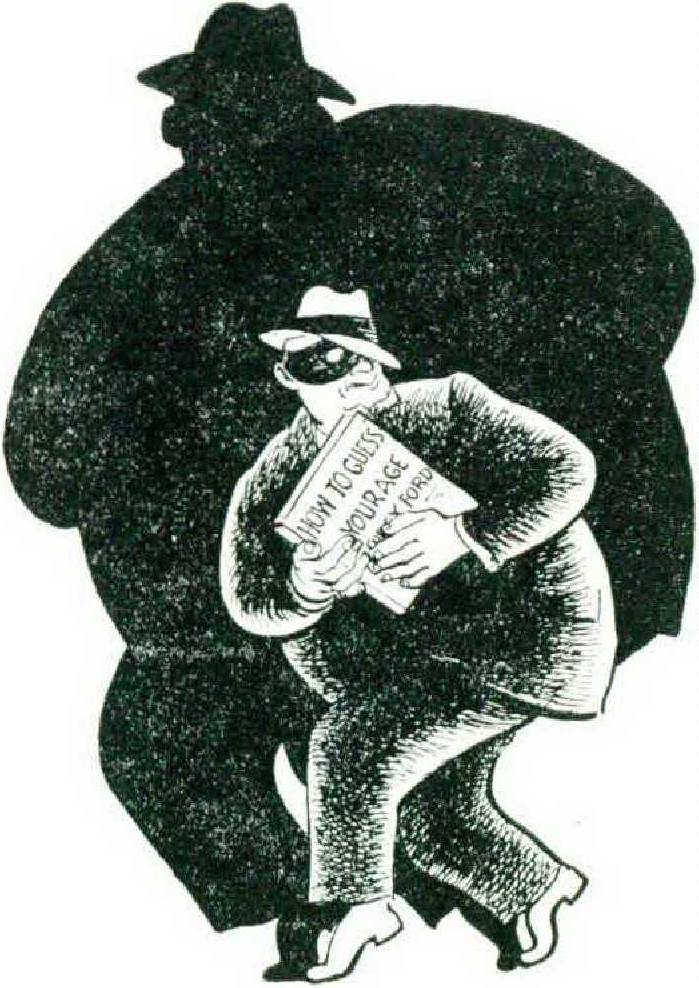
I’m losing friends fast. For some reason, people who steal the piece are highly indignant if I object. I just tossed it off for a laugh, didn’t I? A manufacturer in Middletown, Connecticut, who had been handing out hundreds of printed booklets, was outraged when I suggested some token remuneration. “Why, that piece about getting old was delivered last June in New Haven as the Alumni Day address by a member of the Yale Class of 1900,” he snorted. “I copied it down word for word. Where do you get off trying to claim it. you young whippersnapper, you?”
What’s more, the effects of my own observations on middle age are catching up with me. I notice that people get up and give me a chair when I come into a room nowadays. I’ve given up crossing the street against the lights, and usually my companion props a helping hand under my elbow as I step off the curb. I’ve quit tennis lately because these modern tennis balls they make are so hard to reach when I stoop over. I’m getting more absent-minded, too. The other day, on my way to an uptown appointment, I gave the elevator operator the street address, and then when I got into a taxi I gave the driver the telephone number. I’ve already mislaid three hats since my book came out. I’d tell the publishers to stop printing it, if I could only think of their name.
The next time I write an essay, I’m going to choose some obscure subject like the binomial theorem. Maybe if I turn out a piece that nobody reads, I’ll be able to catch up on a little sleep. I need more sleep lately. Nights seem to be getting shorter than they used to be.