Legacy for the Children
HANNAH SMITH, who was brought up in the Middle West, now lives in Arcadia, California. She is the author of an amusing autobiography, For Heaven’s Sake (Atlantic-Little, Brown).
by HANNAH SMITH
SING the Underwear Song,” we always used to beg my mother at bedtime, and Mom usually obliged. The “Underwear Song” — so named from baby Ruth’s misconception of one line in the little jingle — was the private possession, so far as I have been able to determine, of our family alone. Now, with all six of us married and live of us with families of our own, the “Underwear Song” is being sung at bedtime to Ruth’s children in Alaska, Willis’s in Denver, Lois’s in Idaho, and my brother Shel’s three and my one in California.
The song, an expansion of a familiar childhood rhyme, goes like this: —
Who had a little curl
Right in the middle of her forehead.
When she was good
She was very, very good,
But when she was bad she was horrid.
In her little trundle bed.
Nobody near for to hinder:
She fell with a whack
And lit on her back
And broke her trundle bed to splinters.
And thought it was the boys
Playing on the drum in the attic.
She came upstairs
And caught her unawares
And spanked her most emphatic!
Maybe it was poor child psychology, that song, but we loved it. And even today we sometimes still refer to a certain anatomical area as the “most emphatic.”
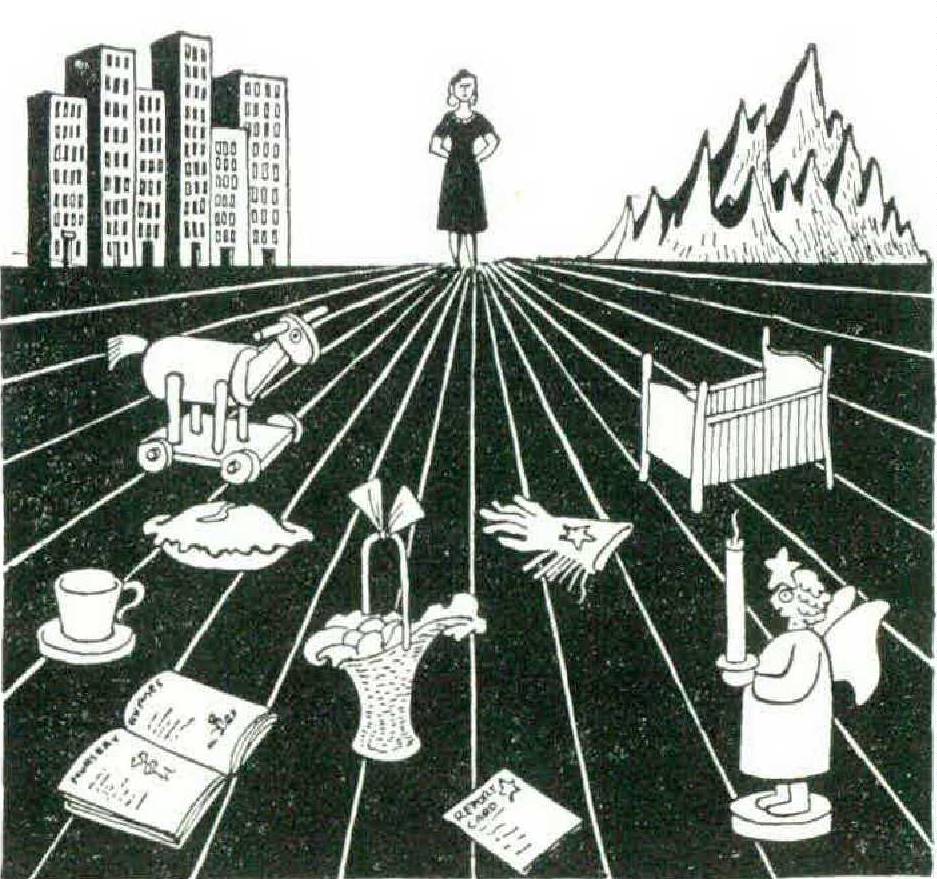
My father and mother were poor, as ministers and their families often are; my father rarely had a savings account and certainly never owned securities of any kind he could pass on to his six children. But we have legacy, my share of which has become of increasing value to me each passing year, because if is made up of familiar riches — the songs, games, stories, little family jokes, small traditions either built up by my mother handed down to her by her mother and grandmother before her.
Each Easter, for instance, before breakfast my mother hid individual baskets of candy eggs around the living room, and without those familiar baskets (she used the same ones every year) it wouldn’t have been Easter for us, no matter how eloquently father preached later that morning.
Retelling that, it sounds too simple to be called a family tradition, and yet all of us look back on that small ritual with warm pleasure.
A friend of mine tells me that Christmas for her would be incomplete without certain fragile old tinsel and plaster ornaments that hung the tree when she was a little girl. There is a frazzled-haired plaster angel, for example, that has always topped each Christmas tree; and very sight, of that chipped, scarred angel always brings back to her breathless, tingling delight of those long-ago Christmas mornings. And to her children, undoubtedly, the aura of history around the figurine makes it twice as fascinating as the most expensive glittering new bauble.
“Why do you do that?” I asked another friend one day as I watched her cut a curious leaf-shaped design the top crust of a newly made pie. She looked up, startled. “What that? Oh, I don’t know — ” She put a flour-tipped finger up to her cheek and stared off into space. “Come think of it, I believe Mama always did that. I don’t know what it’s supposed to be. My kids like it, t hough.”
Every year I expect to get a certain kind of Christinas card from family of our acquaintance. The cards, almost too obviously handmade, have improved over the past few years, and are now much thumbmarked.
“Merry Christmas from Hugh, Jeanie, Pauline, and Peter Waterman” says the slightly wobbly printing on the big red oblong, and I smile as I read, visualizing the little Watermans working on the cards at their dining-room table, Pauline with her absurd horn-rimmed glasses slightly askew on her small freckled face.
Writers and lecturers often declare that the movies, radio, comic books, and television are robbing our children of the simpler participant pleasures of an earlier day. Bitter as the truth is, they are undoubtedly right in great part.
Nevertheless, it’s the very nature of children to love best that which is their very own — the panda they’ve always taken to bed with them as long as they can remember, the big nursery rhyme book with the baby’s toothmarks on its cover, or their own chipped cup or favorite red sweater. A child’s eye unerringly discerns the value of the beloved old and familiar.
“Tell me about when-you-were-alittie-girl,” your children say, or “I want to hear the green turtle story.”
If you want to leave your child an imperishable legacy, you might take conscious thought as to the heritage of remembered things you are accumulating for him. You can be dead sure that, while he may forget what model car he rode in when he was six, or even whether yours was a good neighborhood or not, he will never forget the singing grace before meals you taught him or the small pie you always made him when you baked a big one.
And it may be that a hundred years from now, some other mother and child will still be treasuring the legacy — whether it be a design cut in a pie crust, a certain kind of cake on holidays, or even a silly little song about “her unawares.”