The Handwriting on the Backboard
SAMUEL YELLEN is in the English Department of Indiana University, Having explained to Atlantic readers “How Football Died" in tiro articles, Mr. Yellen now foresees a bizarre end for basketball, as unmistakably evidenced in presentday trends.
by SAMUEL YELLEN
TO MOST readers, I realize, what I have to say will seem like sour grapes. I must confess right off that my friends call me Midget, and that I am a very short man — in fact, an inch or two under seven feel, Yet I am so disturbed by a rumor which has recently leaked out of the basketball squad at Minnesota that I must issue this warning, even at the risk of having my motives questioned. For the handwriting is all too plain.
It is common knowledge that only five hundred years ago, back in the twentieth century, men were much shorter than now. The evidence is indisputable. From the skeletons and artifacts in our museums, we can safely conclude that the average height then was three or four — perhaps even five—inches under six feet, and there were men as short as five feet. Moreover, the popular literature of that remote age speaks with great admiration of a hero six feet tall as being quite a specimen of manhood. What we are apt to forget, however, is the fundamental role of the game of basketball in the Great Anatomical Mutation.
As far as contemporary sources reveal, the first signs of change, which appeared in the 1980s and 1940s, went completely unnoticed. Since t he records are obscure, we cannot determine accurately which school first introduced the concept of the tall center in basketball tall, that is, for those days a player six feet four or five, or often as much as six or seven.
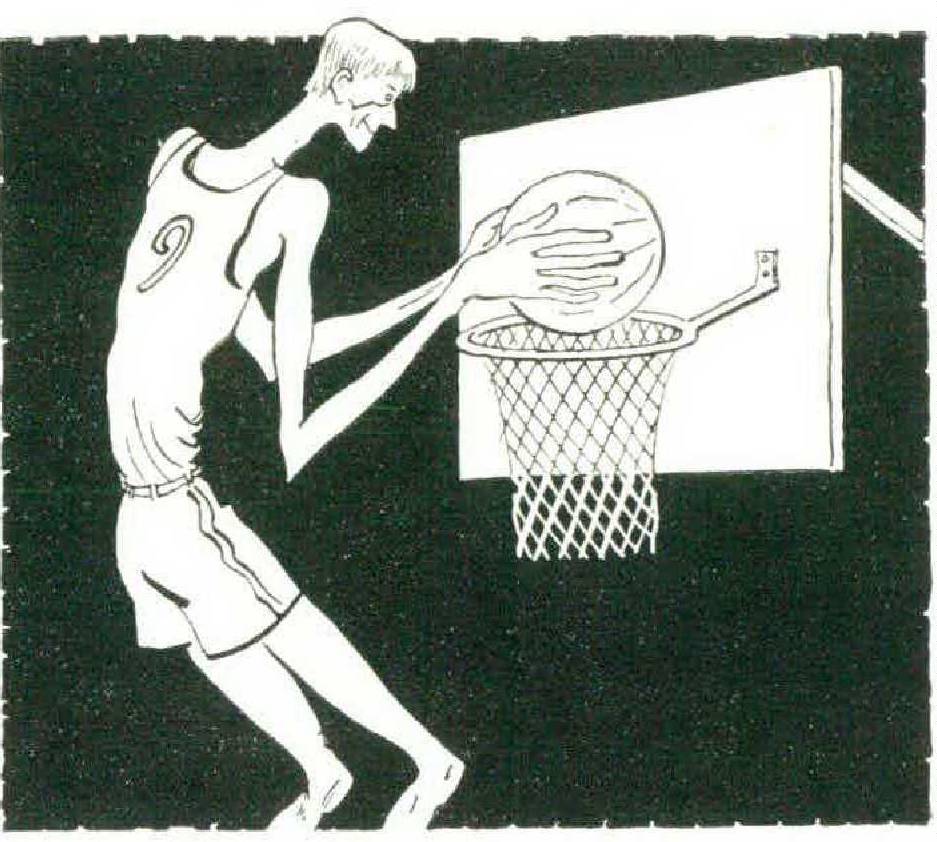
We do know from accounts of sports writers five centuries ago that the so-called “tali" center was usually ungainly, unable to dribble or handle the ball, and of little use in the floor game. His business was to stand, like a sore giraffe, close to the basket and wait until his team males “fed" him the ball, which he then caught above the outsiretched arms of his opponents and, given luck. Hipped through the hoop.
Within a few years every team boasted a tall center. Furthermore, he had grown generally less awkward and more capable of handling the ball. Nor did it take long for the coaches to deduce that if height was an advantage in a center, it might, likewise be so in a guard or a forward.
A premium was thus placed on sheer length of limb. The average height of teams moved upward quickly as men under six feet dropped out of basketball. By the late 1950s, most players were well over six feet two, and six feet eight or nine was common. Eyen seven feet was not rare.
Around 1960, however, a deep dissatisfaction showed itself among the fans — a dissatisfaction which was Soon to swell into revolt. The trouble was that the teams had grown so tall that the players could easily reach above the basket and simply drop the ball through the hoop. Fantastic scores were recorded. Whereas in the 1930s a score of 60 (point-a-minute) was regarded as good, and in the 1940s a score of 00, in the 1960s a team usually ran up 170 or 180 points. Yet, paradoxically, the game itself became slow and uninteresting, and for the most part was merely a flailing of hands and arms around and above the basket.
At first the coaches attempted to remedy the situation by prohibiting any scoring from a circle within three feet of the basket. But finally in 1964 they found it necessary to raise the basket itself one foot higher from the floor. This gave some relief, but not for long. Very soon the teams began turning up still taller players. By the 1970s it was obvious that the cycle had started all over again, as ever taller and taller players appeared.
What was not clearly understood at the time was the relationship between this development in basketball and the steadily rising average height of the population as a whole. Scientists attributed the general rise in height to the absorption of “vitamins “ by the body a quaint notion which was part of the folklore of those days. Actually, it appears, some kind of natural select ion was at work.
We can say with certainly that the game of basketball was as widespread then as now played in every college. high school, and community. We also know from the literature of 1 hat era that basketball players enjoyed great popularity among girls, particularly at the age just prior to marriage. When it came to mating, consequently, the basketball player had a biological advantage. That edge, slight as it may seem, operated steadily — and much more rapidly than the early geneticists might have estimated.
During the twenty-first century, new complaints and rumblings began to be heard. Not basketball but the entire economy of the country seemed to be out of killer. Somehow depopulation and the economy were no longer adjusted to each other. Houses and rooms were too small, doorways and arches too low, chairs too shallow. beds and bathtubs too short. People could not get their knees under tables, nor their bodies into automobiles. Office buildings, factories, boats, airplanes, clothes, farm implements — nothing was right. In fact, every aspect of daily living was a constant irritation.
While the citizenry at large was painfully aware of all this, it took the perspicacity of Professor A. J. Thompson, at the Yale Institute of Human Behavior, to put the problem down in black and white. His Needed — A Seven-foot Economy. published in 209.9, was perhaps the single most significant bookofthal century. Thu usual popularizations followed. Of these, the most widely read and most influential were “Is Man Too Tall?" in the Header’s Digest and “Are We Getting Too Big for Our Pants?" in the Saturday Evening Post.
As a direct result of Professor Thompson’s caveat, census figures on height were first taken in the year 2100. Everyone expressed amazement at learning how man had crept up on himself. The average height of men was discovered to be six feet three, and of women five feet eleven. Basketball teams averaged six feet nine, and there were many players seven feet three or four. Moreover, the average kept moving upward relentlessly.
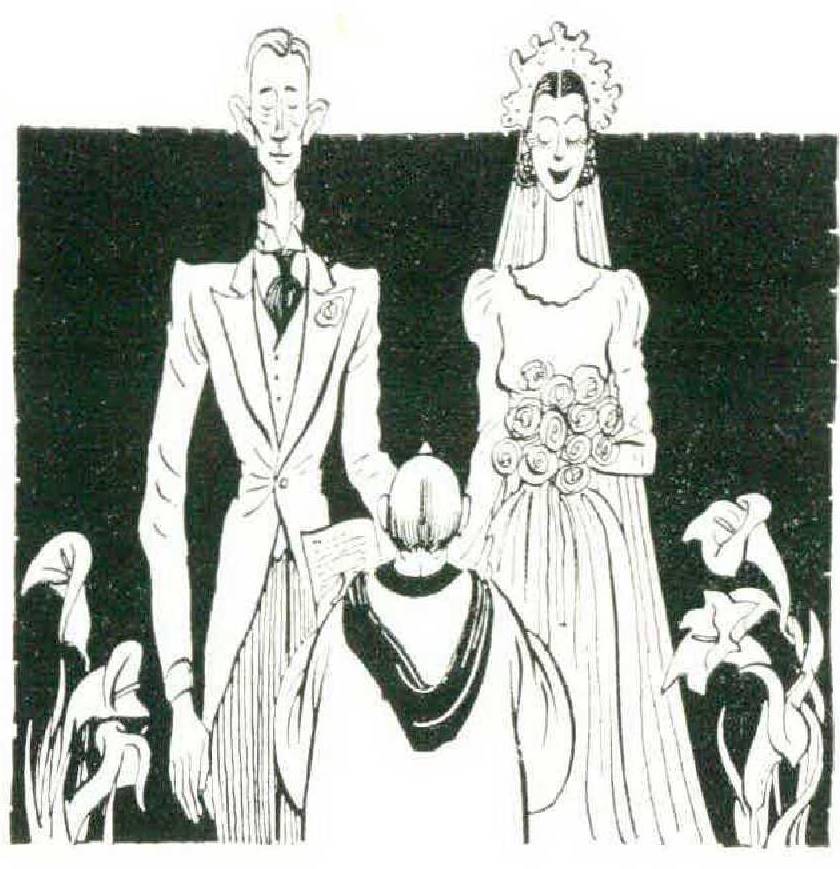
No one knew what to do, although editorial writers, social workers, and Congressmen viewed with plenty of alarm. F, \ cry now and then, the coaches would meet and lift the basket sex era 1 more inches, and the cycle would start all oxer again. Thus the entire twenty-second century passed in helpless confusion, with population and economy growing ever more at odds. Not until 22,92 was the issue faced squarely. By then it was unmistakable that we were undergoing the Croat Anatomical Mutation. The average height of the general population had risen to seven feet eight, and of basketball players to eight feet - the figures which still hold in our time.
It was in that year that President Franklin Delano Roosevelt IX, then serving his fifth term, announced his Rcdeal Program. Obviously an economy which had been built for a five-foot-eight average and readjusted here and there by fits and starts could be no more than a thing of shreds and patches, thoroughly antiquated, thoroughly makeshift. With farsighted boldness. President Roosevelt called upon Congress to appropriate 500 billion dollars to remake, rebuild, retool evcrything — from buildings and clothes to autos and streets— to fit a seven-foot-eight population.
Despite the bitter opposition of the Republicans, the Redeal Program was pushed through. And within a decade, the Strenuous Decade, a miracle had come to pass. The face of the nation was completely changed and took on the appearance we are now familiar with.
The only holdout was the Chicago Tribune, which not only thundered without letup against the Redeal but stubbornly refused to rebuild the Tribune Tower. Indeed, any employee who was caught stooping to enter the building was fired forthwith, since the Great Anatomical Mutation was held by the Tribune to be nothing but a figment of the Redeal imagination. The Tribune Tower still stands today in its original size, though it has since been conxerted into the Chicago Museum for Pre-Adolescent Children.
Fortunately. President Roosevelt was wise enough to realize that a Rcdeal could very likely nexer be undertaken again, for financial exhaustion had set in and the tax structure had piled up dangerously.
At first his advisers considered prohibiting the game of basketball completely. But recalling the failure of the Eighteenth Amendment and fearing an era of bootleg basketball, they gave up that idea. The solution ultimately decided upon was to put a ceiling on the height of basketball players. The Thirty-fourth Amendment to the Consitution, which was speedily ratified, declared that no basketball team might use a player taller than eight feet two inches.
This Amendment has worked better than anyone expected. The average height of our population has been fixed for nearly three centuries, and the economy, as reconstructed under the Redeal Program, has remained a good fit. However, a certain complacency, even laxness, has recently manifested itself.
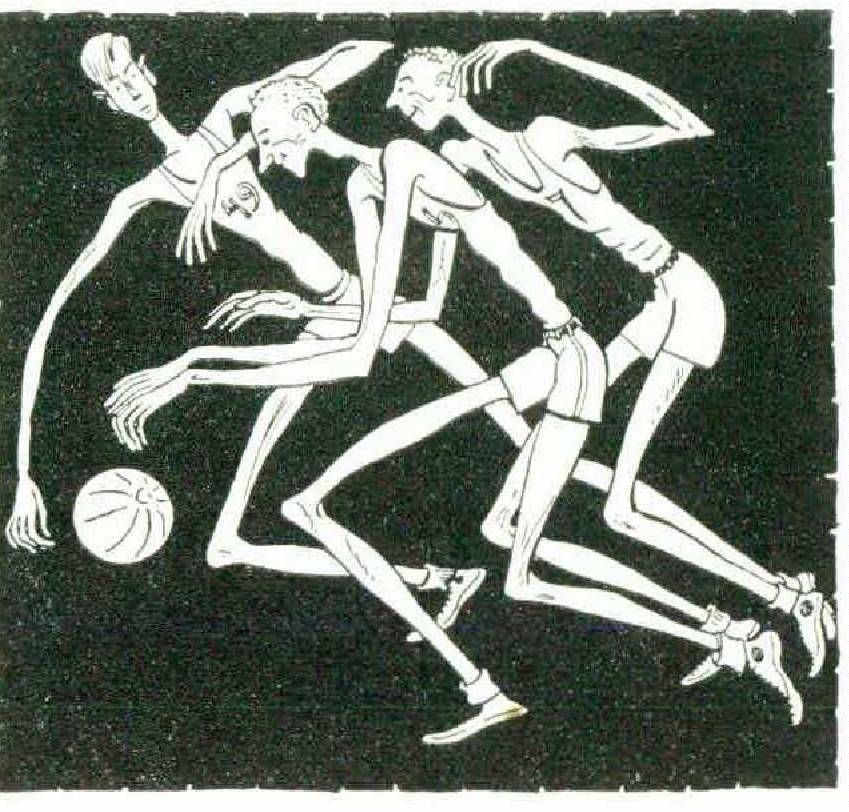
The first signs of danger appeared last year, when Georgia Tech used a center eight feet two and one-fourth inches talk When the FBI cracked down, the Governor of Georgia threatened to call out the militia to protect the sovereignty of his state against unwarranted federal interference. The case, as will be recalled, went to the Supreme Court, and with one dissenting opinion the Court ruled that the makers of the Amendment had not had in mind denying anyone the right to play basketball “because of a mere one-fourth inch.”
And now, as anyone might have foreseen, a reliable rumor has it that Minnesota has under cover and intends to use tins season a new center who is eight feet two and seveneighths inches tall, with his head shaved. The peril is upon us. It can no longer be ignored. As the sole courageous Justice of the Supreme Court stated in his vigorous dissent, “It is not possible to be just a little bit pregnant.”