California Wine Today
WILLIAM WISTER HAINES, the author and playwright, is a Californian by adoption who has long enjoyed the native wines. At the suggestion of the Editor, he made an extended trip through California vineyards last winter, and this is his account of what he learned. Mr. Haines has had three novels published, under the AtlanticLittle, Brown imprint, and his play Command Decision was a smash hit on Broadway and in the film version.
by WILLIAM WISTER HAINES
CALIFORNIA’S vintners of today could answer Omar simply. They are buying land, equipment, and research to produce better wine.
The vine has been man’s immemorial companion, sustenance to his blood, stimulus to the fancy that lifts him above other animals. Genesis records a vineyard as Noah’s first planting. In belated recompense the vine itself has recently offered some corroboration of Noah.
Almost within the shadow of Ararat, Professor H. P. Olmo, University of California geneticist, discovered in 1948 wild growth of Vitis vinifera, parent species of the vine from whose grapes is pressed nine tenths of the world’s wine.
It was known that Vinifera had accompanied man from Greece through every step of his long trek up the Mediterranean coast into Europe and so across to the New World. Dr. Olmo’s discovery, however, confirms an older origin and suggests a new perspective. It testifies that California wines are not the misplaced stepchildren of Europe, doomed by geographical mystique to an imitative inferiority in the New World. They are, like their European forebears, direct descendants of an Asiatic vine, transplanted to alien soil and climate, transmuted by technology to the uses of native culture.
Vinifera entered California with the first white men shortly before the American Revolution. The Franciscan missionaries brought it for sacramental use. The success of the Cross with the relatively humble Mission grape spurred both husbandry and commerce. Other subspecies of Vinifera followed by clipper ship and prairie schooner. By the late 1820s wine was in commercial production and had begun the adventures it continues today with American culture.
Wine had an early taste of the getrich-quick mania which dogs its history in the U. S. The California gold rush, closely followed by the phylloxera scourge which decimated Europe’s vineyards, touched off speculation on a boom-and-bust scale. Men were ruined; Vinifera kept growing.
Wine had a prophetically rude introduction to our politics. In 1860 the state sent its most illustrious vintner, Colonel Haraszthy, back to Europe to gather additional subspecies of Vinifera for experiment with California soil and climate. He brought back over 100,000 choice cuttings, carefully catalogued, only to have the state repudiate his bills.
Haraszthy’s reward was personal ruin. His cuttings had to be sold piecemeal. Classifications disappeared; his treasures were dispersed, often t hrough ignorant hands, to unsuitable soil. Experts are still untangling the resultant confusion of detail. But the broad consequence was to give California the richest profusion of species ever grown under one flag.
Immigration brought the state both the technology of producing wine and a blood stream which loved it. From the beginnings — as now — the Latinity of the great names in California wine has been striking. Legend of northern man as a somber fellow, requiring at least 100 proof spirits to lift his own, rests more on accident than on choice. His climate will not grow wine. Given a chance, he learns fast. One of California’s great houses was founded by a Finn, another by a German. Haraszthy himself was a Hungarian. California offered not only vintners but a consuming populace with wine in its blood.
With the state’s soil and climate Vinifera was not, as first feared, fickle. It was exacting. It played expensive jokes on the pomposity that hoped to press good wine by brute force of new gold on ornamental acres. To the intuition which could unriddle the complex equation of vine, soil, sunlight, and rainfall it yielded wine of immediate excellence and exciting portent.
Nor was the state always inimical. Here no royal smile or noble patronage accelerated the quest for perfection. But here in 1880 the State Legislature voted, and this time paid, public funds to begin the study of the grape in its university.
In wine production as in the cultures it blesses, stability and continuity are factors. These the new land had not. A hectare of choice European vineyard may represent generations of privation, current affluence, and the sole prospect of a family. Here gold itself, timber, wheat, fruit, and oil beckoned to impatience from every horizon. Haraszthy himself plunged into half a dozen enterprises. Only today, under capital made elsewhere, are his acres being reclaimed to their happiest potential.
Nearly every vineyard in the state has known many owners. History shows an unhappy pattern of promising beginnings and then a change of interest in legatee or purchaser. The exceptions illuminate the phenomenon. It is no accident that the rare third and fourth generation houses produce such a high percentage of today’s best wine.
At worst, however, individual change merely postponed development of specific vineyards. Our national instability arrested all progress. The disaster of prohibition injured Vinifera not at all. It had withered before, notably with the Mohammedan incursion into Persia, only to bloom the more brightly elsewhere.
For California wine the blow was catastrophic. Select vineyards were ripped out for replanting to more productive grapes. Roughly a quarter of the state’s four hundred vintners survived on faith, raisins, table grapes, and the limited sacramental wine business. None of these markets demanded, none could support, the efforts prerequisite to better wine. One must mourn not only the vintages not grown but the lessons not learned. Unused soil lies fallow. Unused skills atrophy.
Repeal posed for the California vintner no new production problem. Soil and climate had been proved. Technology, only dormant, awoke to significant advances in refrigeration. The challenge lay, once again, in Vinifera’s adaptation to American culture.
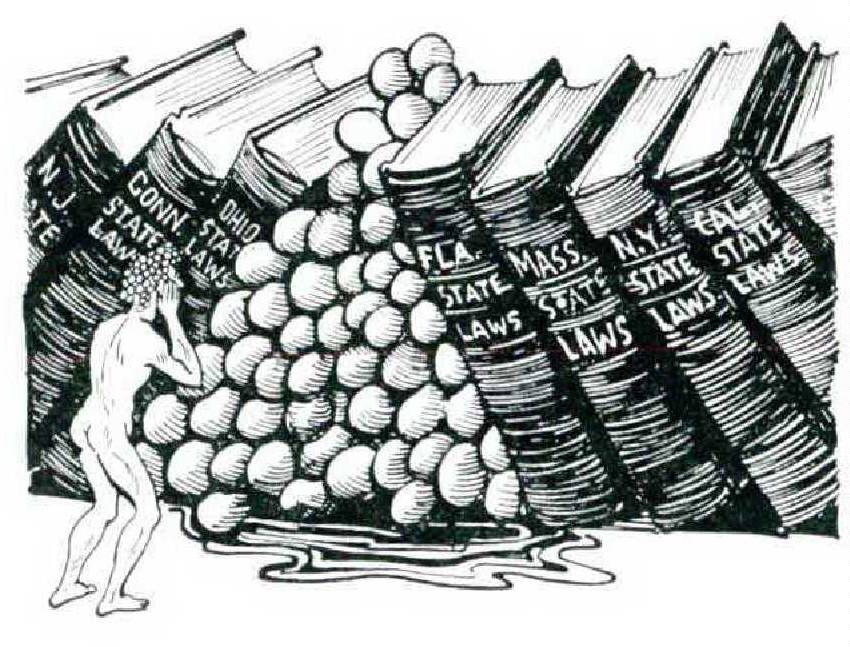
The vintner shares not only the normal hazards of other farmers. Where their troubles end in warehouse or subsidy, his begin as merchandiser of a delicacy bearing his name on every bottle. He operates under rigid government control. No parity protects him, no dollar of the taxpayer’s money has ever been paid for not growing wine. It is not only taxed; its commerce is regulated under forty-odd sets of laws.
Beyond these obstacles waited the American consumer with American impatience. Yet good wine will not hurry. He is a lucky vintner who drinks from his vines within four years of planting. The best takes longer. Technology may suggest, only time proves, the right grape for the right acre. Only patient aging in wood and glass confirms the choice.
With repeal there was no time. Customers who could remember that California wine had once sold on a proudly competitive basis in Europe itself were eager. A generation that had trained its taste buds on bathtub gin waited with its tongue out.
For the new gold rush there was a woefully inadequate backlog of good wine. Opportunism shipped whatever it could press. Vintners of conscience, both old and new, who were planting mightily for the rewards of a decade later had to watch the name of California wine compromised by fluids unfit to pour on fighting dogs.
There may have been rough justice in an industry outraged by the nation returning outrage upon the nation, but the effect was evil. Acting rapidly, the responsible growers formed an energetic trade organization, enacted basic standards into state law, and projected that, through federal statute, to govern California wine wherever sold.
A lasting mischief, however, had been done. Europe had watched Vinifera’s resurrection here with wise apprehension. Propaganda was already attuned to the snob appeal inherent in the word imported. Now it could exploit even disinterested pronouncements unhappily true of much of the initial spate.
California wine was scarcely luckier in some of its friends. New as well as forgetful customers had much to learn; for a time self-appointed teachers arose from under every other typewriter.
Inexperience was bullied with dogma on ritual and the permissible combinations of wine and food. It was beguiled with some of the purplest prose that ever dripped. The correct tastes of wine, sometimes the same wine, were declared to be: “gravelly, suave, flinty, robust, delicate, full-bodied, sprightly, rounded, angular, aromatic and tranquil.” Metaphors ranged recklessly from the firmament through flowers and precious stones.
Apart from snobbery and semantics there was a formidable problem of nomenclature. Here California, like Africa, Australia, and South America, leaned heavily on European precedent. The generic names such as Burgundy, Claret, Sauternes, and Rhine wine were universal landmarks.
They had become so because in Europe, as elsewhere, they conveniently embraced the wide variations within recognizable types. All but the rarest are blends, of a quality determined by choice of grape and the vintner’s art. But just as Europe depends, for the bulk of them, on strong infusions from the mass production of the Midi and Algeria, so California had, and too often misused, the press of its regions most notable for productivity.
Innocence, confronting on the same shelf a California Burgundy at 39 cents and a California Burgundy at $1.50, had not yet learned that the vintner’s name is the most important print on a label.
Worse, large sections of the country never saw California’s better wines. For even as time increased their flow, merchandising and legal harriers multiplied. For the smaller wineries, which bottle an inverse proportion of the best, promotion on the scale America has geared to mass production was prohibitive. The annual cost of a single salesman would consume the profit on something between five and ten thousand cases of wine. Many prizes at the latest state fair went to gallonages under a thousand. Even today much of the state’s best wine never crosses its boundaries.
Again, good hotels and restaurants seldom expect more than double the cost of wine over the table. A $2.50 bottle of gin and a few pennies’ worth of vermouth can be diluted into $15 worth of Martinis. For the professional host, too, there was more than arithmetic to learn. The wiser have learned that good wine is not only a strong attraction in itself; it is magically ameliorative to even the best cooking.
Freight rates handicap quality wine, which must still be bottled at the winery. Half of a case’s 30-odd pounds is glass which pays premiums for breakability. European and Algerian wine cross the Atlantic more cheaply than California’s best crosses the continent.
Technology could answer this problem already by safe shipment of even the best in bulk for Eastern bottling and binning, as winery-aging in glass is called. But the smaller vintner has not yet found the cost answer to rigid control of such important steps at such a distance. Association with the increasing numbers of his kind should discover a solution.
Only two states retain absolute prohibition, but the other forty-six burden wine with as many sets of laws and taxes. Eleven cling to the state store system, which means that employees choose what the taxpayer may consider.
One small vintner of high quality and limited distribution already files eight legal reports a month, adding ruefully: “A check accompanies most of them.” For many another, paper work alone erects proscriptive boundaries.
Through all these difficulties the California vintners of today press an increasing flow of better wine for one primary reason: Americans want it. The question of wine’s adaptation to American culture has been answered by a steadily rising demand.
Taste is subjective. To pronounce wine better is to express the conviction of a single palate. Yet for the reason as well as for the tongue there is impressive testimony of improvement.
The grape is already California’s second crop. Appropriately expanded, the Departments of Viticulture and Enology at the State University’s College of Agriculture at Davis have mapped every significant region of the state. They have measured (heat) degree-days and rainfall, planted, pressed, analyzed, and tasted the product. The aim was to confirm optimum combination of individual grape and certain location.
Major regional potentialities are proved. The optimism and obstinacy that once embarrassed the market with ill-conceived wine must face not only the facts but their competitive fruit. The exciting search for still better conditions, within known probability, narrows into the sights of surer knowledge.
The incursion of the great distillers into winegrowing first met sharp skepticism. Fine wine by mass production seemed a self-evident anomaly. It may remain one, but skepticism is learning that one swallow does not make a sage.
In wine production as elsewhere, survival is the first law. The grower must live; he must profit before he improves. The most illustrious wineries always marketed several grades of wine, scrupulously distinguished by price and label. Most still do.
But in precisely the lowest-price field, which the great corporations first invaded, opportunism and anarchic competition reigned. Heavy investment in a continuing name has to look forward. The giants never pretended to sell first-run cask and bottle aged Pinot Chardonnay at 69 cents a time. But they knew that their futures depended on whether a customer with 69 cents to spend on honest white table wine would return to their labels. Today he does.
There is a story, perhaps apocryphal but apt. When the first love-nest and hatchet-murder tabloid set its type for a new reading public the venerable New York Times was asked for comment on such competition. It gravely declined. To the same question six months later the Times replied cheerfully. Its own circulation had substantially increased.
But, perhaps because all parallels are said to meet in infinity, the story is not ended. The big corporations concentrated first on dessert wines because their grapes and growing requisites best fit mass production. Muscatel, Angelica, Tokay, and the Ports had a strong appeal to the national sweet tooth. Their higher alcoholic content reassured the prohibition generation, which liked to feel its bridgework bend with every sip. These wines still outsell the lighter ones by about four to one.
Yet the country which leads the world in per capita sugar consumption has made the dry Martini its favorite cocktail. Expanding steadily, many of the giants are now aiming their resources toward the profits and prestige of the most selective growths.
In the latest judgings at the California State Fair the biggest companies won not only their usual hatful of awards in the dessert and more modest table wine classes: they won respectable prizes in generics. After that they carried off an honorable mention in Pinot Noir, a silver medal in Sauvignon Blanc, and the gold medal in California’s classic Zinfandel.
At least one communicable standard distinguishes what are called the better wines: they command higher prices. Snobbery and semantics still vex this field but an important step in nomenclature now assists individual judgment of its offerings. The varietal label is not new. Haraszthy sold the press of his Zinfandel grapes as Zinfandel wine ninety years ago. And there are records of California. Black Pinot in the early 1860s.
The increasing adoption of varietal labels today sharpens identification. Merit in wine begins with the grape pressed. Law specifies that a vintner who wishes to demark his better Claret as Cabernet Sauvignon or his better Saul ernes as Semilion must blend into them at least 51 per cent of the press of those dearer grapes.
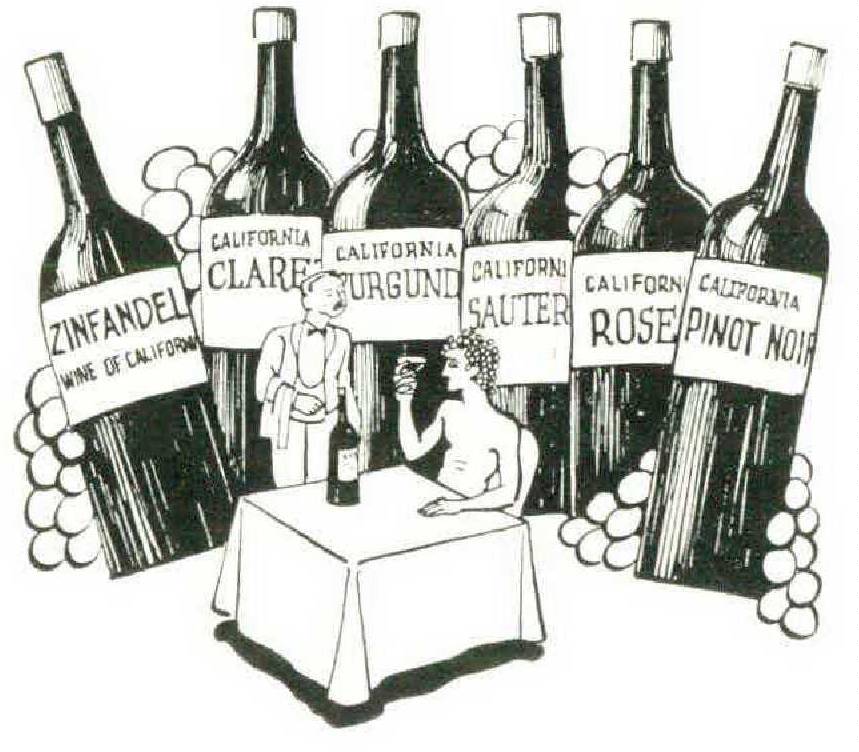
Competition drives the percentage steadily upward from the legal minimum. It assures the customer that the vintner who began with superior grapes has processed and aged their wine with proportionate care.
Some excellent houses still refuse the varietal label for reasons not always so simple as heavy commitment in cheaper vines. Their blending practices have won customer confidence in their generic labels. And some houses have put time and scruple into proprietary house names.
Nevertheless varietal labeling, strongly encouraged by the College of Agriculture, increases. The curious may test its efficacy. State prices differ, but for less than $3 — far less where half bottles are procurable — a reputable wine merchant will sell one bottle of good grade California Burgundy and one of Pinot Noir. Or a California Sauterne, sweet or dry, may be matched against its counterpart in Semilion.
The trend toward varietal labeling is emphasized in the recent formation of an Association of Chateau Wine Growers by a number of relatively small vintners. Its members have agreed that their varietals shall contain not less than 85 per cent, of the grape that labels them.
This innovation has met doubt as well as enthusiasm. Many consider its very name inappropriate to wine of the Western world. Members as well as observers know that its gallonage will be relatively small. Bad years will force it either to lower percentage or to break commercial continuity. It is a step, however, toward still higher standards which impartiality should watch with hope.
Among the better wines vintage labeling increases. It is not universal and still entails difficulty. The myth that all years are vintage years in California has boomeranged on quality vintners.
There was some foundation for the legend. The Californian has seldom had to follow the European practice of picking an insufficiently sunned grape to save it from frost. In the lower common denominators of both grapes and wine this is enormously advantageous. Nine tenths of the state’s planting, like that of Europe, is candidly intended to be consumed within the year of its harvest.
But here as elsewhere the more select grapes experience wide annual differences of both productivity and quality. There are still years when the scrupulous vintner blends his best grapes into medium grades.
As in the varietal-generic controversy, there are reputable houses justly proud of blending practices which include combining presses of different years. Art and experience give their wines a high uniformity. They consider the vintage label not worth the legal condition which requires 100 per cent of the press of the specified year.
For the casual customer, however, as well as for the sophisticate’s cellar book, vintage labeling offers solid advantages. Barring mishandling of individual bottles, Doe’s Cabernet Sauvignon 1946, better or not than his 1947, will always be the same wine. The important exception to this rule works also to the customer’s benefit.
Date is a clue toward the condition of the wine. No reputable vintner sells any quality wine until, after appropriate binning in his own warehouse, it is ready to be consumed. But commercial necessity still releases much wine which will improve enormously during further aging by merchant or purchaser. Generalization in such a ramified subject is dangerous. One limited experience, however, strongly endorses preponderant opinion that while California’s better reds improve up to at least ten years, the whites reach their peak at five or six.
To readers who are interested, the Atlantic will be happy to send free of charge a recommended list of red and white California wines. Address your request to “Accent on Living,” The Atlantic Monthly. 8 Arlington Street, Boston, Massachusetts.
It is as pointless to dispute about California and European wines as about the weather here and abroad. Both have many varieties; both have suffered from chauvinism and mendacity.
No responsible California vintner asserts that he can yet match the highest European development of certain wines. He is a rare American who will ever taste those wines. They are grown in infinitesimal quantity. The driblet of that which reaches America is bespoken in advance at prices ranging upward from about triple California’s best.
Ranging downward from those invisible peaks Europe offers a gamut from the reliable, always costly, to the wholesale dumpings of Algerian dregs. The latter offer only the witch word imported, to sustain their clamant appeal as bargains. Their true value is educational: as cheap lessons in the principle of something for nothing.
Variety remains one of the great charms of wine as taste remains subjective. Consumer taste has created a rising demand for California wine. It supports the vintner’s confidence that except at the aforementioned peaks his product rewards comparison with anything the world offers. It underwrites the planting and the planning which aim still higher.
