For Whom the Bell Clanks
ANN GRIFFITH is writing in New York. Readers of these pages will recall her little survey of advertising by comic strip which appeared in our July issue last year.
by ANN GRIFFITH
FIVE of our leading fashion magazines dedicate their August issues each year to the American College Girl — or Gal, as she is usually called. These magazines fear that the freshman who arrives On Campus without the proper wardrobe may be jeopardizing her whole college career. Furthermore, says one of them, “if you look good, and know you look good, even American History takes on a new fascination.” But, while the College Issues agree on the importance of looking good, their formulas for doing so vary considerably. In fact, the five magazines frequently go riding off in all directions on the most vital Fashion Questions.
Following the exuberant advice of any one of them is in itself a breathless undertaking. “Let your hair grow thicker, fuller; let it swing like a short silk tassel. Go gaga on color on a big evening — orange velvet with pink tulle, a red carnation with orange velveteen. Get a little Spanish color into your life. Pick Jersey that’s ribbed like the lisle stockings your mother wore to grade school. It’s chic to unbutton the cuffs of your jacket and roll them back, so that you appear to be growing too fast for your suit. Shorten every sleeve, some to four or more inches above the wristbone.” This is only the beginning of one editor’s formula, but already the reader must be hopelessly behind, what with sewing up all those sleeves and rummaging through Mother’s trunks in search of an old stocking for comparison purposes.
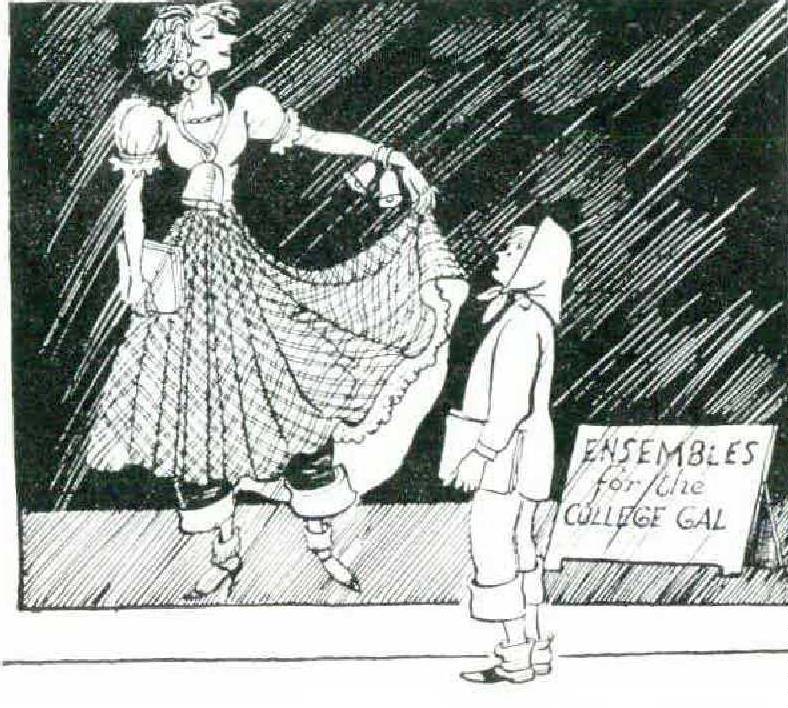
In spite of her heady, confident prose, that particular editor is not above the undignified squabbling that goes on in the pages of the College Issues. Two of her competitors came out strongly for the “ trouser-straight, pencil-slim skirt” and the “direct, uncluttered line.” She promptly sabotaged them with this recommendation: “To give ease and action to a narrow skirt, a checked red and wine tweed apron, cut on the bias and beautifully bulky, with a cowbell clanking at one side.” Instead of the usual bats, she seems to have bells in her belfry, for she told her readers: “Hang a bell in your ear, on your belt, around your neck, clip a cowbell at your waist, and Ring the Bell at College.” To this, a rival coolly replied, “The incoming frosh is urged not to wear cowbells in her ears.”
Wrapping its models in plaid coats, suits, and dresses, one magazine called for “plaids and more plaids and more plaids!” Another answered softly, “Plaids are most pertinent where they are unlikely: plaid shoes, plaid gloves, plaid hat ...” In this case, however, the reader should not have any difficulty in deciding which magazine to follow. The models displaying the unlikely plaids look pertinent enough, but they are posed all alone, whereas the gals covered with plaids have attracted scores of College Men who lounge around the edges and in the backgrounds of their pictures.
One of the hottest controversies concerns the question of Separates. (“Separates” is the fashion-language word for the skirts and shirts that every girl has been wearing since the age of seven.) Four of the magazines are sharply divided as to whether the top and bottom should match or not. Two say they should, “for the neater, newer look.” Two say that “helterskelter” is much more fun. The fifth - the same one that took the cautious line on plaids — dodges the issue, hiding behind such inconclusive phrases as “skirts-and-shirts can be undoubtedly as elegant as any understatement made” and explaining rather loftily that the elegance is a matter “of your ability to put one and one together (with a good belt) and get a clear, crisp, authoritative costume.”
If there is little agreement among the magazines on how a girl should look good, there is no agreement at all on what she should look like. One of them announced, “This is the moment of the Grand Gesture, by the women to the men. After years of admiring now and again (a pink shirt here, a sweater there) this year we fall completely for everything he wears. His Chesterfield, his Oxford flannels, his odd tweed jacket, his hats. . . . This fall, the trend is stronger than ever.” In order to “borrow from the boys,” the entire editorial staff of this magazine “invaded such sacrosanct strongholds as Yale, Princeton and other male campuses” and brought back everything from “his key-chain,” which they made into a “ jangle-dangle necklace,” to, apparently, his scalp, which they made into “Crew Cut Fabrics . . . the furry, glossy brush of the boys’ crew cut heads.”
Meanwhile, another magazine was announcing that “suits grow more ladylike all the time.” Still another liked the idea of borrowing from the boys, but found Yale and Princeton too sacrosanct, and timidly stuck to the public domain with an “English Schoolboy’s Jacket — lifted off the back of Henry James’ precocious youngster in The Innocents.” How is American History going to take on a new fascination if the incoming frosh does not know whether she is supposed to look like a college boy, a lady, or a Jamesian youngster?
Those editors who scoured various male campuses for His fashions to translate into Her terms did not, unfortunately, confine their scavenging to institutions of learning. A gal who followed their advice would find herself setting out for college attired in a “Convoy coat, originally worn by the British Navy,”which “recently made its appearance in The Third Man,” plus “a hat that comes straight off the polo field” and “a suit suggesting men’s semi-formal morning clothes.” Her shoes would be “a shameless steal from our favorite men on campus,”and she would be carrying “a concierge umbrella, exactly like a French doorman’s,” and “a campus slicker copied from New York’s most distinguished doorman, at the Plaza.” The editors claimed that the boys “cheered when they saw these clothes,” but that seems highly unlikely, especially if the wearer had shortened every sleeve so that her wrists were dangling four inches below her cuffs.
In addition to these excesses, disagreements, and bickerings, the College Issues are guilty of tossing out irresponsible statements which further upset the already confused Fashion Picture. “Commonsense fashions have a way of spreading from East to West or West to East,” said one of them, and it is common knowledge that this statement has had a paralyzing effect on the flow of fashion. Girls on Eastern campuses don’t know whether to copy girls on Western campuses, or whether the Western girls should be copying them. And vice versa. While there is still some spreading from North to South, no fashions are moving at all between East and West, in either direction.
It is inevitable that the Big Five will lose the confidence, and the subscriptions, of all gals everywhere if these contradictions and confusions continue. Some sort of Self-Regulating Self-Censoring Central Committee must be set up to arbitrate disputes and to impose minimum standards of clarity and responsibility. Let us hope that the 1951 College Issues will show, by presenting a more united, less quarrelsome front, that action along these lines has been started.