Accent on Living
HEREWITH a few off-season notes on the wonders of television: —
One of the terrifying capacities of the human animal is its ability to get used to almost anything. Noises, scratchy underwear, bad art, hay fever—it makes no difference how uncomfortable or outlandish some detail of living becomes, a man can still learn to live with it. Worse, once he gets into the swing of living with it, he begins to become attached to the wretched thing. Years later he will look back mistily on some bakery doughnut that he had fallen into the habit of eating for breakfast. “They don’t make doughnuts like that nowadays,”hell say, and he’ll mean it.
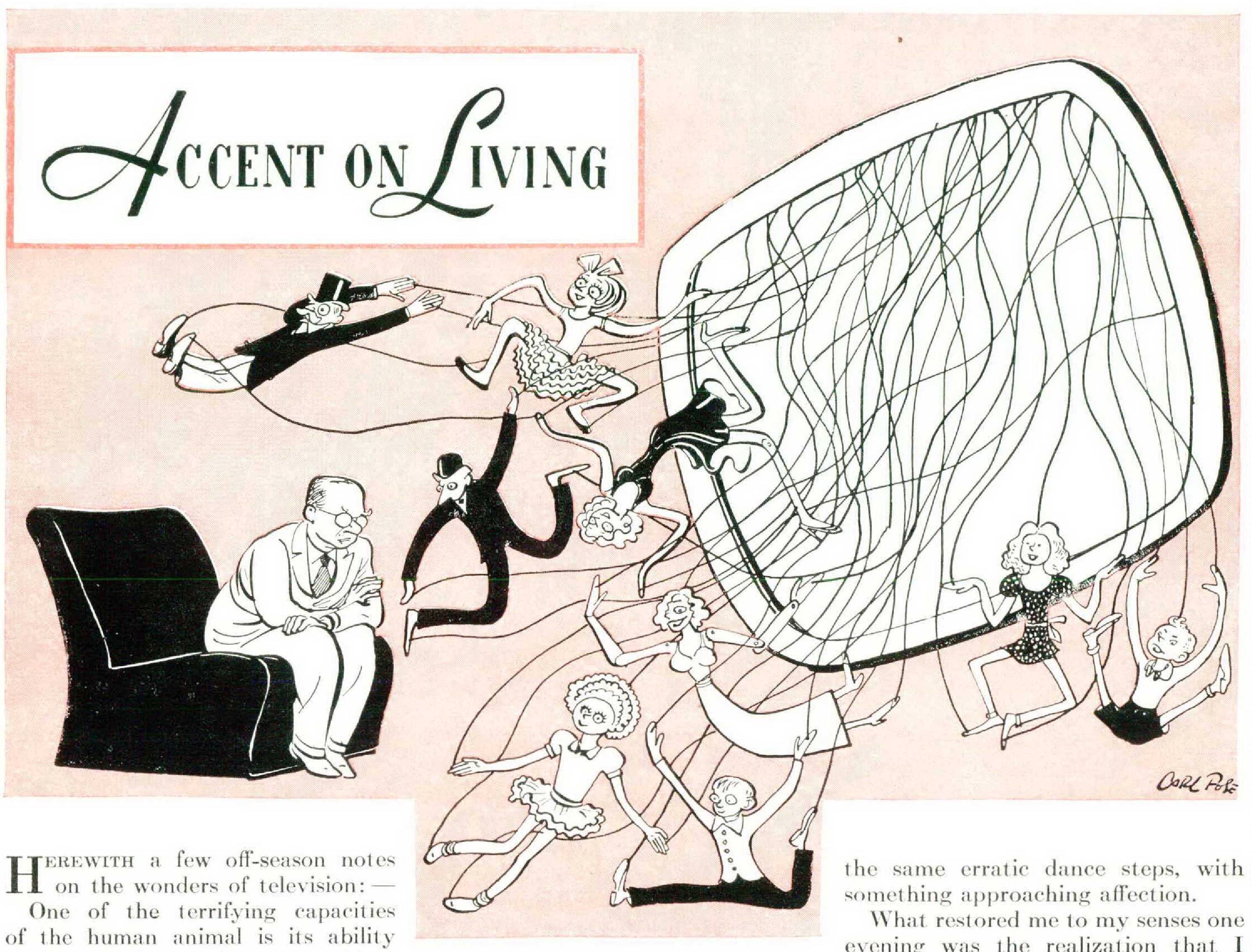
I became aware of just such a tendency in myself when I fell into a routine of catching each night a TV weather report. TV being what it is, it obviously would not do to broadcast the next day’s weather and let it go at that. Not at all. This bulletin came in the form of a sponsored playlet. It began with an overblown commercial for a bank. Music followed, a gay little air. Then curtains parted, disclosing two marionettes. The man marionette looked like one of those sculptured roués featured on Esquire’s cover — same mustache, spats, natty outfit, and beckoning eyes. The girl was bosomy.
Instead, I repeat, of just giving me the weather, these two marionettes were obliged to deliver it through an elaborate song-and-dance routine. “Oh Mis-ter Wea-ther Man.” sang the female automaton, while alternately soaring through the air and dragging her legs in what passes for dance steps among marionette lovers.
Mr. Weather Man — for such was the Esquire roué, spats and all—teetered back and forth meanwhile, before picking up his own cue to soar and drag his legs. He soloed the weather report while the girl swayed on her cables, and the pair wound up with a duet in a veritable cat’scradle of moorings.
Now nobody in a state of ordinary mental health would strike up a friendship with this Weather Man, but I found myself looking forward to him, humming the music, watching the same erratic dance steps, with something approaching affection.
What restored me to my senses one evening was the realization that I was no longer paying any attention to the weather report itself. I was growing dopey. How pleasant, my musing went, to be a marionette dressed like an Esquire cover roué, with nothing to do but sing—or rather, have sung for me by the artificer — a simple verse about the weather. What about the weather? I was ceasing to care. I was marionette-happy, going a bit glassyeyed, humming, not yet beginning to twitch and drag my legs, but well on the road to wooziness.
I switched for a few days to a man with weather maps and a pointer and much talk about “high" and “low" situations, but it wasn’t the same. At that point I gave up TV weather altogether.
A similarly narrow escape was reported by a woman as we sat watching a Sid Caesar show. The sponsor, a frozen foods company, used a man — or a child 1 — masquerading as a bear to point up the commercial with knowing gestures. The bear came capering out, pointed to the can of frozen juice, hopped around, and exited capering.
“It gives me the creeps,” said the woman, “but I found that I was actually liking that wretched bear. Now I don’t look at it any more.”
Radio in its mature years was rarely able to use child performers. Back in the cat’s-whisker days, when anything would suffice, the kid vocalists, fiddlers, and piano-thumpers were a handy filler. But there was nothing to play off against the fact that they made horrid noises — no well-coached smirks and simpers, no toothy grins. You had to imagine the cowlicks and the dental omissions, and most radio listeners couldn’t muster up that much saccharinity for indulging the little so-and-sos as lowbudget entertainers.
Television solves that problem with the theory that because we can see as well as hear these wretched children do their stuff, we will be won over by their appearance. I realize that some of our incredulity is thus diminished: those who had doubted that such children existed, or that their parents would expose them to the sight of others outside the family, or that the noises they made came from a human agency and not some malign spook in the transmitter — such skeptics can see it all with their own eyes on TV. Worse, the art of tap dancing is added to the musical repertoire and TV is giving us both barrels. The children can not only whine such classics as “Body and Soul” but also throw in a bit of clogging and soft-shoe work at the same time.
Even TV needs a gimmick of some kind on which to hang a kid show. It wouldn’t do simply to admit that they were out of talent or hard up and had to lower the draft age. Thus the kid show is usually disguised as something like A Half Hour with the Star Makers or Stars of Tomorrow or a similar overstatement. The idea is that these kids have been scouted out from hordes of talented competitors as the very best the country holds. On this proposition, one can only conclude that the nation is in peril.
I had never thought to see the day when modern science plus production genius in this the richest land on earth would be serving up to me as the triumph of the twentieth century:—
A nasty, greasy-faced, fat, selfsatisfied girl of eight, with a fifteendollar permanent and the standard number of front teeth missing, beating out on a piano—with variations — “The Glowworm.”
CHARLES W. MORTON
- It is still hard to toll on TV whether you are looking at a midget, giant, adult, or child, this being one of the dilemmas posed by a “life-size” image on a 17-inch screen.↩