Advice to Sports Writers
by EDWIN NEWMAN
EDWIN NEWMAN is a former State Department correspondent of the United Press who is now in the London bureau of the Motional Broadcasting Company.
FOR the last three years, courtesy of the Marshall Plan, Britons have been crossing the Atlantic and returning loaded down with American techniques for their industries. The traffic all has been in one direction, but the New World also can learn from the Old, and I propose to give one American industry — sports writing — a bare idea of what it could learn in Britain if only it would.
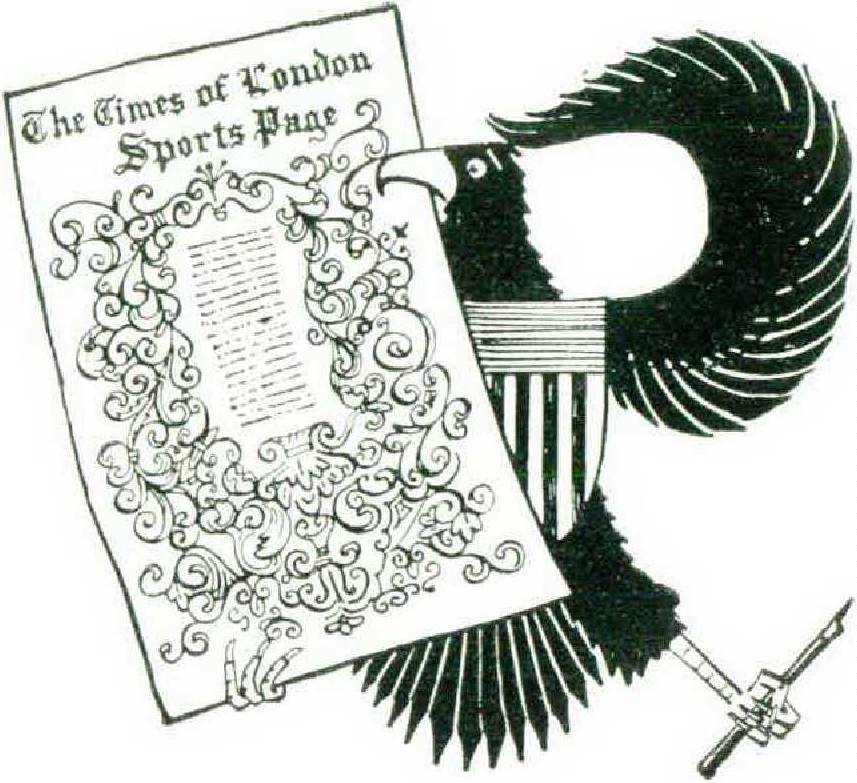
The Times of London, referring to a man who had been left more than 2 million pounds, thought it a fair comment that he was “not unendowed with the world’s goods.” It also has remarked editorially that “to plunge into a third world war would not be the best means of defending peace.” Since this style extends to its sports pages, this is the paper from which American sports writers unquestionably can learn most.
Take its pre-game story on the AllEngland soccer final. It begins plainly enough: the King and Queen will be there, the match is between Arsenal and Liverpool, it will be played in Wembley Stadium, it is the 69th such final. With that, however, the Times man is off: —
“The teams will be birds of a strange plumage, indeed — Arsenal in shirts of old gold and white trimmings; Liverpool in white with red facings. But the disguises will in no way cloak the simple fact that once more the ritual of a Cup Final will have been set in motion.”
Having reassured those who might have thought that the new colors meant that the Final would not be played, he continues: —
“A crowd 100,000 strong will be ranged about the curving, elliptical basin of Wembley, its clear rim far up, cutting the sky. Yet beyond that, and beyond exact computation, some millions will be there in spirit, linked by radio and television with this scene; for the Cup Final, like the Derby, the Grand National, and the Boat Race, is a sporting event of national interest that draws a whole people together.”
Letting fly an “alas” — and knowing precisely when to let one fly is among the most highly specialized techniques in all British writing — the Times man yearns for “ Kennington Oval, first home of the competition, where once the crowds, removing the horses from the shafts of Lord Kinnaird’s carriage, drew the great man in his vehicle to the entrance of the pavilion for one of his nine appearances in the early finals.”
He admits, though, that Wembley also has its points: exquisite velvet turf, community singing, the solemn moments of “Abide with Me,”the feeling for ritual, the controlled excitement — “seldom has an afternoon passed there without its full share of dramatic upheaval.”
By this time, perhaps, the reader could not be blamed for losing the thread. This the Times man is able to sense.
“Into this atmosphere,” he says quickly, “now sharpened by a North v. South motif, will stride Arsenal, twice winners of the Cup, and Liverpool, who have yet to lay their hands on the trophy.” And rather reluctantly, he mentions the teams’ records, their personnel and playing styles, and their chances.
The man who wrote this story must be admired. He has burned his bridges. He has left himself nothing for next year.
The Times cares nothing for that old, spent rule about packing as much important information as possible into the first sentence. Note its approach to golf: —
“Walton Heath with a blue sky, a hot sun, and a cooling northeasterly wind before which the young birches bowed their heads in their new green liveries — what better conditions could anyone desire for the watching of golf?” The question is purely rhetorical, and the Times golf correspondent goes on: “This was the second day of the Daily Mail golf tournament, the end of which would see a sad chopping off of heads before the final two rounds on the third day.”
Which heads were chopped off, which were not ? Only the most pedestrian sports writer would tell. Instead: “As the hours wore on with comparatively few low scores, it seemed that Walton Heath had the better of the argument and the qualifying scores would be high.” Here there is a diversion to describe a round played by Alf Perry.
Presently, on the thirty-third line, we are informed that Perry’s tworound total was 142, which gave him a two-stroke lead over Ward. On line 84, after a detour in which the Times golf correspondent remarked that Ossie Pickworth of Australia was the man he most wanted to see and that he was not disappointed - on line 84 we are told that Pickworth came in with a 73 and was only one stroke behind Perry.
It is, naturally, in cricket, which has produced a vast literature of its own, that the literary allusion really flowers. Nobody writes reports on cricket; the essay is more appropriate. Thus, the Times correspondent from Sydney, Australia:
“Once more your messenger enters to report a setback. But not, be it noted, with the sickening self-satisfaction of his ancient Greek counterpart whose probably sole delight was to catch the King in a moment of rare happiness and to tell him with sadistic prolixity that his summer palace was burnt to the ground and that his mother, in whose continued existence the King still fondly believed, was even now crossing the River Styx, then to leave the bemused monarch to the beard-waggings and breast-beatings of an ancient and admonitory chorus.
“No, the chorus will be controlled. But the King will recover, perhaps within the week. He has done so before. In short, our cricketers out here are like many fighters of repute. They need to be knocked down first. It is partly a matter of temperament. Their performance against Queensland just before the first Test match was too bad to be real. It is hoped by Australian as well as English spectators that the same may be true of their current performance at Sydney. After two days of play, M.C.C., with three batsmen gone, are still 479 runs behind an Australian eleven’s total.”
Precisely how this style should be adapted to baseball must be left to the men who cover that sport.
What can a boxing writer learn from the Times? To keep an eye open for the dramatic, the philosophical, and the patriotic: —
“Hopes and fears were nicely balanced in the chief contest at Harringay last night, with rather less intense feeling intermittently aroused by the efforts of the novices engaged in a heavyweight competition.”
So! The novices engaged in a heavyweight competition aroused only moderately intense feeling. There’s an opening to quicken anyone’s interest. Would any American have thought of it ? Let us carry on: —
“The interest in the two chief bouts also was nicely divided, though, in the titular sense, it was clearly more important that Terry Allen, the Islington flyweight, should win a world championship recently given up by Rinty Monaghan than that Danny O’Sullivan, the bantam champion of Great Britain, should acquire a European title as well.” This may appear to overlook O’Sullivan’s feelings in the matter, but he probably would be biased. Anyway, the Times man has established the relative values of the two bouts, and he continues: —
“Both were confronted by sufficiently formidable foreign boxers, and Allen’s opponent, Honore Pratesi of France, had once out pointed him over ten rounds.” Now he looses the dull fact: “This time, in a tiring rather than punishing fight, Allen won, and deserved to do so, on points.”
This information digested, what, an American might ask, of O’Sullivan? Granted that it was not so important for him to win. Still, we might be given a clue. No, that is not the way. There must be first a strictly chronological account of the AllenPratesi bout, covering 575 words. Then: —
“The fight between Danny O’Sullivan and Luis Romero of Spain, a southpaw with a devastating punch in either hand, had a hair-raising start. It remained hair-raising to round 13, when Romero was declared the winner.” After 300 words of another round-by-round account, there are two lines for the novices engaged in a heavyweight competition originally mentioned 1000 words back.
The Times is not alone in its learned approach. Ear from it. The Daily Telegraph, for example, has written that one boxer’s immense courage enabled him “to give perhaps a quarter of a Roland for an Oliver.” It even turns up on the air. A BBC announcer once described a fighter as “a better puncher qua puncher” than his opponent.
What, summing up, is the chief lesson to be learned from British sports writers? The answer, clearly, is to suppress any inclination to unseemly haste. Here is a last example of how it is done, from the Sunday Times, which is unconnected, except in spirit, with the other Times: —
“It being impossible even in this age of speed to be in two places at the same time, I devoted part of a perfect Saturday afternoon to the White City, and part to the Chiswick Stadium.
“At the former,” the story goes on, “the first London Caledonian games ever held in London provided food for all tastes. I confess with shame that I have never yet seen a Highland games meeting on its native heath. I intend to remedy the deficiency at the earliest opportunity. There was a most impressive opening ceremony which did not seem in the least out of place, and the ‘call to the gathering’ made spectator, dancer, official and athlete alike feel that they were sharing in a fine common spectacle.”
Three more paragraphs — equally absorbing — follow, and then it comes: “Later in the afternoon, E. MacDonald Bailey won the 220 yards in 21.1 seconds. If this time were to be recognized, which is unlikely, it would beat by one-tenth of a second the British record made by W. R. Applegarth in 1914.”
It’s hard to resist the feeling that Bailey should be ashamed of himself for intruding at all. Getting that reaction from one’s readers is the ideal for which to strive.