Father of the Twins
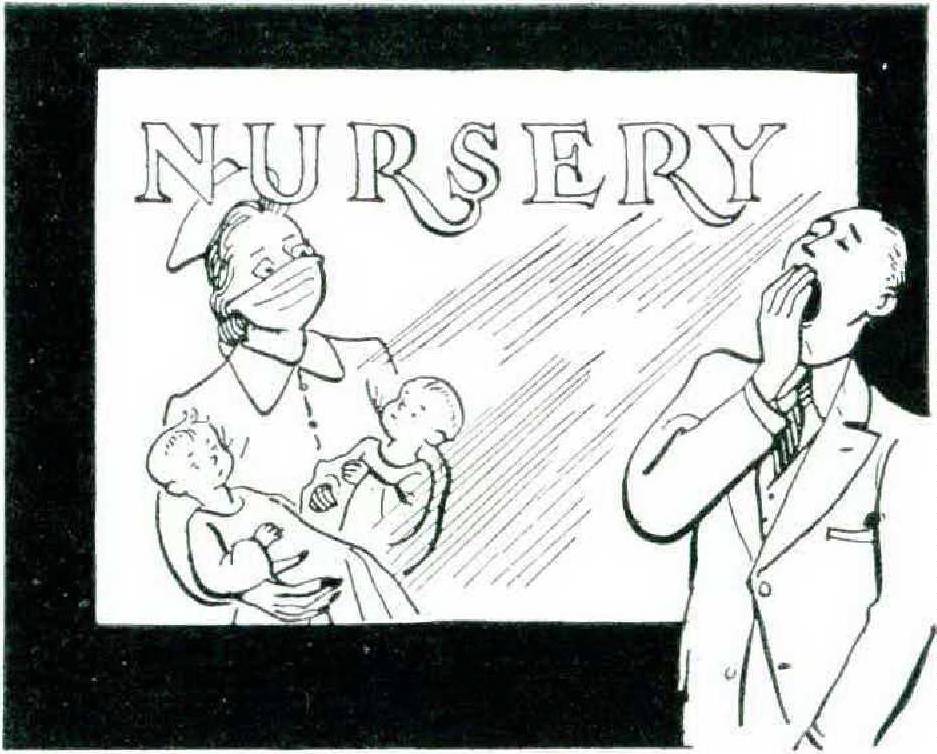
by PAUL H. ROHMANN
PAUL H. ROHMANN, a native of Brooklyn, New York, and a graduate of Antioch College, is now assistant manager of the Antioch Press, a printing and publishing house associated with the college.
I GOT my first inkling of what I was in for the day my wife returned from her five-month scrutiny at the clinic and brought the obstetrician with her. This was in itself no unusual token since he is a near neighbor and good friend even when not needed professionally and it was the end of his office hours for the day. But the two of them were assuming an air of mystery. I didn’t understand it, because we already had two small sons.
“Let’s all have a drink,”my wife began.
“Sure,” I said, “but not for me. I’ve got to work tonight.”
“Go ahead. You’d better have one anyhow,” said the doctor.
“ Nope. Not even on a doctor’s proscription,” I answered, pouring out two drinks. “I don’t want to get muzzy.” I handed out the glasses and lit a cigarette. “Well, what’s new at the clinic?”
“Paul,” the doctor said portentously, “your wife is going to have a baby.”
“I know that. What do you think she went over to see you about? Dyspepsia ?”
“ In fact,” he went on, “she’s going to have two of them.”
“Is that right ?” I said.
“Now don’t you think you need that drink?”
“No, thanks. I’ve got to work.”
We went on to talk about how his suspicions had been aroused, how an X-ray had disclosed two heads — and, thank goodness, two spines — and the general excitement that had reigned at the clinic. When the doctor left I sensed a vague disappointment in his manner. I realized later — much later — that I had failed to live up to my part. Here I was in one of the world’s favorite comedy positions — the expectant father of twins — and I had not reacted in the expected manner.
The fact is that the possibility of twins is always in the back of an expectant parent’s mind and the actual announcement is as much confirmation of an unvoiced suspicion as it is surprise. Also, a piece of news of these proportions takes a while to sink in. The first reaction is simply, “Gee, that’s swell.” Then later, one by one, all the ramifications sink in. One day when our three-year-old was particularly obstreperous I suddenly thought, “In three years we’ll have this same situation t—doubled!” Again, while going to sleep one night, I calculated the number of diapers to be changed during a normal day. In the midst of the daily struggle to get the two boys ready for school and nursery school I would wonder, aghast, how it would be when there were four children to bundle off each day. And so on. I might add at once that the realities so far have not proved as dire as the prognostications.
All the same, I suppose I should have reacted more violently to the announcement. In the movies the father always faints or drops things, and who am I to go against the general cultural pattern ?
In due time I found myself settled in the fathers’ waiting room. But my calculations were off in one respect. I had figured that two would take at least as long as either of the singles had, and conceivably twice as long, but I was paged before I had got past the second corpse in the mystery novel with which I had fortified myself.
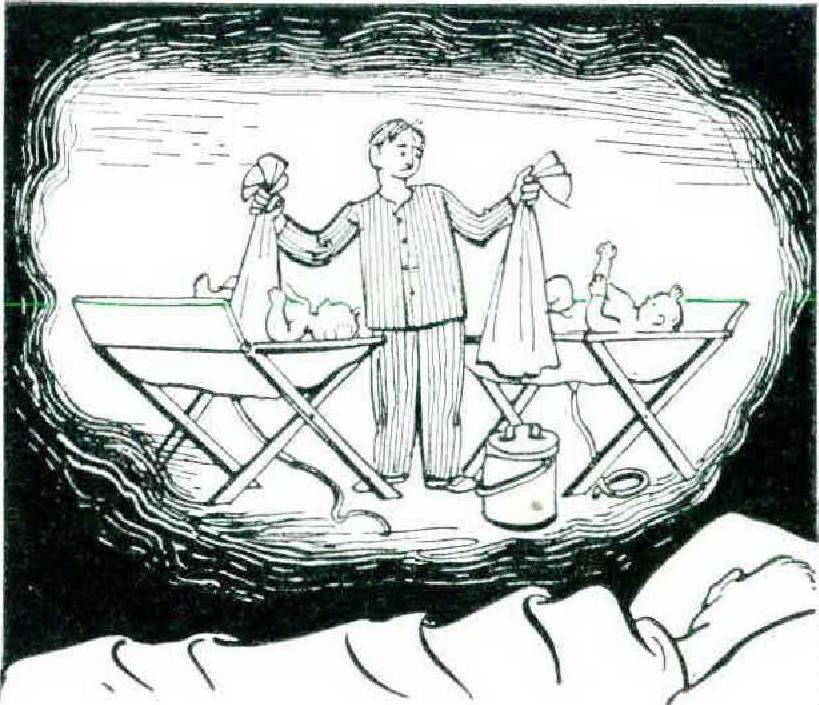
“Mr. Rohmann?" the nurse asked. Then, with a big smile, “ You may see your daughters now.”
“Daughters? That’s fine.”
I rose and followed, was introduced to the new girls, congratulated their mother, shot the breeze with the doctor, drove home, phoned the grandparents and siblings, went to bed, and finished my book.
My wife informed me later that I had again failed to live up to the role I was supposed to play — An Expectant Father of Twins (low comedy part). My failure was evidently the talk of the nurses’ home. It seems I should have been at least twice as excited as the normal expectant father, or as the normal expectant father is expected to be. All the fathers-to-be I have encountered in hospital waiting rooms have been morose fellows given to chain smoking, staring moodily out of windows, or doing crossword puzzles. In addition, nothing is more discouraging to the free play of emotion than a hospital waiting room late at night. But the maternity ward nurses — who knew it was going to be twins, who knew I knew it was going to be twins, and who probably know more about how expectant fathers really do act than anyone else — evidently thought the least I could have done was a mild sword dance in the corridors. Poor things; if I had known how much they counted on it I would have worked up a display for them.
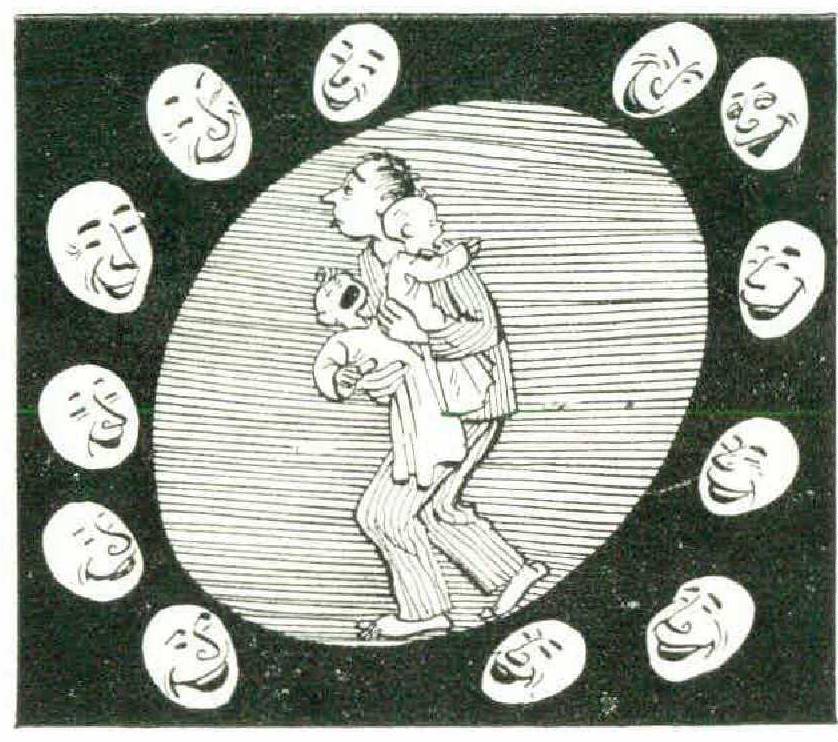
After that I tried to live up to my part as far as I could judge what it should be. I did such accepted things as giving out pairs of cigarettes instead of cigars and interlarded my conversations with feeble witticisms about “double trouble” and “seeing double.” It was tough going but people seemed to appreciate it. Actually, I doubt whether I need have done anything. The initiative was taken from me; I was typed and could do nothing about it. When people hear you have had a baby, they smile. When they hear you have had twins, they laugh.
During the month after the twins were born, chance acquaintances and total strangers stopped me in the street to ask how the girls were doing and how it felt to be the father of two at once. Nobody has any idea of how many jokes have been made about twins unless he hears them all within the space of a week, as I did.
Most of this sort of thing died down in due time, but I got echoes of it all during the first year. For instance, the girls have been healthy and well behaved, gave up their 2 A.M. feeding at a reasonable age, and have given us very little trouble at night. But if anybody sees me yawn during the morning, I am bound to be regaled with, “What’s the matter, Paul? Been up walking the floor with the two of ‘em? Yuk! Yuk!” Even parents who, like us, have seldom had to rise during the night to soothe an infant seem to consider it natural for a father to spend all his nights pacing the floor with his baby. And the image of a man pacing the floor with two babies is excruciating.
I should have mentioned earlier that the girls are not identical twins in either appearance or personality. They look about as much alike as any two random babies of the same age — no more. And yet the visitors invariably ask, “How in the world do you tell them apart ?” It is the favorite line in the play we find ourselves in. Our answer, depending on our relationship to the visitor, varies from, “Oh, a parent gets to know them quite well,”accompanied by a simper, to a curt, “Take another gander and see for yourself.” This applies only to adult visitors. Children, candid by nature, take one look at them and say, “Aw, they aren’t twins at all.”
It has taken my wife and me some time to catch on to all the preconceptions and clichés regarding twins, but we learned in time and even came to use some of them for our own ends. As I mentioned before, the girls have never given us any nighttime trouble and after a few months it was perfectly all right to leave the family in the care of a baby sitter — although most sitters blanched at the prospect. But we found that when an invitation for an evening out came along which appealed to neither of us we had only to murmur, “Well, I’m not sure. The twins, you know—” and the refusal was immediately accepted with profuse understanding.
We have had a selfishly pleasant year socially.