Accent on Living
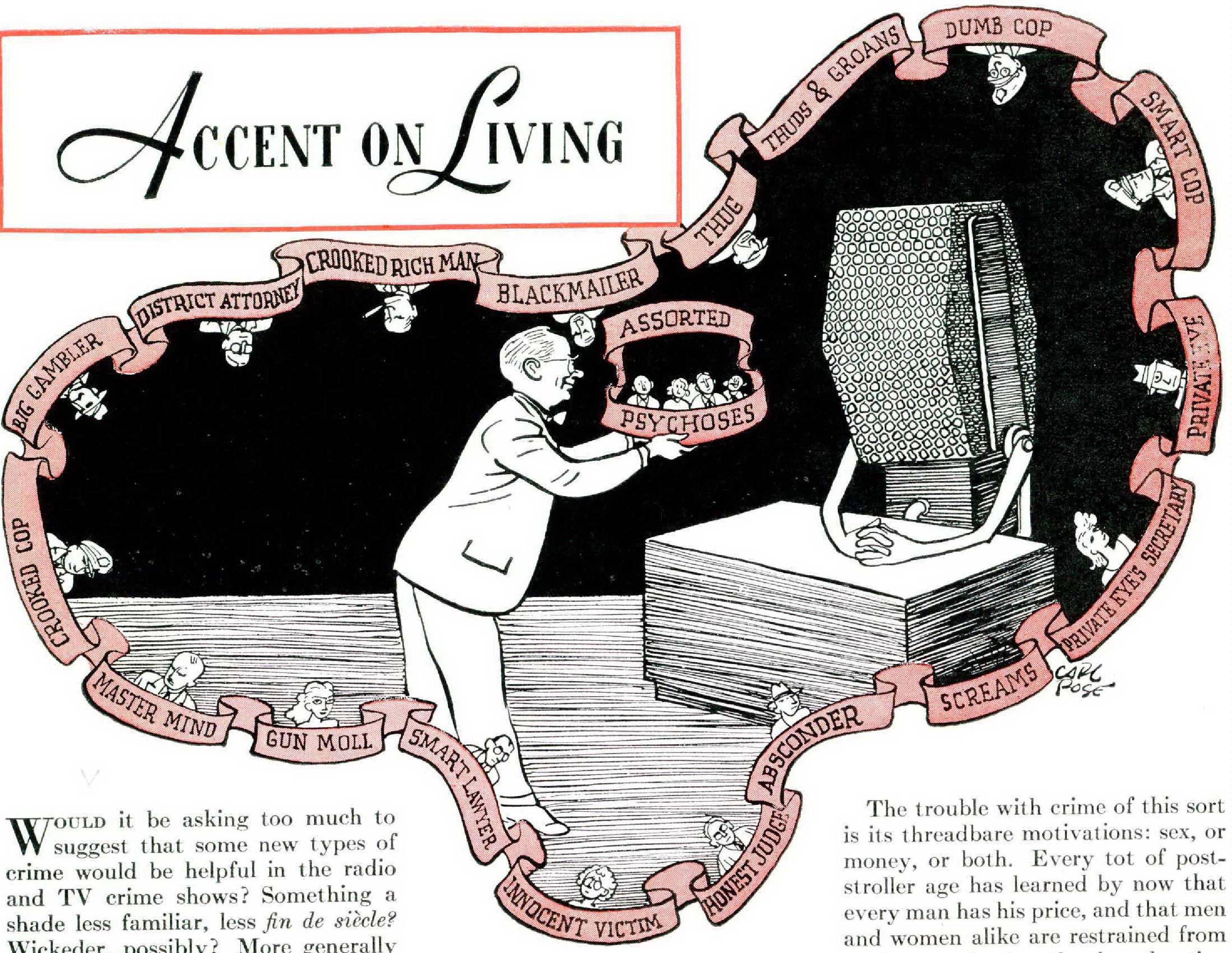
WOULD it be asking too much to suggest that some new types of crime would be helpful in the radio and TV crime shows? Something a shade less familiar, less fin de siècle? Wickeder, possibly? More generally damaging?
Criminality is still the backbone of broadcasting, and I have no intention of belittling its status as the greatest single asset of the air waves. The incorruptible judge, the spouse of indubitable virtue, the bank cashier who is not and never was a horse-player — these are hardly in the heroic mold long since taken for granted by the radio audience. Such characters would lack plausibility, I realize, and it would be terribly poky for the script writers to have to drag in the artificialities of a make-believe world where people speak grammatical English, carry no firearms, and keep their cash in a checking account. Again, without tough criminals, there would be no tough cops. No tough cops, no tough Private Eyes, and then where would radio be? What would happen to society?
But I discern a certain sameness in our crime-entertainment. One squeaking door sounds much like another. The thud of blackjack on glabella (or occiput), and the ensuing groans, are the same from one studio to the next. Fiendish laughter is still fiendish laughter, whether it comes from the crooked District Attorney, the crooked president of the Nirvana Trust Company, or from Blackie Slam himself, a real cardcarrying crook.
“Okay, Slam — drop that heater and face the wall!”
(Thud! Smack! THUD!) “Oo-oo-o-oh.”
(THUD! THUD!!) “ Ee-e-e-e-aha-a-a-ah.”
“Fooled yuh, didn’ I, shamus? Heh-heh-heh.”
These situations must seem humdrum by this time even to the most aggressive of us. The boredom in Blackie’s voice as he wields the cosh is not simulated. He’s in a rut and he knows it. So are the listeners, the technicians, the sponsors. And in the blowoff, when the Private Eye — whose head has been neatly fitted together again by his faithful secretary — rattles off the denouement, all hands are just as fed up with the story as he is.
The trouble with crime of this sort is its threadbare motivations: sex, or money, or both. Every tot of poststroller age has learned by now that every man has his price, and that men and women alike are restrained from adultery only by the broadcasting code. Naturally the will was forged, naturally the race was fixed, naturally the blackmailer double-crossed the victim. So what! Violence helps to while away these half hours, but it’s always violence for the most transparent reasons.
Yet even as broadcasting fondles the well-worn themes of criminality, a far richer vein of “drama” lies untouched and ready at hand. I refer to the broad field of lunacy, hitherto entered only fitfully by our entertainers and on a relatively limited basis.
The proposition that every American is a crook would be enormously vitalized if broadcast entertainment, could also show him to be a schizophrene with as many fancy psychoses on the side as the script writers found convenient to assign to him. Plots and “situations” would become not only more complex but also highly unpredictable. The sameness, the tedium, would vanish before novelties that fairly stagger the imagination. Consider, for instance, what might become of Lt. Grim of the Nirvana police department.
Grim is a crook to begin with. Well and good. But he is also an undiagnosed schizophrene — half crooked cop, but with the other half believing himself to be Catherine the Great. As a crooked cop, Grim is, into the bargain, a fetishist, a pyromaniac, and he suffers from a morbid fear of handling public telephones.
Into Grim’s orbit, possibly for a mere parking violation, comes Harrison J. Ravenel, crooked rich manabout-town and split cleanly down the middle into one-part dilettante and one-part turret lathe operator. Ravenel is also a food faddist who eats nothing but graham crackers and blackstrap molasses. His preachments to this effect send Grim, who has been daydreaming about blinis and caviar in one of his Catherine the Great intervals, into a frenzy. Grim gives Ravenel a classic radio beating with full sound effects and locks him up in the tank.
Meanwhile, word of Ravenel’s plight reaches his fellow turret lathe operators, a highly organized group and all crazy as loons. They are led by lovely Dixie Swanson, a paranoid and jury-fixer who believes that she is desired in marriage by Grim, who has in fact never heard of her.
Under Dixie’s leadership, the turret lathe operators set fire to the plant and march on the police station.
Such a plot might veer in almost any direction. How would Grim react, for example, to having his head put through a few turns on a turret lathe? Far more noisily, one suspects, than he would to the tiresome blackjackings and pistol-whippings that we have all heard so often. And what of lovely Dixie Swanson, languishing on Ravenel’s graham crackers and molasses, prisoner in a penthouse filled with Old Masters, scrap metal, and whirring machinery? Would Ravenel’s parking ticket case ever reach a jury? Would Grim burn down the courthouse?
No nursery school toddler is likely to tick off the answers to that kind of question in a hurry. Broadcasters, the way is open! A new epoch awaits you! Floreat Dementia! CHARLES W. MORTON