Tourist in Argentina
by RAOUL SIMPKINS
RAOUL SIMPKINS is the pseudonym of an English resident of Paris who has recently been traveling in South America. He has been a frequent contributor to these pages.
POSSIBLY Juan Perón, President of Argentina, is unaware of the fact, but a lot of people in that country — several hundred thousand, I should think — are blatantly disobeying his orders. And with a dictatorship, that is rather a bad show. In all the hotels, bars, and restaurants there hangs a notice. “By order of the authorities,” it says, “all tipping has been abolished from October 1, 1945.” Tipping abolished? Can this be true? Hats off to Perón, surely? Read on. “Instead, the amount of the bill will be legally increased by twenty-three per cent as a service charge. Aside from this, employees are forbidden to accept any tip.”
Twenty-three per cent! Even in the best of European luxury hotels, fifteen per cent is the highest for service. Nor does it stop there, in Argentina. The employees, naughtily ignoring their president’s wishes, still continue to accept propinas in the same bad old way, explaining — which is doubtless true — that the twenty-three per cent is simply used by the hotel or restaurant to pay their wages.
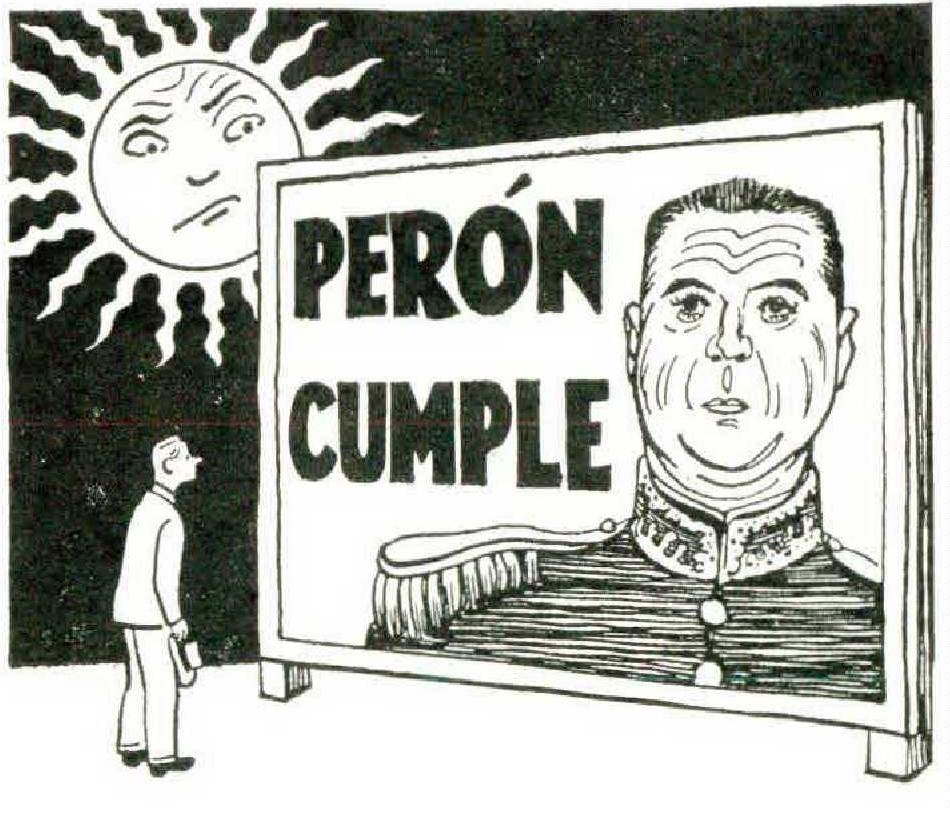
So that’s one thing that Perón can’t chalk up for himself. But he is busy claiming many other credits. Everywhere — in Buenos Aires itself and out in the countryside — I encountered vast billboards alongside public work projects. “Perón cumple!” they cry, in huge black letters. Meaning “Perón did it!” And sometimes, by way of variation, the second line reads, “And Eva dignified it,”a graceful reference to the First Lady.
The building projects and the big blocks of flats for “workers” that have gone up in the capital are certainly badly needed. For a country that has not suffered a major war in recent years, Argentina in many ways is just like a country that has. The appalling crowding of public transportation, the chronic lack of taxis, the log jam on the air lines, the wheezing dilapidation of the railroads, taken over from British control a few years back, and the enormous difficulty of making a hotel reservation at a spot like Mar del Plata, Buenos Aires’ Atlantic City, is all reminiscent of a post-war boom.
I wanted to go to Mar del Plata myself, as I thought it would be fun to meet the sailor from the Graf Spee who had recently broken the bank at the government-run Casino there (by strictly legal means). But when I mentioned this desire to the hall porter in my hotel, adding that I purposed to travel the next day, the fellow gave a merry laugh. “Ah, you English are drolls,” he remarked. “For Mar del Plata you would have to reserve on the plane two or three weeks ahead. And once there, señor, who knows when you could return? No round-trip reservations are ever made nowadays on any of our trains or planes.” This seemed so odd that I investigated. It’s true enough no round trips! Just one-way!
There is a frightening shortage of telephones in Argentina. To be on a waiting list for as much as four years is taken as a matter of course. And the practice of shifting the telephone you already have when you move to another house or flat is not. allowed. You must start again from scratch. I was sitting in the office of a newspaperman one afternoon, in Buenos Aires, when a man popped his head round the door and said something in Spanish. My friend reached up and heaved over a vast switch on the wall near his silver-painted, candlestick telephone, and the other man disappoured. “We share a telephone,” explained my man. “That’s a business office next door and they pop in and ask me to switch over. It’s the partyline system — but awkward somelimes when they are trying to clinch a business deal and I am trying to get a story.”
As I stood in a Buenos Aires street at three o’clock in the morning watching the buses go past, all as crowded as if it were the rush hour and all bearing the Completo notice, I said to a friend with me, “What are all these people doing up at this hour?” He said, “Perón has raised everyone’s wages and most oi them can’t think what to do with their money. So they rifle back and forth on the buses.”
Later this same friend was driving me along in an old Ford, 1936 vintage. I noticed several times, when we stopped fora traffic light, that men would step eagerly forward and mutter something. “Who are they? I inquired, “They are making offers for this car,” he said. “I bought it for 3000 pesos in 1946. I could get 30,000 for it tomorrow.”
The car situation is bad and leading to scandals. In line with the Perón “self-sufficiency” policy, all car imports have been halted. To get a car into Argentina, even if you bought it yourself while abroad and are perfectly prepared to fulfill all legal requirements, pay the steep tariff, and so on, requires such a monstrous battle with red tape that, most people give up. One man I met has had his new American convertible all crated up and waiting across the River Plate at Montevideo for nearly a year. Nothing doing. But the official at a small legation who has been bringing in six Cadillacs a year, under diplomatic immunity, and reselling them at fabulous profits is, it is confidently stated, on the verge of comfortable retirement.
This economic xenophobia of Perón’s leads to the strangest black markets. Doormats, for example. The operators have cleaned up nicely on doormats, which are, or used to be imported. In consequence mats are usually kept on a chain, or else brought out specially for the honored guest, like a bottle of rare wine.
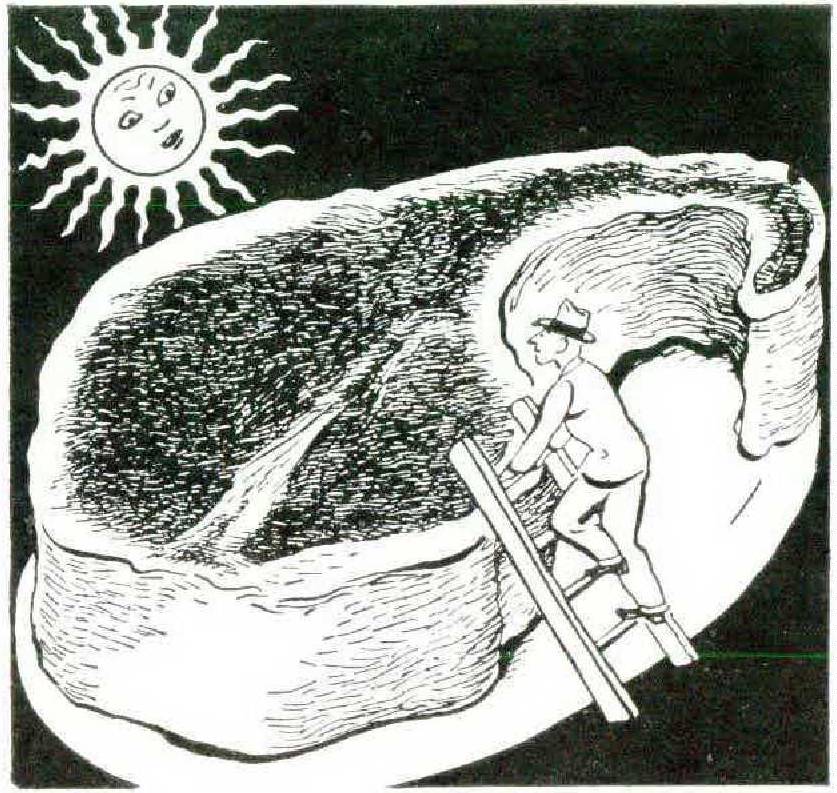
The meat consumption in Buenos Aires is staggering. I soon wearied of the steaks and caused surprise by clamoring for chicken and fish, for one thing, the Argentines are not verygood cooks. And the scale of their meat cutting is so heroic that I found it tending to rob me of my appetite. Order a T-bone and you will have planked down in front of you a great slab of flesh which could satisfy three men — but which, in Buenos Aires, is quite often taken care of by a woman giving a solo performance.
I went to an asado, an Argentine barbecue, one Sunday afternoon, and it was small wonder that afterwards the company, neglecting a very fine swimming pool on the premises, mainly stretched out under the eucalyptus trees and went to sleep. A peon had been at work on the victuals for several hours. He worked with a large and elaborately compartmented grill, set at a slope, over a slow charcoal fire. Besides straight cuts of beef, you could have sausages (very good these), spareribs, and flaky hot pasties which were a sort of cross between sausage rolls and mince pies — delicious. Your plate satisfactorily loaded up, you made your way over to a table set beneath the fig trees. Here the men were placed at chairs and the womenfolk fluttered dutifully about us. I was plied with vermouth, salad, fruit, cakes, and cheese, the whole irrigated by red wine in great profusion. I felt it the next day.
No visit to Buenos Aires would, as the saying goes, be complete without a look into the Jockey Club. A member showed me something of the ornate lushness of the place. It cost $2,000,000 to build in the eighties and is the quintessence of Victorianism. Here, beneath several superb Goyas or over the drinks in a charming bar, the members had some hard things to say about the regime. In the club museum they keep the skeletons of many a famed old-time race horse, and I got the impression that they wouldn’t at all mind adding one or two human skeletons to the collection. The members, who are all of great substance — most of them cattlemen — do themselves well. I here are 225,000 bottles of vintage wine in the cellars: there are 40 cooks, and in all 1328 employees. I was sorry not to see the club’s premises out at the San Isidro race track, which include a swimming pool for horses only. (Humans are expressly forbidden its use.)
The policemen, who wear jack boots and sky-blue collars and ties, resemble graduates of an SS division who have wound up in a musical comedy having social significance. To direct traffic, they climb up ladlers onto little covered-in platforms, Clearly men who worry about, the sunshine, they are not content with the roof over their heads but, for extra protection, wear a great white thing like a nun’s veil as well. They go home to lunch — probably steak.
Several times as I walked about Buenos Aires I heard men’s voices calling out the word Malvinas! About the fourth time it happened I was accompanied by an Argentine friend, and I said to him: “Malvinas must be a most popular girl’s name around here?” He looked uncomfortable and said, “I am afraid it is no girl’s name. You see, it is what we call the Falkland Islands, and these men, having spotted you as a Britisher, are shouting to suggest that you let us have them back.” As Confucius might have put it: “Lucky is the man who, through ignorance of the language, remains unaware that he is the object of a public demonstration.”