Escorting the Cow
RIXFORD KNIGHT, who lives in Jamaica, Vermont, has provied Accent on Living readers with the more exotic fcts about goats, pigs, and hens. He now takes up a point of etiquette which has long tormented all thone who own a cow.
by RIXFORD KNIGHT
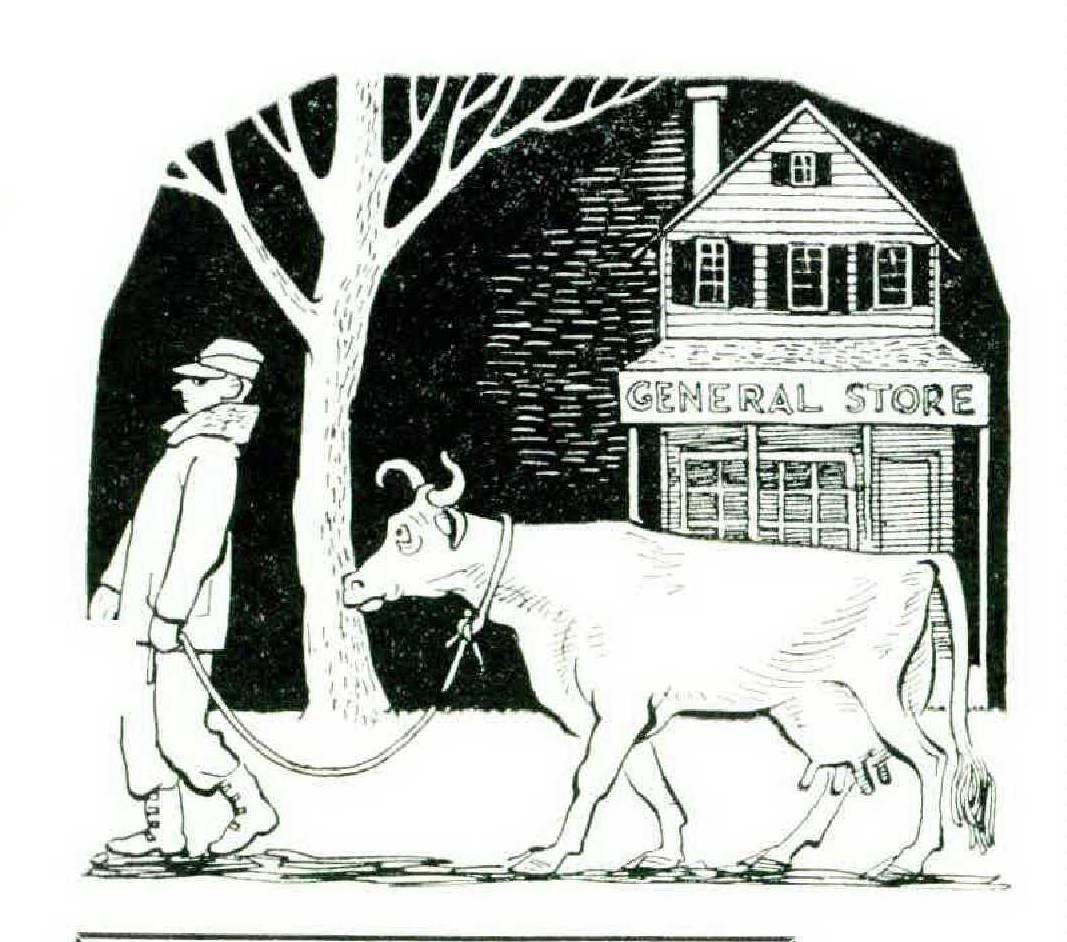
MOST cattlemen, when conducting their cow along a country road, either keep in front of their cow and yank on the rope to make her go faster, or hang onto the rope from behind to make her go slower. My own practice, however, is to walk along side by side with my cow, accommodating my pace to hers and letting the hand holding the rope rest lightly on the cow’s thigh. In this way I avoid having to walk directly in line with my cow, cither before or behind. Nevertheless, even this method has its physical hazards, as I found out when my cow, catching sight of a clump of red clover offside of the road, swerved suddenly and jerked me, holding the rope, against her hipbone, cracking two of my ribs.
I assumed at once that my injury, or rather the manner of receiving it, was unique among cattlemen. I suspected too that its uniqueness was not of the kind that would excite awe or sympathy among my colleagues in the cattle business in case they got. wind of it. Therefore I explained to the doctor, who was something of a cattleman himself, that my misadventure had been caused by slipping and falling against a fence post.
But while he was taping me up the doctor told me that he himself had once broken the same pair of ribs. He had been taking his cow along a country road. She had veered suddenly, jerking him against her hipbone.
When I heard this I saw that my injury was by no means so atypical as I had supposed. It seemed probable that dozens, even scores, of cattlemen throughout the nation had had a similar mishap but were keeping it under their hats like a secret sin, for reasons like my own.
And to support such casualty figures there must be hundreds, even thousands, of cattlemen who prefer not to walk directly in line with their cow but who are unknown to one another because each, when about to meet another on a country road, slips quickly ahead of his cow and strides resolutely there till around the next bend.
But the result of this simulated boldness is only that those cattlemen fool one another. They are never able to hide their timidity from those hardened cattlemen who habitually walk before or behind their cow.
Whenever a side-walking cattleman has to conduct his cow past the village store he will, of course, demonstrate his intrepidity by striding ahead of her with never so much as a glance behind. At the same time, he can never forget that an animal has a peculiar ability to detect irresolution on the part of its master and that it is likely to take advantage of this. Therefore, whenever he feels the rope slacken, your cattleman executes a goosy withdrawal of his most vulnerable part accompanied by some quick little prance steps designed to regain the distance between himself and his cow. But the cow, feeling the consequent tightening of the rope, obediently quickens her pace, with the result that the rope again slackens, and the progress of the cattleman, past the village store becomes a series of hitches, like a switch engine with an awkward load, and calls forth from the fore-and-aft walkers on the store steps such observations as “A pretty dangerous critter that feller’s got there,”or even — knowledgeable of the purpose of the expedition—"He can’t hardly wait till he gels there.”
Every side-walking cattleman has, at some time in his life, wondered whether his timidity is an acquired or an inherited characteristic. Could he not, by constant practice, eventually train himself to walk intrepidly before or behind 800 pounds of cow? The answer is “No.” Once a sidewalker always a side-walker. Hope does not lie in the adjustment of the individual to the institution. But in view of my own accidental discovery it does appear possible that something might be done through the organized effort of hundreds, even thousands, of side-walking cattlemen in the way of adjusting the institution to the individual.
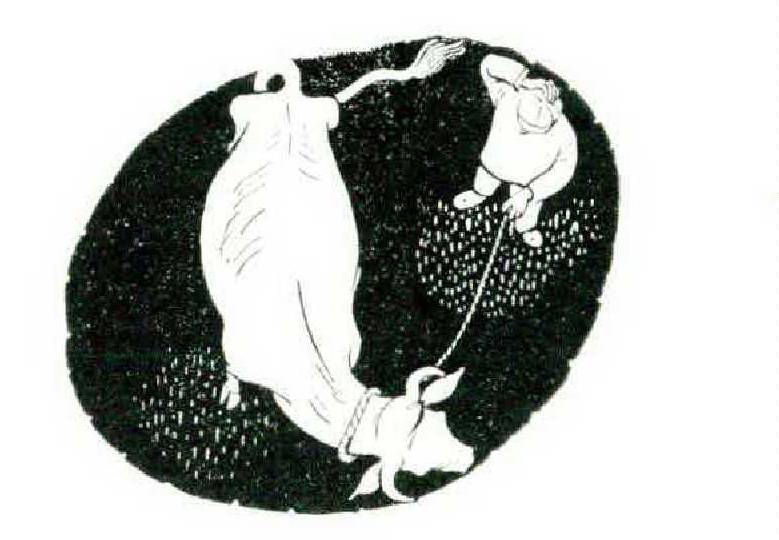
It is evident that the customs and mores governing the conducting of a cow along country roads have been fixed by those cattlemen who habitually walk before or behind her. But whether these actually constitute a democratic majority among cattlemen is now open to question. Also in question is whether the customs instituted by these cattlemen are in the best interests of the group as a whole.
The entire matter stands in need of critical review.