Sherry
MACKIALEY HELM is among the most versatile contributors to the Atlantic. which has published his writings in the fields of biography, fiction, the fine arts, and travel. He spent four months in Spain last year,and now brings us an account of the wine and brandy industry in Jerez,
by MAcKIALEY HELM
YEARSS ago in Venice, at a still impressionable age, I read in John Buskin’s Praeterita, from the chapter called “Papa and Mamma,”of Papa Buskin’s partnership with don Pedro Domecq of Jerez in a business concerning Spanish sherry and brandy. I was touched by Ruskin’s account of the friendship existing between his father, who handled important British accounts in his own ponderous person, and the Spanish landlord who cultivated inherited vineyards in southwestern Spain. Their trustful relationship, as short-winded as it was fruitful — its fruit, remember, enabled the Englishman’s son to live at the fabulous Hotel Royal Danieli while he sketched and measured the stones of Venice — seemed to me to represent the utmost in nineteenthcentury probity in the world of affairs.
Two or three exchanges of letters resolved a year’s problems in a business running to hundreds of thousands of pounds. Papa Kuskin, who could shut his eyes and identify wines by taste and olfaction, mysteriously anticipated the tastes of the persons of property, the peers of the realm who bought Domecq sherries largely. In a brief memorandum to Don Pedro in Jerez, he suggested that next year’s British buyers would undoubtedly lay down wines a shade darker (or paler) than last year’s consignment, and a little younger (or older). Perhaps the handwritten note would reaffirm the English partner’s primary requirement, namely, that every drop of export brandy and sherry, of whatever variety, should he nothing short of incomparable. Don Pedro, a Spaniard as proud as himself, and as honorable”—so John was to write — complied with the elder Ruskin’s demands and suggestions in every particular.
John Buskin’s graphic account of the partnership stayed alive for a number of years in my mind, so it seems, for when in due course I set up my own household and began to buy sherries, I sampled the whole list of American imports from the house of Domecq. I came to prefer the dry (fino) wines for myself, though I like champagne sweet. I liked the vinos de prnio and amontillados; and, as it happened, I did not by any means give the first rank to the most costly varieties within the fitto, or dry, category. To suit other tastes, I liked also to have the richer sherries on hand: the medium dry amoroso,s, the soft, sweet olorosos with their golden fragrance. They were all pleasant to decant and pour out. .
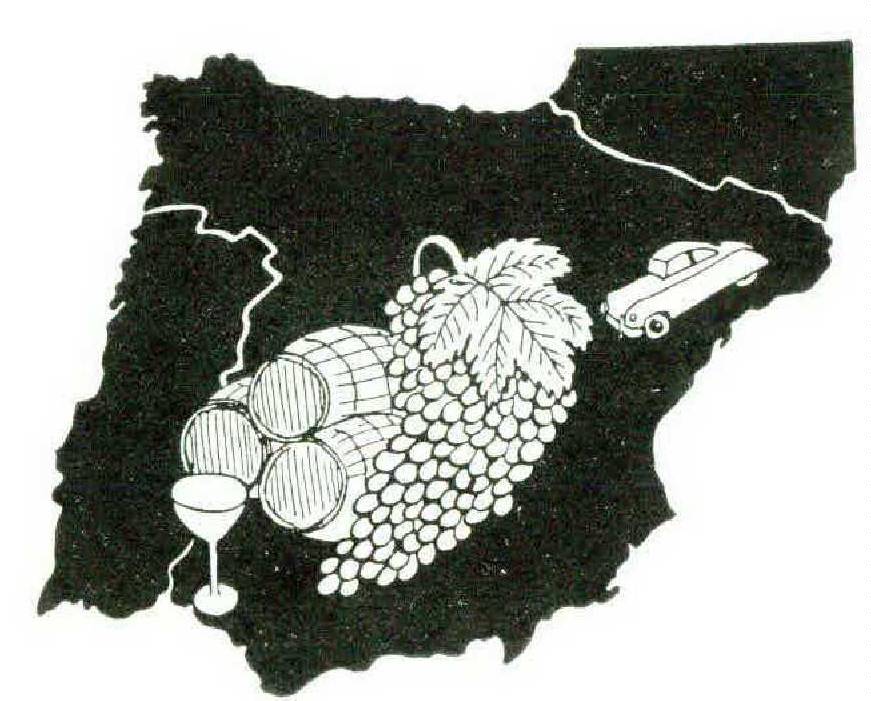
Having thus disclosed an old-fashioned addiction to the habit of sherry, perhaps I will not sound out of key when I say that I felt a high degree of excitement when my wife and I set out by motor from Cádiz, on a sunny late-winter morning, bound for the wine cellars of Jerez. We skirted the south rim of the blue Bay of Cádiz, headed north, caught sight of an arrow that pointed the way to Jerez and Seville, and within an hour we reached the city where Don Pedro’s descendants still bottle sherries the like of which have tickled men’s palates for more than two centuries. (Two export olorosos, clover sweet, picture-frame golden, have been celebrating Domecq’s bicentennial for some twenty years.)
You do not. actually see, on the highway from Cadiz to Jerez, any considerable part, of the 15,000 scattered acres of vineyard which lie between the seaward reaches of the two southern rivers, the Guadalquivir and the Guadalete. You drive, instead, through vast ranches where brave bulls, toros bravos, are bred for the bull ring, and past fields of wheat. (These we saw wholesomely green again, in the winter, after long years of drought.) The black stumps of grapevine prepare their green buds in the calcareous soil of the rolling back country, in the dark clayey soil of the bar r os (loosely, mud banks) southwest of Jerez, or in the arenas, the sandy soils near the sea. So that when you begin to smell Jerez de la Front era, you might, if you had not been briefed on its principal industry, be perplexed by the sudden and overwhelming odor of grape.
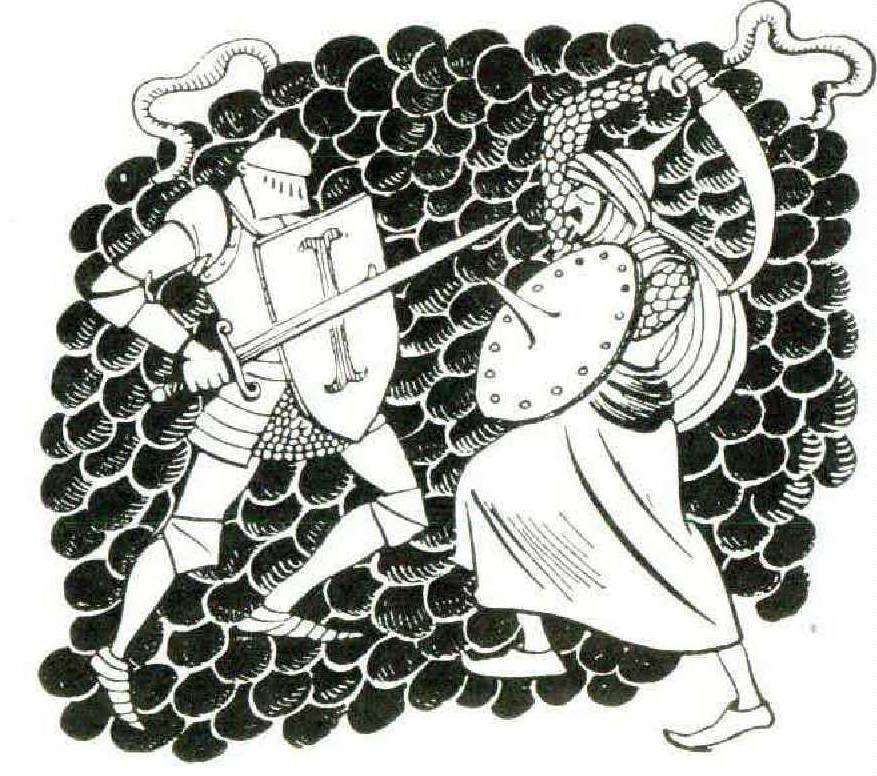
What you unmistakably smell on approaching the city is the fruity effluvium of the ferment of pressings which give off the substance of “sherris,” as sixteenth-century England called the white wines of the formerly Moorish city of Sherish: Good sherris sack ascends me into the brain, dries me there all the foolish dull vapours, says Falstafi (in King Henry IV). The Moorish vineyards were made to produce wine and not sugary raisins aft er Alfonso X stormed the city in 1264 and set out to eliminate the old Moorish culture. El Sabio, as this Alfonso is known, made such a clean job of it that one finds the puritanical age of the Moslem dominion reflected in present-day Jerez only by inference, as in the Gothic church of San Dionisio, brightly embellished in the Mudejar manner: which is to say in a Spanish style employing such Moorish invention as brick paneling, tiled domes, and tiled or mosaic dadoes and fountains. For the rest, the history of Jerez — the Roman and Visigothic Asido, the Castilian raid, the Moorish recapture—has been swallowed up by expanding warehouses, the aromatic bodegas of The Brothers Sanchez Romaic, Gonzales Byass & Co., Domecq, and the others, good Christian establishments all, and devoted to restoring the vine to its God-given use.
We followed our noses through the delectable fumes and presently introduced ourselves at the Domecq headquarters, at the end of a winding sycamore driveway. On the strength of our stated attachment to the house and its products, we were hospitably put into the hands of a youthful employee who had learned British English without stepping out of the province of Jerez. Sehor Gonzalo Marin Ruiz de Ojeda—at our service! — was a small, compact young man with black hair, a glossy mustache, and a spontaneous smile. The latter assured us that we would be no trouble at all to the staff of Don Pedro.
Our arrival was not strategically timed for a scientific inspection. The bottling departments were shut down for the two-hour midday rest and lunch period and the 2000 workmen were already lining up for their second daily capita of manzanilla — a fight, dry, tonic wine which takes its name, meaning camomile, from the pleasantly bitter aftertaste which it leaves on the tongue. Don Gonzalo explained that the crew is served with drinks on the house at eight in the morning, at midday, in midafternoon, and at six-o’clock closing, and observed that few of the men, tor this reason, spend any considerable part of their daily wage, which is less than a dollar, in the public cantinas. (It might also be supposed, though this never was said, that they would likewise be less disposed to dip and drink, while on duty, from the costlier barrels of sherry and brandy.)
The time of day thus conniving to put us promptly to work in the sampling division, where visitors more often conclude a scientific tour of the works, we walked past the queues of thirsty employees and repaired forthwith to the brandy bodegas. We first of all fell to work, all of us, upon about three ounces apiece of a sixty-year cognac called Carlos I in honor of one of my particular heroes, the first Spanish King Charles, perhaps better known to our world as the Roman Emperor Charles V. The antique brandy was tenderly lifted out of its cask in a small cylindrical metal cup (a venencia) fixed to the end of a length of wire and bravely poured into tulip-shaped goblets. In pouring from dipper to glass in a stream which I judged to reach eighteen inches at the height of its flow, the veteran maestro spilled not a drop of the precious brandy, however breath-taking the flourish with which he gave light and air to the liquor he drew from its dark, quiet pool.
The dusky, dank cellar grew perceptibly warmer and brighter as we sipped this good brandy. Then with Don Gonzalo as guide and narrator — and as fellow-taster — we worked our way up and down through many varieties: up to the 150-year-old Nelson, Fox, and Napoleon and down to my favorite bar brandy, a fine champagne which is sold by the case at the plant for around half a dollar a bottle and is retailed in Spanish bars somewhat more cheaply than coffee. (What with taxes and all, Domecq’s Fundador sells, alas, at above five dollars a bottle at home in America.)
We sampled the more ancient brandies in minute globules mixed with wine, the maestro pouring the heavy opaque liquors into the slim, tapering, crystal goblets — catavinos — prescribed by Spanish etiquette for the consumption of sherry. Holding the stems between thumb and forefinger, the old man rotated the filled glasses gently so that when he returned the dark distillations to the casks they pertained to, a few drops would adhere to the sloping sides of each goblet. To these droplets the maestro then added a dry, almost transparent sherry, and we tippled Nelson and Fox and Napoleon suavely dispersed in this straw-colored vehicle.
After working an hour or two in the brandy department, we went on to the neighboring sherry bodegas. There the maestro of the wine-tasting division, a lean family man about thirty, dipped and poured skillfully from rusks containing every gradation of dn and sweet sherry, the sparkling streams ranging in color, as they splashed from the dipper, from palest straw through buff, bay, and tawny to the sunlit campania browns and the ochers. We worked long and hard at the sampling, yet it was never suggested that we might be approaching the finish, the pay-off, the ultimate tasting. On the contrary, the cellars were endless and we endlessly sipped the penultimate copa.
By the time we had drunk and approved of almost too many penultimate sherries, it became apparent that the slim-bellied maestro was beginning to feel that he needed his dinner. We mumbled something expressive of leaving and requested Don Gonzalo to offer the man a glass of good wine in our name, with our thanks and our blessing: whereupon the dipper and poorer, pleased as well with a tip of a day’s pay or thereabouts, showed us photographs of his family, joined our ranks as participant taster, and pressed us to take additional glasses of sherry in each distant corner of the damp vaulted cellars.
For each export name I was able to mention, we had, in the sum, a taste of the product under its Spanish label: long drafts of a fino called Guitar in America, an elegant, pale dry wine which Americans sometimes overlook because it is cheap (it costs less than two dollars); Guitar’s dainty and costlier sister. La Ina; a flowerlike amoroso known at home as Delicia; the full-bodied and storied wines known as Celebration Cream and Double Century. A subtle Jandilla with no exact export equivalent proved to be Klizabethan in content, a wine to warm the blood and make it “course from the inwards to the parts extreme. We even good-naturedly sampled a wine which would one day be called “drissuck" locally, a mixture too prankish to own a Spanish name and equivalent.
Dry sack is ambiguous. Sack is not, never was, a dry wine, as Dr. Johnson well knew, though other lexicographers have tried to derive the name for it from sec or seco. The more sirupy versions of the wine called dry sack by shippers— I believe never by vintners — find a ready market in England, where 70 percent of the sherry runs thick and hearty, though not quite so sweet, I was told, as in Papa Ruskin’s time. The vintners will tell you that England still calls lor dry sack and drinks sweet, while American taste, so the don Pedro Domeeq of our day informed me, runs 70 percent on the side of dry wines.
Don Gonzalo obliged us by explaining t he confusing disparity between the domestic and export labelingof the Spanish sherries. Spaniards, like Frenchmen, want to know where their table wine comes from. If it is an Albariza, for instance, does it come, they inquire, from the Garrascal region, the Balbaina, or the Macharnudo in the lime-white hills west of Jerez? If a Maeharnudo, Is it Upper or Lower? A very great wine, lor example, is a Maeharnudo Alto from the Río Viejo.
In addition to isolating the region, the Spanish connoisseur likes to know , if he may, the specific domain producing his bottle—though he realizes that vineyard bottling has nearly everywhere given way to the (generally better) standardized system of blending and bottling used in the warehouses of Jerez. For a party, he is likely to think there is nothing more snobbish than, say, a Vino de la Baza from a nobleman’s vineyard, and it makes him feel good to serve it. The foreign consumer, on the other hand, though he may be sufficiently acquainted with France to fuss over the claret and Burgundy labels, is not often familiar with Spanish regions and vineyards. The export sherries therefore bear names and labels intended to tickle his fancy, make him think of Iberia. . . .
So what with tasting and talking, the four of us worked our way into deep afternoon. We learned that Don Gonzalo had acquired a bicycle, as much a mark of success in his country as a car in America, We heard that his marriage would follow promotion and we hoped both were imminent, the boy a capable, well-met fellow and the dark-haired girl in his wallet. decidedly pretty. We listened, above all, to good talk of the grape: the “while" Palomino, sweet, topaz yellow: Pedro Ximonez, rich in grape sugar: the fat Muscatels from the sandy regions. Each processed grape has its seasoned lover.
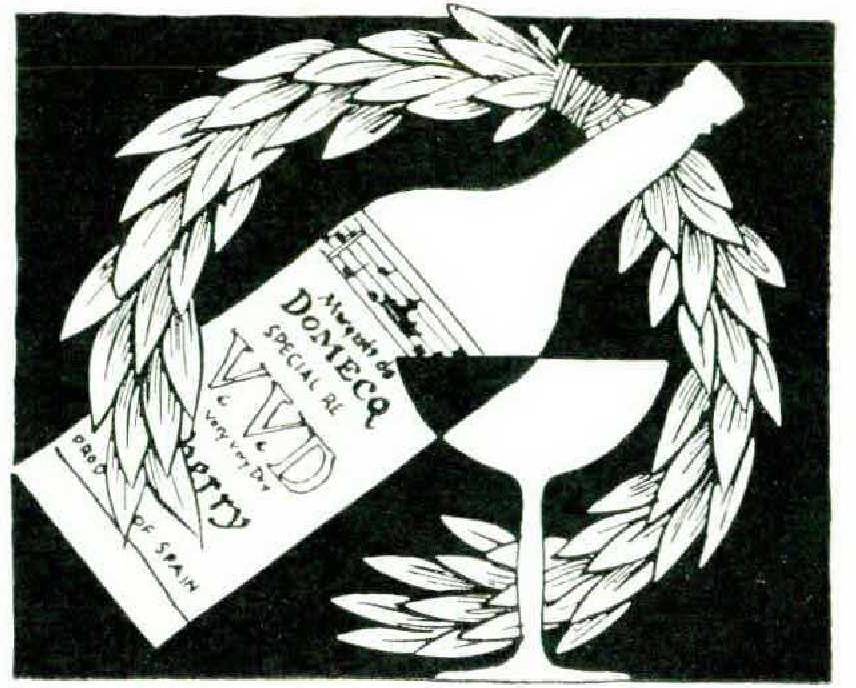
In September, the harvest is sprinkled with gypsum and pressed in the nighttime by the spiked hoots of treaders. The new wine is fortified, after fermentation, by substantial additions of good, wholesome brandy. In the big plants of Jerez, the bottling is standardized by the blending of old and new wines from the highpiled 500-liter casks in the cellars—casks coopered from sound American oak; so that such color as the colorless pressings acquire from contact with the wood and not from the chemist is American color. This thought somehow pleased me.
Before we took leave of our good friend Don Gonzalo in a shower of vinous presents that rained on us all, we were coaxed, imreluetanl, to pay a last visit loan innermost chamber in the most ancient bodega, and what a bibulous holy of holies it was! The scented barrels of sherry were ornamented with the names and crests of historical persons. The Spanish royal family was well represented, beginning with Carlos III, the first Hispanicized Bourbon, and ending with Alfonso XIII and the Infanta Eulalia. Alba and Primo do Rivera and Franco had lent their names to old wines as Nelson and Fox and Napoleon had done in the case of old brandies. And while we fondled our truly ultimate intemperate copus, I spied, through a barely transparent screening of cobwebs, a moist, bearded cask on whose beaded head I spelled out the name of old sobersided Papa Ruskin himself.