Halls of Ivy
by EDWIN O’CONNOR
EDWIN O’CONNORhas written several articles about radio for these pages. His the author oj the novel published last year, The Oracle,the central character of which is an omniscient and thoroughly fraudulent network commentator.
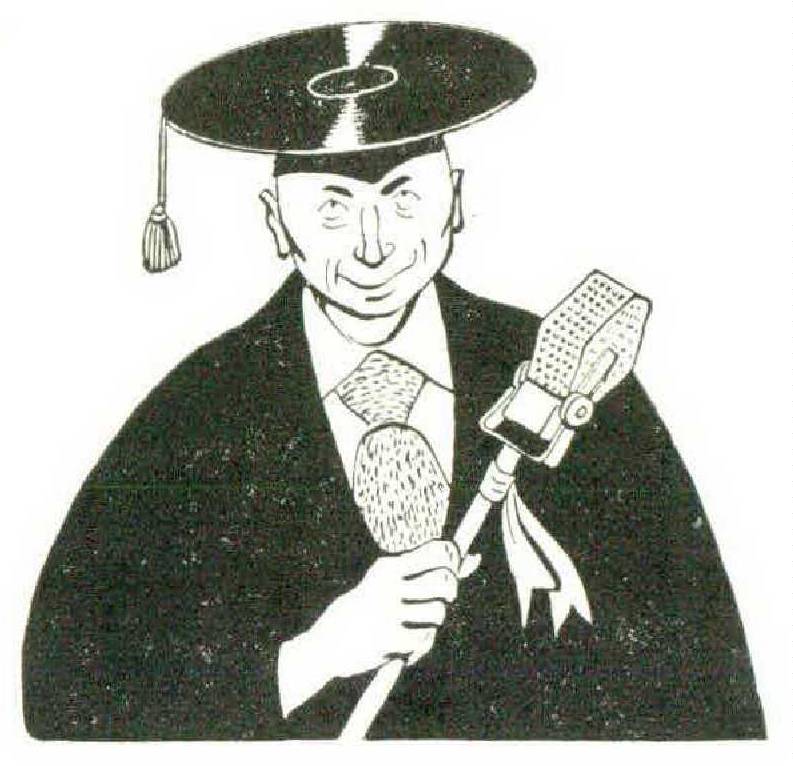
ONE morning not long ago, as I prowled, hot-eyed, through the radio gossip column of a newspaper, panting over each racy item—“No one, but no one, is more generous to her friends than Kate Smith, TV’s first lady of song”; “Red Skelton, beloved comic, earned his nickname because of his red hair” — I was distracted by a large advertisement adjacent to the column and oddly educational in tone.
“RIDE THE AIR WAVES TO SUCCESS!” it read. “Become a PROFESSIONAL DISC JOCKEY by going to SCHOOL! Enroll now! Study with established disc jockeys as your teachers! Be a GUEST DISC JOCKEY while going to school! Yes, FAME can come to you as a DISC JOCKEY if you register NOW. . .”
It had never occurred to me, before this moment, that disc jockeys prepared for their peculiar calling by going to school. I had heard them often on the radio, in the early morning hours, as they spun their records and talked over the telephone to admiring listeners; as they chattered about the great and the near great with whom, apparently, they were on the best of terms; and as they alternately commended or scolded important public officials on their handling of significant issues. And never once did I dream that all this was the Jruit of curricular training.
What, I wonder, can such a school be like? And the students: what of them? Is it possible they are sons of Old Alumni, enrolled at birth by their successful Disc Jockey Dads? Or are they simply ambitious young men who, eager for success, are willing to put up with the long academic training — Six weeks? Seven? — to gel it?
It is perhaps not impossible to imagine such a student as he prepares for graduation from this school. He is in his room, the night before the finals; he is about to rehearse for the big day. Clothed in a kind of official school uniform — a fawn-colored suit with preposterous shoulders, black knit tie gathered in a giant Windsor knot—he mirrors the elegance of graduate Disc Jockeys everywhere. His teeth have been capped in the eventuality of a television appearance. His name is, or was, Artie Pumple; in the interest of euphony, the faculty has suggested a simple and decorous change. He is now known as Conrad Mountbatten.
Wordlessly, he seats himself before a desk on which have been placed an unconnected microphone and a dummy telephone; he is rehearsing with props, to give himself confidence. His smile stretches as he prepares; suddenly be bursts into a strange, chanting rhythm. His voice is nasal, rasping, extremely loud: —
From the Club Stingaree, it’s . . . MOUNTBATTEN CHATTIN’!”
He has decided upon this as his signature: it is a simple, classical opening, one sure of approval. He repents the couplet in a voice only slightly louder, then abruptly reaches out and picks up the receiver in response to an imaginary ring: —
“Hello, I’m on the phone, MOUNTBATTEN CHATTIN’. . . . What’s that, dear? Will you repeat that, doll? . . . You say you think I have a marvelous voice? Full of charm? . . . Well, doll, that’s very very sweet of you to say so. . . . What? You say I sound just like Cary Grahnt? You say you bet I’m a graduate of Oxford College? Ha ha ha, dear, that would be telling. . .
As he talks he relaxes. his original nervousness ebbing. He realizes that he has struck at once the proper note of intimacy, so desirable in establishing rapport with the public.
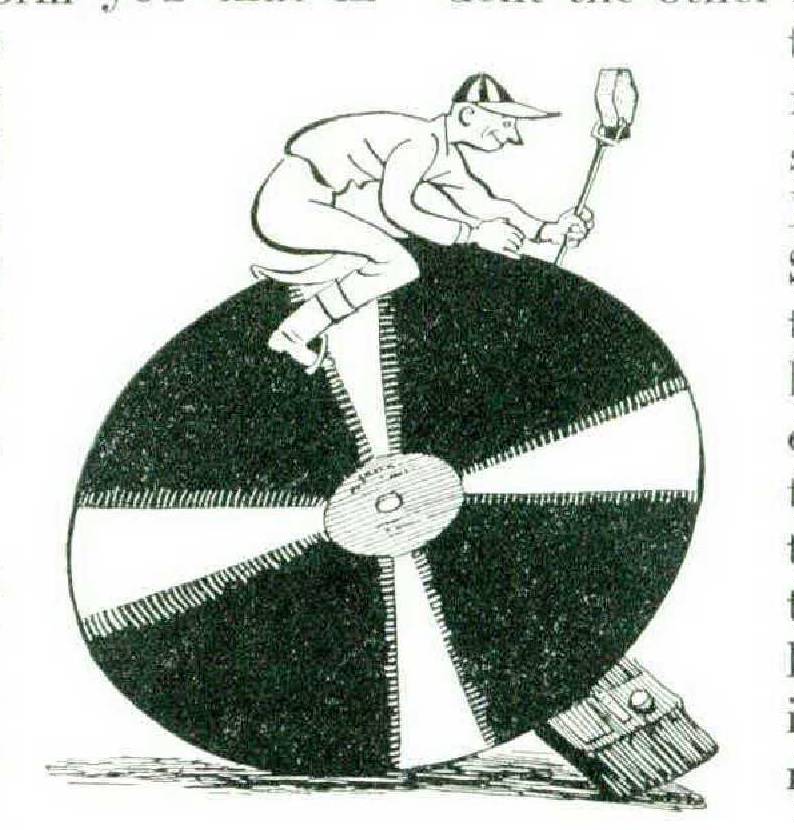
“What’s that, darling? You say I must be a very very charming person to have a voice like mine? Well, thank you very much. doll. . . . What’s that? You say you think all the girls must be crazy about me? Ah ha ha ha. Modesty forbids, darling, modesty forbids. . . .”
He breaks off suddenly, aware that thss preliminary phase has been mastered. He now sets himself a sterner task. In his mind’s eye, there is a woman on the other end of the phone; she has asked him to play a record for her. This is easy; he refuses in the standard manner: —
“I’m sorry, doll, but we don’t play requests on this show. Less platter, more chatter, that’s what your boy Mountbatten says!”
His lips tighten as he imagines the woman proving obdurate; he imagines she tells him that it is his duty to play what the listeners ask for. His reply is quick and curt: —
“Listen, doll, let me inform you of something. Let me inform you that in these troubled times the only music I feel it’s my duty to play is “God Bless America!” Which, incidentally, happens to be written by that great American and my very very personal friend, Mr. Irving Berlin!”
It is a stunning squelch, one worthy of the Great Disc Jockeys. He permits himself a small, selfcongratulatory smile; then, sobering, he continues to test himself. He has not yet touched The Arts; he frowns momentarily, then quickly picks up the receiver once more: —
“MOUNTBATTEN CHATTIN’. . . . What’s that, dear? You want to know have I read what best seller? You’ll have to speak up, doll; I read a very great deal and I don’t know which best seller you’re talking about. . . . You say have I read the sensational I Stole Stalin’s Overcoat? Yes I have, doll, and I think it’s tremendous. Let me tell you, doll, that in my opinion it’s the most important book to be written in the past twenty years. . . . What’s that, doll? You say do I think it’s a book you should let your little boy read? Listen, doll, it’s a book that should be read by every American, old or young, because it isn’t just a book; it’s a SEARCHLIGHT.”
It is a neat bit of handling; he pauses, justifiably proud of his performance so far. There remains Politics; it is, for the contemporary disc jockey, the critical area. Hurriedly, he goes over in his mind stern classroom lessons learned; bending slightly forward, he again picks up the receiver and prepares to meet the acid test:—
“HELLO, I’M ON THE PHONE. . . . Pardon me, doll? You say you want to know if I Like Ike? Yes, doll, I do. I hope I’ll always like all my fellow Americans who agree with me in my opposition to Communism. . . . Let me have that again, doll? . . . oh, you say you disagreed with my remarks about the President the other night? Well, dear, let me tell you something: this microphone stands for free speech. Any time the President of the United States wants to come on this program to defend himself, he’s at perfect liberty to do so. . . . What’s that? V ou say is he going to come? I can’t answer that question, doll; all I know is I’ve extended the invitation to him. It’s his move, not mine. . . .”

It is a brilliant stroke; he knows it. It represents the most Inspired work he has yet done; he makes a note to repeat it, word for word, before the examining board tomorrow. It is the apotheosis of name-dropping, yet it has been done with dignity. He is so excited In his success that he scarcely can compose himself to deliver, in grave accents, his closing, definitive words: ——
. . and so this has been your boy I Mountbatten chattin’, and leaving you now with this thought: Thank God we live in a country where they hang the Flag instead of the People! So good night, guys and dolls, sleep sweet, and please dream all night through of . . . your boy, CONRAD MOUNTBATTEN!”
He pushes the switch which starts an electric record-player beside him; from it come the strains of his theme song, “I’ll See You in My Dreams,” which suddenly segues into his other theme song, “The Star-Spangled Banner.” Mountbatten listens solemnly until the last note has been played; then he rises, smiles dazedly, still a little awed by it all. He knows, on the strength of tonight’s performance, that his radio future is golden and unlimited. Education, he realizes, is about to pay off.