Hannibal Visited
by CHARLES BOEWE
CHARLES BOEWE grew up in West Salem, Illinois, took his A.B. and M.A. at Syracuse University, and is now working for his doctorate at the University of Wisconsin. This is his first appearance in the Atlantic.
I HAVE just returned from Hannibal, Missouri, and I should like to report that it is a success. It is a success beyond anything Mark Twain ever dreamed of for the Paige typesetting machine, and it is my guess that Twain had the business acumen to see that this would one day be so and invested heavily in Hannibal real estate — else how do you account for the Mark Twain Chinchilla Ranch and Mark Twain Frozen Custard? It seems obvious to me that the genius of Mark Twain has been enormously underestimated; a man who could foresee frozen custard was an American Nostradamus; can you buy Thoreau Balsam Pillows at Concord, or Emily Dickinson African Violets at Amherst?
The Mark Twain Museum and Mark Twain’s Boyhood Home are operated admission-free by the Hannibal Chamber of Commerce. To them every year come thousands of people who have read one or more of Mark Twain’s books —or because their travels have taken them across the Mark Twain Memorial Bridge, down Mark Twain Avenue, past the Mark Twain Memorial Lighthouse; and they figure they might as well stop and find out what all the fuss is about. At any rate, the kids have an exciting time spinning the old steamboat wheel that is preserved in the Museum. I myself was impressed by the fact that Aunt Somebody-or-other — who lived in Hannibal when Mark Twain was a boy there, but as far as anybody knows never said a word to the lad — thoughtfully saved her lace fan for the Museum, where it is still lovingly treasured.
The Boyhood Home, at 208 Hill Street adjoining the Museum, is a pleasant two-story white frame house with green shutters. At one corner of it a whitewashed wooden fence about ten feet long invites the tourist to pose his offspring, paintbrush in hand, and take his picture. The only reason this is not done more often than it actually is, is that no enterprising citizen has yet set up a Tom Sawyer Paintbrush Renting Service.
Nevertheless, many visitors do photograph their children in front of the fence, and the result is probably as pleasing as pictures of the children reduced to the size of ants with the Washington Monument in the background. One may also see at the Boyhood Home the downspout that may have suggested the downspout Tom Sawyer used to slide down when he wanted to get out of the house unobserved by Aunt Polly, or it may be that Twain saw another downspout somewhere. But the most remarkable feature of the Home is its automatic sprinkler system; not only does the Home have sprinklers inside, but outside as well, with the pipes running down the ridgepole of the roof and along the sides of the house. I was astonished to learn that Mark Twain, who left Hannibal when he was only eighteen, had begun smoking in bed at such an early age.
There are noofficial guides in Hannibal, yet as you wander around town following the map in a pamphlet distributed by the Chamber of Commerce — which marks not only Becky Thatcher’s home but the Tom ‘N Huck Motel — you soon learn that many of the citizens fancy themselves qualified by their deep study of Mark Twain’s writings — though not all of them, it seems, have got as far as The Innocents Abroad.
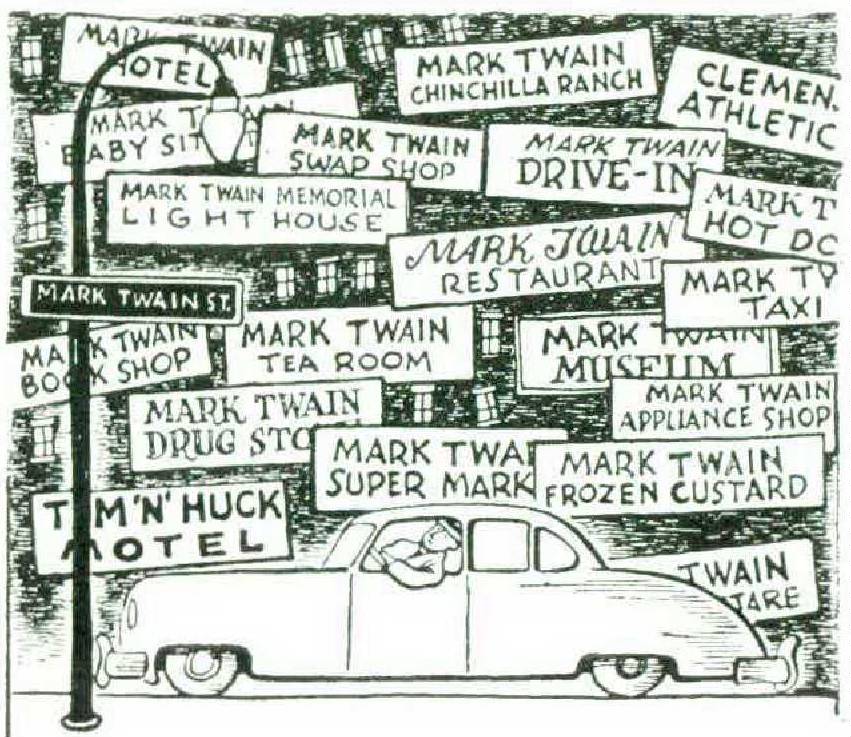
Having paused only briefly to admire the Mark Twain Hotel and the Clemens Athletic Field, I found myself at the foot of Cardiff Hill (Holiday’s Hill in Life on the Mississippi) where there stands a statue of Tom Sawyer and Huckleberry Finn. It is an interesting enough piece of bronze, showing Huck properly rugged and with his single suspender, and I was happy to allow a few minutes to it; but when an eager amateur guide walked over from a gas station to explain it to me, I somehow lost interest in Tom, and the Doctor in The Innocents Abroad suddenly seemed to be the most memorable character Twain ever drew. I couldn’t resist the temptation to emulate him.
“Who is Mr. Twain’s friend?” I asked my companion, when he paused in his raptures long enough for me to insert a word. For a moment he looked bewildered.
“Oh, that’s not Mark Twain,” he said, when he had sized up my stupidity. “Mark Twain’s statue is up in Riverview Park. This is Tom Sawyer and Huck Finn. Only statue in the world to be erected to the memory of fictional characters!”
“You mean,” I said, “these lads aren’t real? Didn’t really live?”
“Oh no. They’re only fiction — made up. Mark Twain, that’s Samuel Clemens, made up their names and put them in a book, Tom Sawyer. And then he put them in another book, called Huckleberry Finn.”
“Very interesting. But who is this fellow Clemens?”
“That’s Mark Twain. That is, his name was Samuel Langhorne Clemens, only he made up the name Mark Twain for himself.”
“Then Mark Twain was no more real than Tom Sawyer or Huck Finn, and this isn’t the world’s only statue to fictional characters, for you have another right here in Hannibal, in Rivcrview Park.”
“No, no, no. Mark Twain was a writer who lived here in Hannibal a long time ago, only his real name was Samuel Clemens. And if you’ll read his books you’ll see that he talks about Holiday’s Hill, where he used to play, which is Cardiff Hill — right here in front of you — and this statue represents two of the characters in his books, Tom Sawyer and Huck Finn, who played on Cardiff Hill, only Mark Twain calls it Holiday’s Hill.”
“Rather confusing, isn’t it? Do you suppose he was ashamed of his home town and was trying to disguise it ? ”
My guide said he thought he had a customer at the gas station.
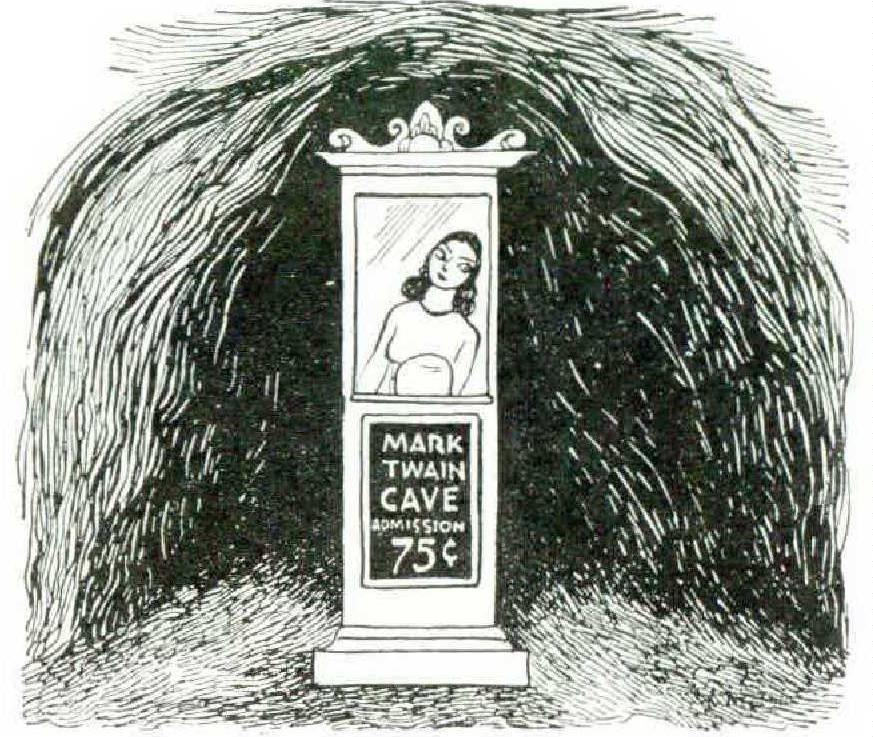
I turned and started down Main Street for the Mark Twain Cave, Hannibal’s greatest natural wonder. The cave is situated in a hill two miles south of Hannibal, a short distance from Mark Twain’s River. Some say this river is identical with the Mississippi, but in Hannibal that seems unlikely. Mark Twain never owned the cave — any more than he ever owned the river — but he did get lost in it once, thereby providing himself with the raw material for one of his most famous scenes. Someone owns it now, and it costs a visitor seventyfive cents to go in with a guided party to see where Mark Twain used to play cops and robbers for free.
I paid my seventy-five cents cheerfully and went into the cave with a party of about twenty-five others. As the guide encouraged us to ask questions, someone soon asked if Mark Twain’s name was among the many that were smoked in candle soot or scratched on nearly every available smooth spot in the ceiling and the walls.
The guide apologized for its absence, and went on to volunteer the information so dear to Hannibal residents that Mark Twain’s real name was Samuel Langhorne Clemens, as if that explained it. Then he also had to admit that that name wasn’t in the cave, an oversight which you can bet he wished he’d thought of earlier. Evidently someone else in the party had read The Innocents Abroad, for a gentleman wearing one of the denim jackets provided by the management against the coolness of the cave promptly asked why it wasn’t called the Becky Thatcher Cave, since that wasn’t her name either.
The guide said he was sure that would be as good a name as any, and added that it once was called McDowell’s Cave because a Mr. McDowell had placed the body of his little daughter in a cylinder of alcohol, and then had placed the cylinder in the cave, thinking the body would petrify. After he had assured several ladies in the party that the child’s body had been removed years and years ago and given a decent burial, he hurried on to repeat a number of educational statistics about the expense and difficulty of fitting the cave with electric lights.
The gentleman in the denim jacket had been studying the Chamber of Commerce’s pamphlet carefully. At the mention of the lights he said, “I see here that the first railroad to cross Missouri was started at Hannibal, and that the first mail car in the world was built in Hannibal; but I don’t see any mention that the electric light was invented in Hannibal.”
“As far as I know, it wasn’t,” said the guide. Then, the dawn of understanding that only a professional guide can give facial expression to — “The lights were put in after Mark Twain left Hannibal. Long after.”
By this time the party had penetrated pretty far into the portion of the cave exhibited to tourists, and we had marveled at chunks of rock which the guide believed resembled a piano, an alligator, the devil’s backbone, a post office, the prow of a ship, and an assortment of other objects unlikely to be found underground. We lingered a good while under the cross where Tom and Huck found Injun Joe’s buried treasure. The man in the denim jacket suggested that Mark Twain must have needed a long stepladder to carve the cross in the ceiling. He was told patiently that the cross was the natural result of the intersection of two seams in the rocks. Somehow this tarnished the wonder of the thing a little.
Leaving the cave at the conclusion of the quarter-mile walk, the man in the denim jacket said that it astonished him. “ Yes,” he said, “it’s really astonishing — I might say unbelievable. . . . How many books did you say Mark Twain wrote?”
“The Collected Works numbers thirty-seven volumes,” said the guide.
“To think that a man could write thirty-seven books and still find time for such an engineering feat! Why, most men would do well to dig a swimming pool singlehanded. But to dig a cave — well!”