Pleasures and Places: Side Roads in Spain
Though Spain ‘s low prices tend to go up in response to the increase in tourist trade, the less celebrated places, off the main routes, are still uncluttered and inexpensive. And if the roads arc rough, why hurry? DIGGORY VENN is the author of “ The Porto Game" in the December, 1951, Atlantic.
by DIGGORY VENN
To TRAVELERS, there is nothing more exciting — or fatally fascinating— than a map. A map is the grand overture to life: better than the breathless instant in a theater when the curtain hovers momentarily in its flight to uncover the first act; or the delivery of the menu at a threestar restaurant in the French provinces; or the delicate sigh of a cork parting company with a spiderwebbed bottle of heroic vintage.
Not too long ago, my wife and I were at the Franco-Spanish border, a 9-horsepower Singer sports car underneath us, and the map spread out upon our knees. The Spanish roads appeared in seductive thick and thin red lines, and in tantalizing green. They linked such fabled names as Cádiz, Jerez, Burgos, Toledo, Avila, Madrid, and Salamanca. Forthwith we turned the nose of the car into Spain and surrendered unconditionally to the lure of a green-striped side road which led toward the Costa Brava.
For one hour we lunged through the exploded mine field which served as a road. We covered exactly 15 miles. Then we bucked to a stop at a Y in the road. Either fork, the weather-beaten signpost obligingly announced, would lead us to Llafranch, our destination. While we deliberated, a horse and cart, dipping gently in and out of bumps like a boat in a swell, advanced slowly and easily towards us.
The driver lolled negligently and comfortably on his wooden seat. lie had ihe best of us for all our twentieth century transportation; yet like a (rue Spaniard, he politely gave no indication of triumph, but watched intently as we indicated our dilemma in sign language. He smiled gently.
“Carretera mala,” he said pointing to the right.
Then, more softly, “Carretera malisima,“’ and he pointed to the left.
We took the carretera mala, resolving never to stray off the major roads again. But even the malisima would have been worth it to find Costa Brava at the other end. Tucked into the northeast corner of Spain, the Costa Brava is a collection of Carmels with golden sands, treelined streets, and drowsing hotels separated from one another by perpendicular headlands. There is no concession to tourism. Fishing boats and bathers, gay-striped bath towels and ocher-brown fishing nets, jostle each other on the beaches. There are little coves where peace and solitude are disturbed only by an occasional fishing boat. So far, Costa Brava has been preserved from commercialism — from piers, pavilions, casinos, and publicity directors. Even luxury hotels are rare. If bad roads form the Costa’s Pyrenean line of defense (and obviously they do), then it is up to the tourist to judge the quality of the Spanish road by special standards.
’he Costa Brava’s roads are by no means atypical of Spain. No wonder Franco wants American money for his lines of communications. Militarily speaking, our own government has admitted that the present condition of roads and railroads would make Spain a liability rather than an asset as a partner in wartime. It is a long time (and an insurrection) since the motoring monarch, Alfonso XIII, used to burn up the kilometers between his capital and the French border at the wheel of a high-powered automobile. Then the roads were tended more carefully.
Not all the Spanish roads are poor. The main routes are fast and smooth. The highway from Málaga to Granada is another Corniche. Within 9 miles of Málaga, the road climbs to a height of over 3300 feet, and at every turn of the road the views grow grander. It is a stretch of European highway not to be missed.
Potholed or smooth, the Spanish road grows on you as it takes you from one beauty to another in its own way. It is, for example, a far more democratic piece of machinery than our aristocratic post roads. The Spanish road is for everyone. It is for sleeping, and the curb — where there is one — is just the right elevation for a pillow. And why should the Spaniard pull his sleeping legs off the road?
If there is no room in the warehouse for a new shipment of supplies, there is plenty of free space on the highway. It seldom rains, and the shipment will impede traffic for only a couple of days.
Of an evening in the summer, the townspeople take their recreation promenading up and down the main route in the traditional paseo. On Saturdays and feast days, the roads are for dancing — and in Spain, feast days come oftener than Saturdays.
’he roads are, of course, used for vehicular traffic, but only occasionally. Away from the main centers of population, you can drive for hours without meeting another car. No matter whom you meet, it is an occasion for honking of horns, waving of arms, and very often a short halt to exchange credentials, felicitations, and information on the location of the nearest gas pump.
Fellow travelers (in the tourist sense) arc the most reliable source of up-to-date information about Spain. Particularly the British. The British motorist is first of all a confirmed Continental tourer. With Europe on his doorstep, he is apt to explore the Continent piecemeal, instead of gulping it all down in a hurried two-month leave of absence like the American. As a result, he knows individual areas well. Finally, he is limited to an infinitesimal amount of foreign exchange and must spend wisely. He is a good man for answering questions.
The Spaniard is not. His pride, combined with his desire to be hospitable, tends to make him minimize or exaggerate, with disastrous results. He will tell you what he thinks you want to know. Of course, he will say, you can reach the next town by sundown — and the trip turns out to be a day’s journey. Or he will disarmingly add that with your beautiful modern and fast car, you can be there in a very few minutes. You arrive two hours later.
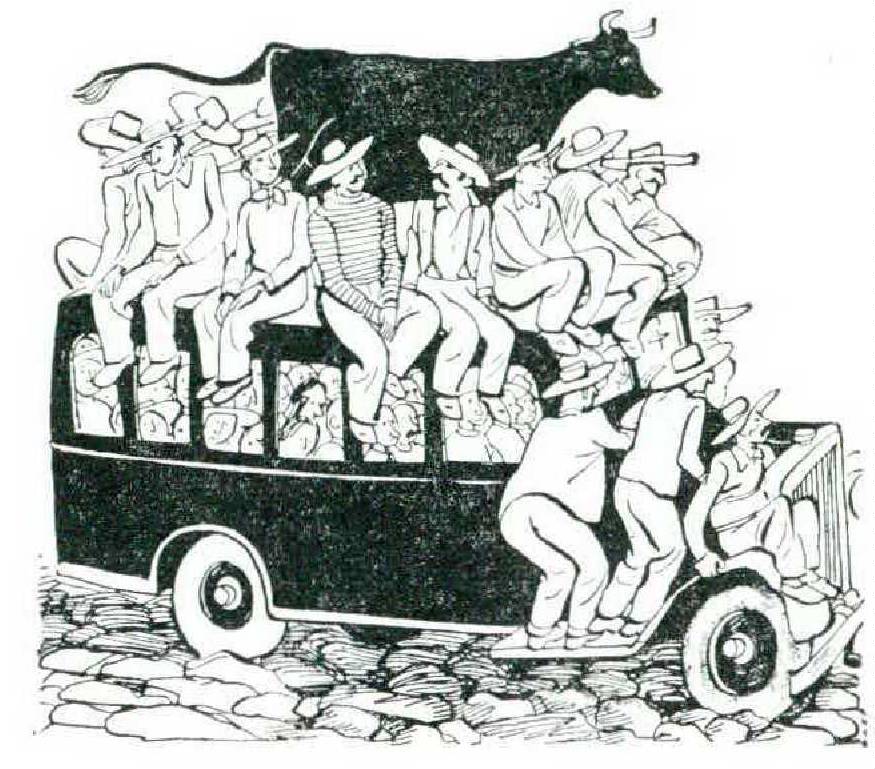
The Spanish bus will share your travels if you go through Spain by motorback. Its progress is heralded by a writhing pillar of dust and an exhaust which has long since dissociated itself from any relationship with a silencer. Unless the bus is stopped by the road or your car is equipped with an air-raid warning siren, you have no hope of gaining the right of way. But the bus is worth studying in flight or at a standstill for the number of persons it can be persuaded to accommodate.
The inside is always jammed. The residue, very often soldiery, is put on the roof. This space they share with baggage, and frequently with assorted livestock. One bus we met near Jerez de la Frontera contained the usual military quota, which clustered quite happily around the four lashed-together feet of a cow. We never did discover whether it was being transported dead or alive. On another bus, the management, had kindly provided an extra windshield for the topside passengers.
The rule of the road in Spain is an opportunistic affair except in Ihc big cities. Fortunately traffic volume is so light elsewhere that this absence of regulation is not a cause tor alarm. As a driver navigating the highways and/or byways of Spain, however, you must always take these factors into consideration: first, vehicles are likely to drive on the shady side of the road no matter which way they are going; secondly, on the theory that the grass is greener on the other side of the fence, vehicles will drive on t he wrong side of 1 he road, hoping to find fewer bumps and potholes.
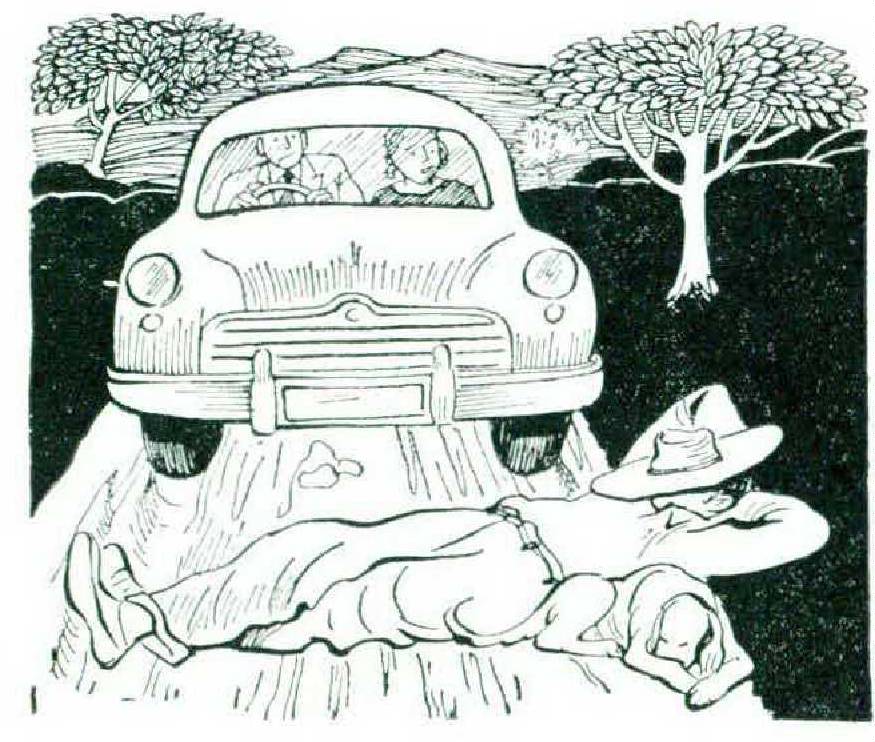
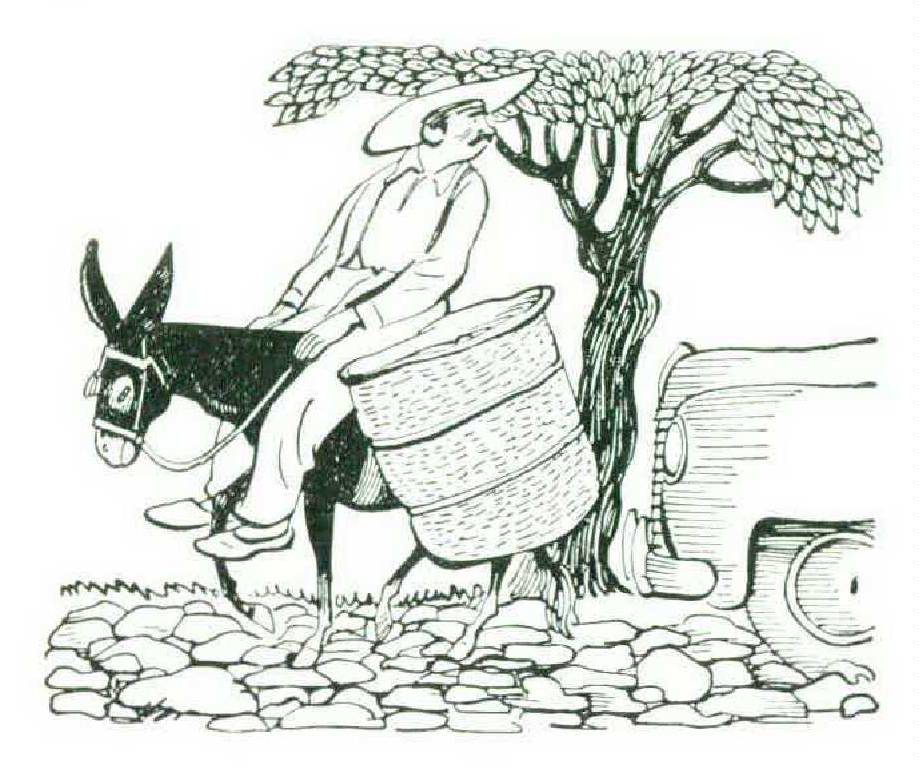
The major moving hazard (as opposed to stationary hazard) on the Spanish road is the mule and cart. It is a relaxed form of transportation, and more often than not the driver is sleeping off the slow progress from point to point on a bundle of hay. In this case, as a motorisl, you are well off. Left to itself, the horse or mule will either get out of your way or maintain such a steady course that you can dodge around it. II the driver is awake, there is likely to be trouble. First he must pull himself upright to look around and see if you ar’ really there, then goad his animal to a brisker pace, and finally pull him off the road in a right-angle turn which completely blocks the way.
Every road has its turning — even the Spanish road. One turning is the system of albergues and paradores begun during the days of Alfonso XIII by the Tourist Department. The albergue is a roadhouse of modern design with a lounge, dining room, and bedrooms. The purpose is to provide shelter and accommodation where none is to he had at strategic points along the highway. The rates are uniform and cheap; t he bathrooms gleam with porcelain, glass, and chrome in the most approved transatlantic fashion; and the service is friendly if a little slow. You may not, as a rule, stay longer than three days.
In the paradores, you may stay as long as you like. They are not modern buildings, but have been converted from castles or old convents. One of the paradores, for example, is the Henry II, a fourteenth century castle which forms part of the walled defenses of Ciudad Rodrigo, near the Portuguese border. You dine by candlelight, with a magnificent view across the river to Portugal. Another parador is the Cartuja de San Francisco in Granada, a friary which overlooks the Alhambra in one direction and the Albaicín in the other. It is built around a central courtyard that is sheltered from the hot sun by a canvas awning, and is opened to the stars in the evening. The Moors" legacy to southern Spain, a fountain, provides a continually cooling background of sound. The gazpacho soup, with pellets of tee blending the cucumber, garlic, and beef stock, and the merluza a la bilbaina, a fine white fish wonderfully flavored, are both memorable.
The albergues and paradores are but one activity of the Spanish State Tourist Office, which is probably the best in Europe. Each major city has a Tourist Office complete with interpreter and a polylingual staff—all personnel must, pass a competitive examination with stringent language requirements. Each office has a street map of its town, and will mark out tours for you which encompass the town’s most important buildings. The office will also tell you the hours of admission to ihc historical buildings, and patiently answer floods of questions.
Efficient as it is, the system is still not foolproof, You must make allowances for the Spanish road. Spaniards, happily, do not share the Northern time neurosis. No one starts or stops anything early — except bullfights, which begin with remarkable promptitude. Spain is one country where you can arrive in the middle of the night and find a welcome, and probably a good supper as well. The cocktail hour, for example, is nearer 10 P.M. than .5 — an ideal arrangement for the late-starter. The snag is that official hours of admission to buildings are not necessarily the actual hours.
Similarly, the official st reel names do not always correspond with the adutual street names. I he Spanish have a habit of changing street names to agree with their history. Almost every town has its Avenida Generalísimo Franco. If not Franco, then it is José Antonio. Portraits of both men are likely to gaze down upon you from the wall of any government office, and many a café and restaurant. José Antonio, son of the dictator Primo de Rivera and founder of the Falange Party, is the chief Kill ionalisl martyr in the CiviL War.
The best way we found to combat, the name changes and the sliding scale of admission hours was to select a guide from the swarms of children who flock around any foreigner’s car. The juvenile guide would then conduel us around town until we found our bearings, and happily guard the ear for a few pesetas when we left it for prolonged investigation of some architectural wonder.
The golden rule for traveling in Spain is never to take anything too fast. Neither the roads, the Spanish soul, nor the mechanics of officialdom are geared for speed. If you want to do business with anyone, be there early and bring every document and serap of official paper that you possess — yoI’ll need each one before you’re through.
The care and feeding of automobiles also calls for careful planning. Be prepared to fill up often with water. Radiators develop abnormal thirsts along the hot and dusty Spanish roads. Carry a water jug with you if possible, and certainly take a whisk broom to fight the dust which invades every crevice of your person and your car.
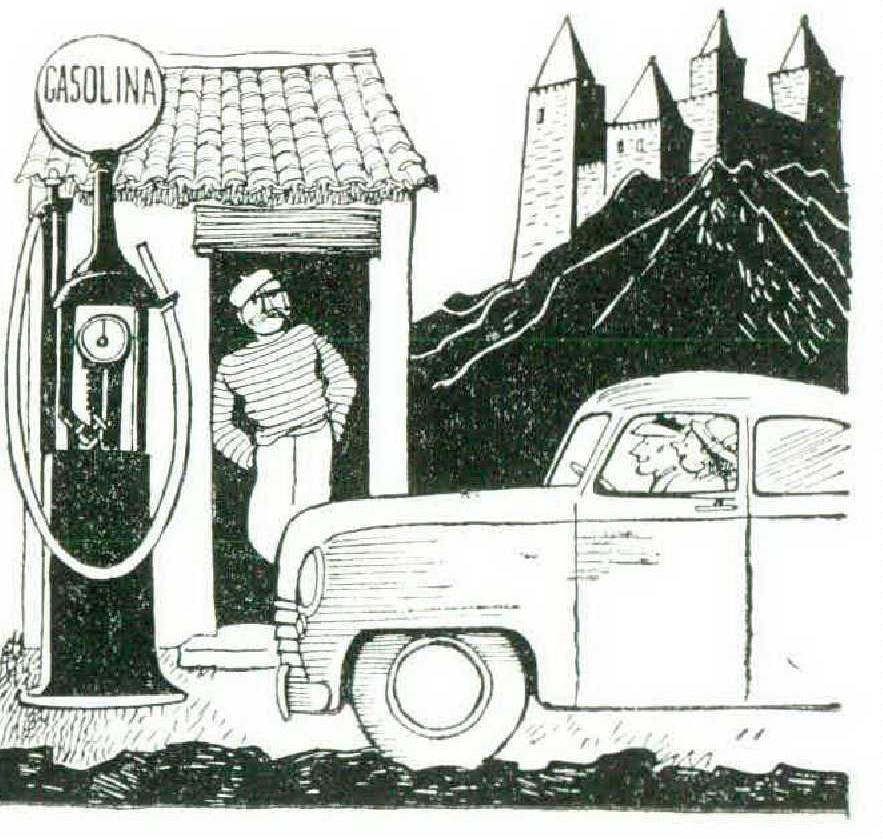
Never let a gasoline pump go by; it may bo the last you will see for 100 miles. If you have the patience — and you should learn to develop it you will strain the gasoline through a chamois leather before allowing it to dribble into your tank. Otherwise your carburetor and gas tank will need constant attention and cleansing. A mechanic in Barcelona told us that Spanish drivers clean out their carburetors every three weeks. A few elementary lessons in carburetor care before entering Spain will pay dividends.
You will be smart to buy gasalina plomo (with lead added) in the big cities. It is perhaps 10 pesetas extra a tank, but the extra quality of the gas and its more careful handling make it worth while. The wisest traveler carries a 5-gallon jerrican for emergencies. There is no telling when all the banks will be shut or all the pumps dry. One morning in Rondo, one of Spain’s most beautiful hill towns, all five pumps were dry. We proceeded only because a taxi driver volunteered (at a price) to spare us a few gallons from his own tank.
The price of gasoline runs about 50 cents a gallon, and is the most expensive part of traveling in Spain. The albergues and par adores are considered first (lass B hotels and charge a standard rate of 115 to 110 pesetas a day for full room and board. The exchange rate is now around 40 pesetas to the dollar. You can do much better by changing your money outside Spain into the 10,000 pesetas you are allowed to bring in with you.
Even at the official rate of 40 pesetas to the dollar, $3 a day for living in a magnificent castle like Henry II’s at Ciudad Rodrigo represents about ihe best money’s worth in Europe today. In the major cities, it is advisable to kick over the traces and go do luxe. You will never live so ducallv for so little again. For $7 to $8 a day, you can achieve full room and board at such super international host dries as the Alfonso XIII in Seville and the Ritzor Palace in Madrid.
The only trouble with this gambit is that it’s becoming too well known. During the season, these holds are booked solid. With the mobility of riding by motorback, however, you can — and should — escape the wellworn tourist track and discover spots of your own. The Costa Brava, for example, is full of them. Another is the privately run Rarador do Ifach on the Cape of Ifach just below Valencia. The Cape, one of Spain’s natural wonders, is a Gibraltar-like rock, two or three hundred feet high, joined to the mainland by a sickleshaped shore, which embraces a Eilliputian harbor. It is a Hellenic reminder of Spain’s past. The simple, white-walled pa rad or, where the two of us stayed for $3 including dinner and breakfast, sits on the handle of the sickle.
Possibly the best of them all is the Hotel Los Cisnes in Jerez de la Frontera, headquarters for the sherry trade, and as carefully manicured as the inside of a bodega.
You can love Spain for many reasons— for her huge plains, floating clouds, and snowy mountains; for the history that lies layer upon layer, like the paint on a pine chest you are restoring, over the cities, the shores, the old quays of little ports. You can dig below the Moor to the Goth, the Roman, the Carthaginian, the Greek, and the Phoenician. You can sorrow over more recent evenls: the Carlist wars, and the tragic Civil War which added a new layer of history to towns like Toledo, Seville, and Barcelona.
You can rue lhe dust, the pot holes, and ihe shadelessness of ihe roads as you beat your way along the length and breadth of the Iberian Peninsula by motorback. But underneath all ihe glories and the irritations you will find the Spaniard, obstinately unchanged by his long history and graciously individualist ie. Except for the jaded concierge of the big city hotel, ihe bored frontier guard, and the indifferent petty bureaucrat, you will find a very reasonable facsimile of the brotherhood of man in Spain.
One Sunday afternoon we arrived at a small town near Seville with our gas gauge hovering dangerously around the empty mark. We drove to the middle of the deserted plaza and rudely beeped our horn. Within a matter of minutes we were surrounded by a smiling crowd of 200 men, women, and children. They understood our predicament immediately. and dispatched a flying squad to rout out the patron of the only gas pump in town. He arrived in due course, buttoning up his Sunday suit, and led all of us off to the source of supply. He filled the tank, refused a tip, solemnly shook hands with us, and then with the entire 200 of his fellow townsmen waved and shoutedus a tumultuous good-bye. Two hours later we reached Seville with a laboring, spitting engine. It took us another two hours to purge the car’s insides of our friend’s bad gasoline. But it was worth it —as it always is in Spain.