The Case of the Sober Shamus
by EDWIN O’CONNOR
EDWIN O’CONNOH writes from long experience in radio stations and more recently as n reviewer of television shows. He has just completed a surrey of radio and TV programs in Ireland, on which he will report in one of our future issues.
TELEVISION, which has a bad habit of monkeying around with perfectly acceptable types, has already left its mark on the private detective. The private eye is not at all what he used to be. In his prime he was a tough, hard-drinking ladies’ man, fast with his guns and faster with his fists; he is now, television-style, a kind of windy dud, fit only for slouching a round hotel lobbies, keeping a weather eye on the potted palms. The decline is obvious, sad, and due to a single cause: strong drink. The television detective hasn’t had one in years.
The old private eye — who operated in books or in magazines — was never a really very good detective, but he had one great advantage: he was seldom completely sober. If he did not think, he did at least drink, and it was soon found that for all practical purposes the lit tie brown jug was quite as helpful as the little gray cells. It was television which put a stop to this, and for rather sound commercial reasons. At the present time, no hard liquor is allowed to advertise on television; presumably the industry felt that there was little point in giving a boost to a product from which there was not even potential revenue. And so something new was introduced: the tem-
perance detective, a good safe man who might smoke or eat aspirin or use hair oil, but w ho would under no circumstances drink.
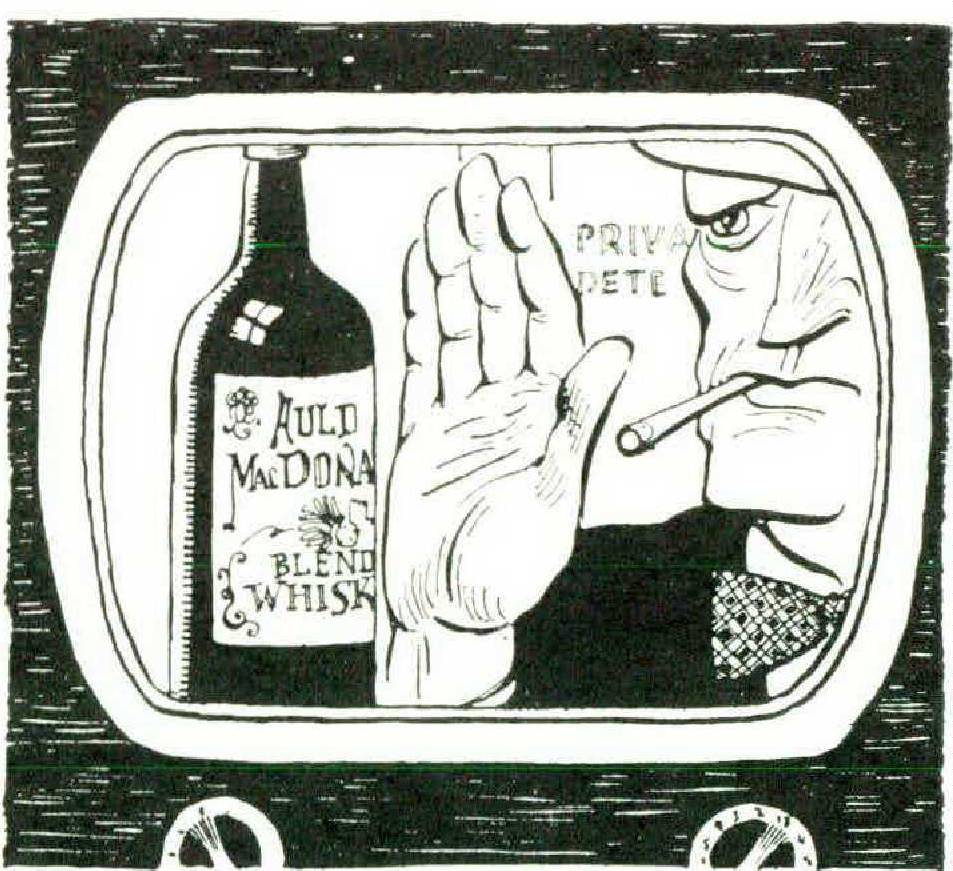
This has been hard on the telev ision shamus. Cold sober, he is forced to face his foe, himself, and his script, a combination which is apt to prove too much for any man not in his cups. Take, for example, Jeffrey Jones, the detective starred in “The Files of Jeffrey Jones.”He is the only detective on television who is also a law student, and although he can usually be found in a saloon, conscientiously examining his lawbook, he is proudly abstemious at all times (“No, thanks, Joe; I’ll just have my usual cup of coffee”). In real life, the number of people willing to place their problems in the hands of a law student — even a temperate one — is relatively small; this is not so on television. When Jones begins his coffee-bibbing, the line forms on the right, led perhaps by the anxious Mr. Wong of the Chinese Better Businessmen’s Association, who wants to find out who’s really smuggling the opium (“Quite frankly, Mr. Jones, my people arc concerned. They feel it is giv ing them a bad name”).
Barring a miracle, this gullible Oriental is in for a sharp disappointment; poor Jones wouldn’t know dream-dust from table salt. Despite the fact that his opponent is almost always a cretin, no man on television has been sandbagged more often than Jones. Persuaders rain upon his head, and as a consequence his script is heavily loaded with the lush narration which all private eyes slip into as soon as the blackjack meets the scalp (“and so I sank into lullaby land, where dappled horses were prancing through a field of yellow roses, and a beautiful princess was stroking my hair”).
Still, if Mr. Wong had consulted “Boston Blackie,” he would have been no better off. Blackie is ihe
Methuselah of American detectives; he has recently been exhumed from the Hollywood boneyard to take his rightful place in television. A laughing, jaunty dolt, Blackie is billed as “the enemy of those who make him an enemy, the friend of those who have no friends!”— Robin Hood in a snap-brim felt.
At no time during his show is Blackie permitted a drink, although no man ever needed one more. Blackie’s great specialty is the affording of no protection to his clients. On television, the quickest way to get an ice pick in the spine is to run up to Boston Blackie and say, “Blackie, my number is up! Ya gotta protect me!” This is followed by shouts of laughing reassurance and an early funeral. After the funeral, Blackie, still cold sober, goes after the killer. A long lifetime spent in detection has enabled him to evolve the most imperfect technique since that of Charlie Chan’s Number One Son, who used to solve crimes largely by falling into open manholes.
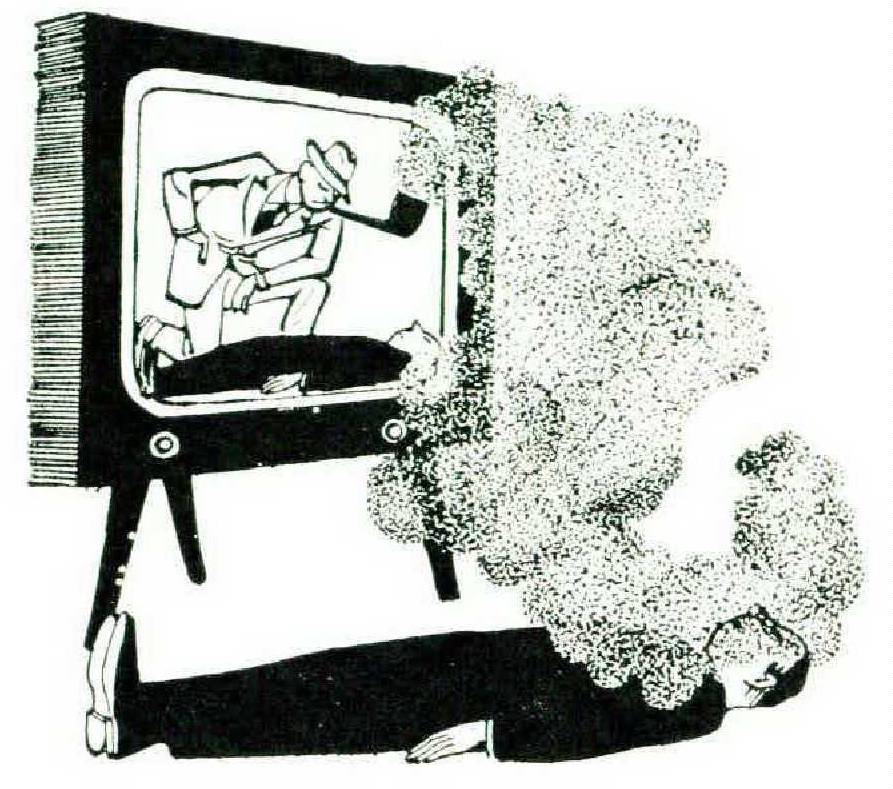
Martin Kane, the detective-hero on “Martin Kane, Private Eye,” though not as old as Blackie, is more experienced on television. He has been chasing his shabby brood of telev ision criminals for more than three years now. He is a sharp-faced, nervous man with a loud voice and bold gestures; beneath his churning surface lies a brain unrivaled for sheer torpidity. In his moments of stress he paces about wildly, searching for something, anything, to save him from the necessity of thought. What he is looking for, obviously, is three fingers of the best. What he gets, however, is a briarful of cut-plug, for “Martin Kane, Private Eye" is sponsored by a company selling pipe tobacco.
As those who control this program apparently suspect that the public does not always identify Kane with the product, he is kept smoking and refueling constantly. The chase is never so urgent that it cannot be interrupted while Kane jumps into a corner store and calls strongly for another tin of that mild, sweetsmelling, perfectly blended tobacco. After the stoking up, the hunt is resumed, and Kane is permitted to return to the old false scent, trailing smoke like a vintage Reo.
The high mortality rate found among the Martin Kanes must be mentioned. A Martin Kane cannot hope to last too long; in the three years of the program’s existence, three different actors have been used up in the title role. All that smoke in the lungs, and nothing to drink: it takes its toll.
Tobacco also plays a large part in “Man Against Crime,”a program in which the tcetotaling detective is one Mike Barnett. The difference between Kane and Barnett is chiefly this: Kane smokes a pipe, Barnett cigarettes. This is not a matter of temperament; it just so happens that Barnett’s tobacco company is pushing cigarettes these evenings.
Barnett’s life is not an easy one. While the criminals he faces are of an agreeably low standard —a typical murderer on this show is one who runs a clam rake over his victim’s face, in the interesting belief that the victim will then appear to have been clawed to death by a jaguar—the adventures they get mixed up in are pretty much of a piece. The plots on “Man Against Crime" are of either the “who” or “why” variety; a program may open, on the one hand, with lines like these: —
“Barnett, someone is trying to kill me!" “Why?” “I know why . . . but I don’t know who!”
Or, conversely:—
“Barnett, someone is trying to kill me!" “Who?” “I know who . . . but I don’t know why!”
In these circumstances, the old private eye would simply feint a couple of times with either hand and head for the bottle. Barnett can only reach for his cigarettes. They prove to be no help. In the first place, he is kept far too busy lighting them to have very much time for the actual business of detection; and in the second, nicotine seems to blunt rather than sharpen his faculties, which are fairly blunt to begin with.
In the end, tho criminals on “Man Against Crime” really catch themselves, as indeed they do on “Marlin Kane,” “Jeffrey Jones,” and all the rest. They have to: it is the only way out. The average television criminal is a natural for the gallows; slowwitted, maladroit, and unimaginative, in real life he would be gibbering at the end of a bailiff’s arm within ten minutes after his first misdemeanor. He is a miserable specimen of his class, but he is not without decent instincts. He knows that on television Crime Must Not Pay. He knows that he must, in the end, be caught, and he understands that if he doesn’t catch himself, no one else is going to do it. Who else could do it? Jeffrey Jones? Boston Blackie? Martin Kane? Mike Barnett? It is most unlikely. Since they’ve been in business, the poor men haven’t been able to catch so much as a drink. A real live criminal would be out of the question.