Gags
by JEAN PARADISE
After attending Syracuse and New York Universities, JEAN PARADISE worked in a variety of jobs before turning to full-time writing.
MY FIRST job after graduation from college was that of secretary to an unemployed burlesque comic and an ex-advertising man, who had formed a partnership to write radio scripts.
I stumbled into the job on a particularly damp and miserable November day — I was wearing a borrowed beaver coat, and the wet weather made the fur curl while it straightened out my own hair.
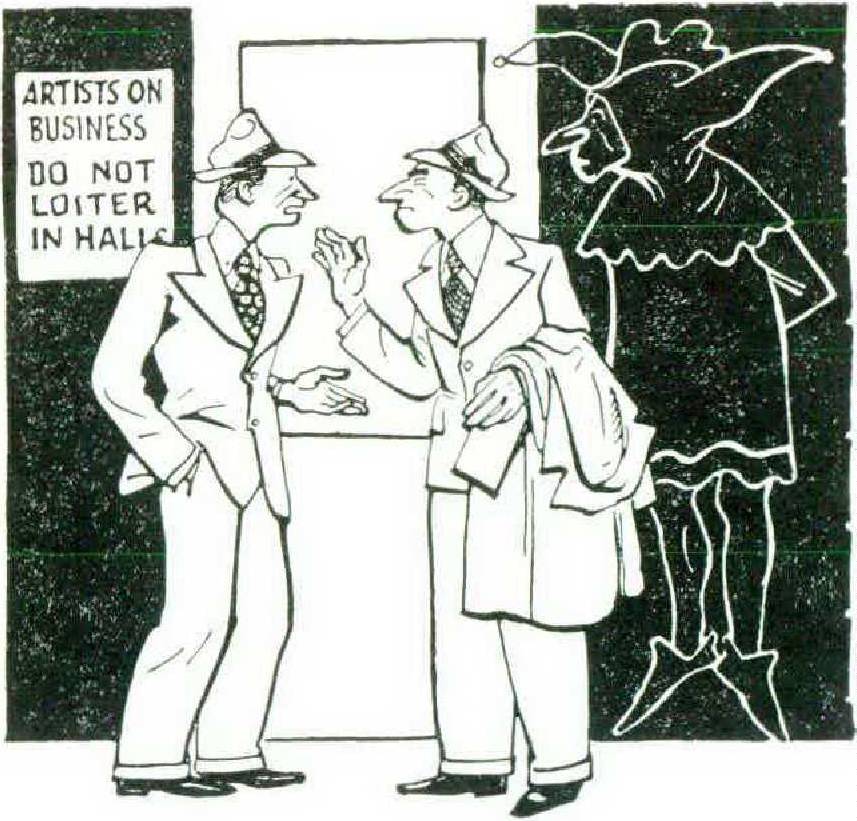
The office was in the Palace Theatre Building on Broadway, already a musty and dying relic of the dying vaudeville profession. The address was last on my list, and seemed an unlikely place to find any employment, although there were brisk signs on the walls saying: “Artists on Business. Do Not Loiter in Halls.”
The burlesque comic and the ad man, Mr. Ernie Cotton and Mr. Frank Haskell, occupied an office so small that it could properly be called a closet. They had managed, however, to squeeze in a desk, ty pewriter, table, and two chairs. (The table was used to put their coals on and the desk to prop up their feet.)
I stood in the doorway and squinted at the partners through a haze of smoke. “The employment agency sent me,”I said feebly .
Mr. Haskell, the advertising man, arose and made a lordly gesture. “Oh, sure, sure. The secretary.
They had never employed anybody before and I had never been employed, so we were ignorant of the formalities on both sides.
“Uh, you can start right in, honey,”Mr. Haskell said. “Sit down at the typewriter, huh? Krnie, get up and give the girl your chair. And let her have a few gags to type. ’Tomorrow we’ll buy a filing cabinet with a lock and key so none of those characters that hang around Ernie can swipe our gags.”
I took off my hat and coat and sat down at the typewriter as directed. Mr. Cotton, deprived of his chair, perched on the window sill and smiled at me gently.
Mr. Cotton was a whimsical, kind little man. I have no idea whether he had any talent on the burlesque stage. I had never seen a burlesque show up to that time nor have J since; however, during my employment with the firm of Cotton and Haskell I met many burlesque performers and found most of them likable enough in their own quaint way.
Mr. Haskell was larger, younger, and more dashing than Mr. ( otton. He had an air of self-confidence and was excessively vain about his appearance; he wore a hat all the time, to hide a conspicuous bald spot.
The gags which Mr. Cotton handed over to me were scribbled on small, crumpled bits of paper, some of them on the backs of unpaid bills.
“I used ’em all over the country,” he told me. “ Played burlesque, night clubs, vaudeville—the Palace too — but now I’m through with that small stuff.”
“You ever listen to Eddie Cantor, honey?” Mr. Haskell interrupted.
I said yes.
“Well, men like Cantor need radio writers who know gags and show business. Ernie’s an old pal of Cantor’s. We’re going to the Coast soon, like Cantor and Benny. Jack Benny,
I mean. The big radio money is on the Coast. We’ll take you with us, raise your salary.”He looked at me eagily. “I didn’t tell you what your salary was, did I?“
“ No.
“Ten dollars a week.”Mr. Haskell waited for a protest, but when none came he added, “That’s just for now, you understand. As soon as we sell a couple more scripts, we’ll expand, take over the office next door, break down the walls . . .” He made a sledge-hammer motion with his hands.
“Sure, we’re gonna go to the Coast,” Mr. Cotton said. He leaned over to me confidentially. “ This is just between you and I. There’s a fellow on radio — I’m not mentioning names, but he’s one of the biggest comics on the air — well, this character borrowed thirty-five gags from me before he went to the Coast and now he’s using them on his show. Every week!”
In the days that followed, I grew to like Mr. Cotton and tolerate Mr. Haskell — he wasn’t so bad once you recognized him for a faker. I would come in at ten o clock and type gags on small white cards, one gag to a card. At noon Mr. Haskell and Mr. (Otton would appear. They lived in some seedy hotel off Times Square-;
I believe they moved from one hotel to another when their credit ran out.
After I exhausted Mr. Cotton’s personal gag supply, I started to copy jokes from back numbers of magazines. I even made up a few of my own. The filing cabinet was never bought, so I filed the gags by subject matter in a shoe box which was kept on the w indow sill.
Along about three each afternoon, Mr. Cotton’s cronies would begin to drift in, all of them actors and most of them indigent or temporarily “at liberty.” The office was smoky to the point of suffocation, but you could always lean out of the window for a breath of fresh air. Whatever business the partners transacted had to be done out in the hall anyway, partly because there was no room in the office and partly because they were afraid that if I saw any money coming in I would ask for a raise.
One of the cronies was Al Carpenter, a monkey-faced comic who worked the burlesque circuit. He liked to give advice to Mr. Cotton. “Drop this business, pal,” he’d say earnestly. “Get back into your act.
smarten it up a little — you can always make a living.”
“What kind of living?” Mr. Haskell sneered. “Vaudeville is dead and so is burlesque. The money ‘s in radio.”
“I got my gags,” Mr. Cotton said complacently. “Radio needs gags just like burlesque.”
At the mention of the magic word “gag,” Al would brighten. “You think you have gags. Wait till you hear some of these.”
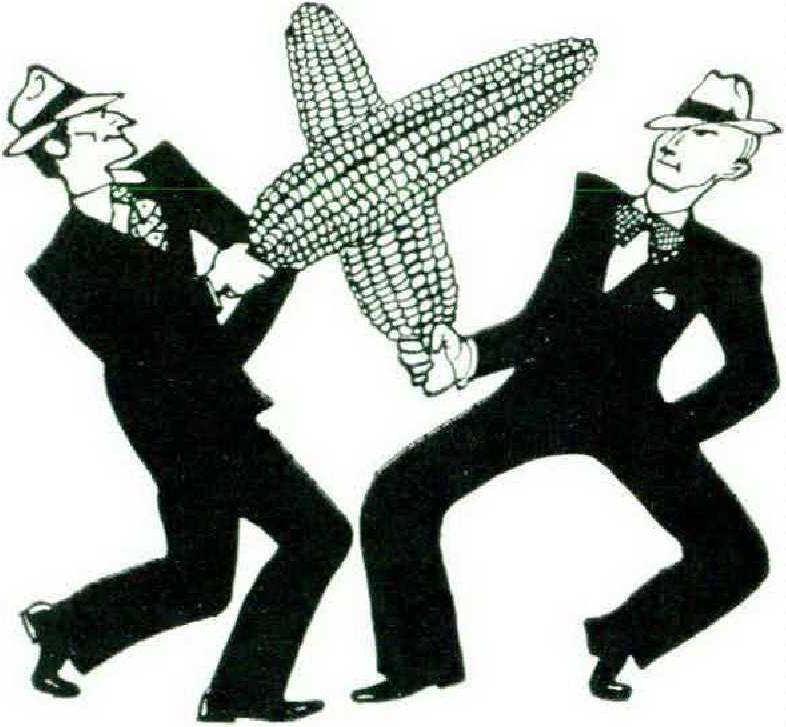
There would follow then the formal ritual of a gag exchange. A1 had a dog-eared, blue-covered little notebook in which he wrote down his gags. He would thumb through his book, muttering to himself, and finally, after tearing out a few sacred pages, hand the rest over to Mr. Cotton, who would in turn give Al a handful of cards from the shoe box.
Part of the routine was to belittle the other’s gags. “What corn,” Mr. Cotton would remark. “You got your nerve!”
Once A1 grabbed his book back indignantly. “You just don’t know a smart gag!” He began to sing in a lusty baritone: “Oh, if I had the wings of an angel, over these prison walls I would fly . . .”
Abruptly he stopped and his face creased into a smile as he addressed an imaginary audience. “I was singing this song the other night, folks, singing it just like that, but I happened to leave out a few bars . .
“So what?" Mr. Cotton asked.
“So three prisoners escaped.”
“Stinks.”
However, after Al Carpenter left, Mr. Cotton instructed me to type out the prisoner’s gag and file it away in the shoe box. “On the Coast they make a fortune with corny gags like that,” he said bitterly.
Mr. Cotton and Mr. Haskell never sold any radio scripts while I was there, although once, it is true, they nearly sold a script.
They were commissioned to write a half-hour comedy show for a star of the silent films who was trying to make a comeback via radio. The star suffered badly from both advancing age and alcohol; however, he had received the tentative promise of a spot on the air if he turned up with a decent script.
Mr. Cotton and Mr. Haskell worked hard on that script. The day before the audition, however, the star disappeared — simply dropped out of sight. Mr. Cotton and Mr. Haskell went on a personal tour of every bar in or near Times Square, but their man was not to be found. He didn’t show up until five days later. Nobody ever learned where he had been. That week the partners were unable to pay me my ten dollars.
I must confess that all this time I had kept answering “Help Wanted” ads in the Times, and during mv second nonsalaried week I received a reply to one of my letters. I took the morning off, ran over for an interview, and got myself another job, as secretary to the advertising manager of a hair dye company. The pay was fifteen dollars a week; moreover, the company had pink and chartreuse offices and looked solvent.
I fell sad, however, when I had to tell Mr. Cotton and Mr. Haskell that I was quitting. They were decent about it, though, and treated me to a farewell lunch at the Theatrical Pharmacy, an airless little drugstore on 36th Street where even the countermen were duespaying members of Actors’ Equity.
Both partners told me I was behaving very foolishly. “You’re walking out on a big thing, Cotton said, shaking his head. “I’m surprised at you — a girl with your brains and education. If you’d stick with us, next year at this time you’d be on the Coast.”
“Don’t try to convince her,” Mr. Haskell said coldly.
For a moment, I actually had misgivings, but the madness passed.
Several years later I bumped into the burlesque comic, Al Carpenter, right in his natural habitat, the corner of Broadway and 46th Street. He looked older and sadder and more like a monkey than ever; his pants were impressed, but a copy of Variety still stuck out of his back pocket.
“What ever happened to Mr. Cotton and Mr. Haskell?” I asked.
Al looked at me morosely. “Haskell got married and went to work for his father-in-law in a box factory. And Ernie Cotton’s gone. One day he was here, and the next day he wasn’t. Even his agent couldn’t find him.”
I didn’t believe any of it, not about the box factory nor about Mr. Cotton’s disappearance. Now that television has arrived, I am certain that Mr. Cotton and Mr. Haskell are hard at work somewhere in the vicinity of Times Square, trying to keep up with the moving hand of show business. A gag is still a gag. The partners never doubted that they would reach the golden land of success, and their optimism, like their gags, was indestructible.