Faith or Fear
“What’s wrong with this world is, it’s not finished yet. It is not completed to that point where man can put his final signature to the job and say, ‘It is finished. We made it, and it works.’ Because only man can complete it. Not God, but man.”
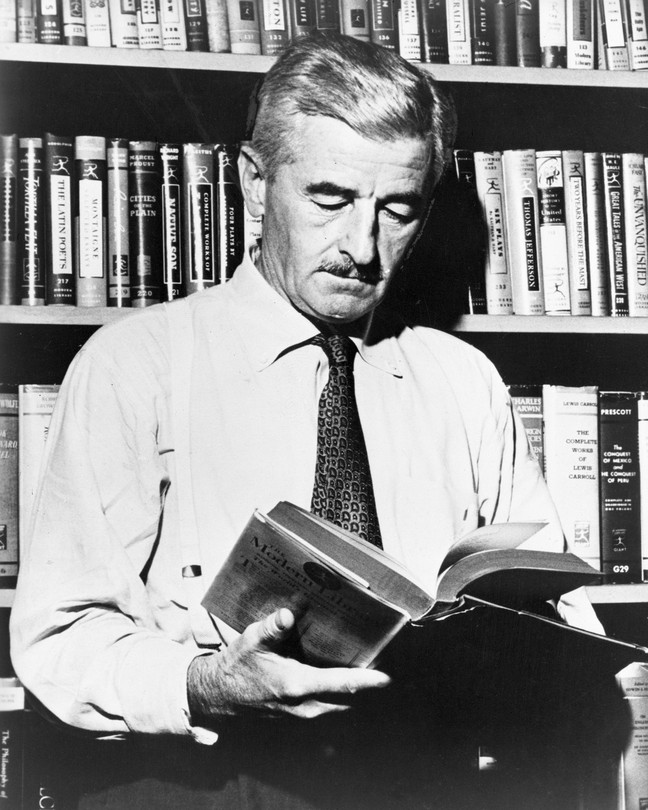
WHAT’S wrong with this world is, it’s not finished yet. It is not completed to that point where man can put his final signature to the job and say, “It is finished. We made it, and it works.”
Because only man can complete it. Not God, but man. It is man’s high destiny and proof of his immortality too, that his is the choice between ending the world, effacing it from the long annal of time and space, and completing it. This is not only his right, but his privilege too. Like the phoenix it rises from the ashes of its own failure with each generation, until it is your turn now in your flash and flick of time and space which we call today, in this and in all the stations in time and space today and yesterday and tomorrow, where a handful of aged people like me, who should know but no longer can, are facing young people like you who can do, if they only knew where and how, to perform this duty, accept this privilege, bear this right.
In the beginning, God created the earth. He created it completely furnished for man. Then He created man completely equipped to cope with the earth, by means of free will and the capacity for decision and the ability to learn by making mistakes and learning from them because he had a memory with which to remember and so learn from his errors, and so in time make his own peaceful destiny of the earth. It was not an experiment. God didn’t merely believe in man, He knew man. He know that man was competent for a soul because he was capable of saving that soul and, with it, himself. He knew that man was capable of starting from scratch and coping with the earth and with himself both; capable of teaching himself to be civilized, to live with his fellow man in amity, without anguish to himself or causing anguish and grief to others, and of appreciating the value of security and peace and freedom, since our dreams at night, the very slow evolution of our bodies themselves, remind us constantly of the time when we did not have them. He did not mean freedom from fear, because man does not have the right to be free of fear. We are not so weak and timorous as to need to be free of fear; we need only use our capacity to not be afraid of it and so relegate fear to its proper perspective. He meant security and peace in which to not be afraid, freedom in which to decree and then establish security and peace. And He demanded of man only that we work to deserve and gain these things — liberty, freedom of the body and spirit both, security for the weak and helpless, and peace for all — because these were the most valuable things He could set within our capacity and reach.
During all this time, the angels (with one exception; God had probably had trouble with this one before) merely looked on and watched — the serene and blameless seraphim, that white and shining congeries who, with the exception of that one whose arrogance and pride God had already had to curb, were content merely to bask for eternity in the reflected glory of the miracle of man, content merely to watch, uninvolved and not even caring, while man ran his worthless and unregretted course toward and at last into that twilight where he would be no more. Because they were white, immaculate, negative, without past, without thought or grief or regrets or hopes, except that one — the splendid dark incorrigible one, who possessed the arrogance and pride to demand with, and the temerity to object with, and the ambition to substitute with — not only to decline to accept a condition just because it was a fact, but to want to substitute another condition in its place.
But this one’s opinion of man was even worse than that of the negative and shining ones. This one not only believed that man was incapable of anything but baseness, this one believed that baseness had been inculcated in man to be used for base personal aggrandizement by them of a higher and more ruthless baseness. So God used the dark spirit too. He did not merely cast it shrieking out of the universe, as He could have done. Instead, He used it. He already presaw the long roster of the ambition’s ruthless avatars — Genghis and Caesar and William and Hitler and Barca and Stalin and Bonaparte and Huey Long. But he used more — not only the ambition and the ruthlessness and the arrogance to show man what to revolt against, but also the temerity to revolt and the will to change what one does not like. Because He presaw the long roster of the other avatars of that rebellious and uncompromising pride also, the long roster of names longer and more enduring than those of the tyrants and oppressors. They are the long annal of the men and women who have anguished over man’s condition and who have held up to us not only the mirror of our follies and greeds and lusts and fears, but have reminded us constantly of the tremendous shape of our godhead too — the godhead and immortality which we cannot repudiate even if we dared, since we cannot rid ourselves of it but only it can rid itself of us — the philosophers and artists, the articulate and grieving who have reminded us always of our capacity for honor and courage and compassion and pity and sacrifice.
But they can only remind us that we are capable of revolt and change. They do not need, we do not need anyone to tell us what we must revolt against and efface from the earth if we are to live in peace and security on it, because we already know that. They can only remind us that man can revolt and change by telling, showing, reminding us how, not lead us, since to be led, we must surrender our free will and our capacity and right to make decisions out of our own personal soul. If we are to be led into peace and security by some individual gauleiter or gang of them, like a drove of sheep through a gate in a fence, it will merely be from one enclosure to another, through another fence with another closable gate in it, and all history has shown us that this will be the gauleiter’s enclosure and fence and his hand which closes and locks the gate, and that kind of peace and security will be exactly the sort of peace and security which a flock of sheep deserve.
So He used that split part of the dark proud one’s character to remind us of our heritage of free will and decision; He used the poets and philosophers to remind us, out of our own recorded anguish, of our capacity for courage and endurance. But it is we ourselves who must employ them. This time it is you, here, in this room and in all the others like it about the world at this time and occasion in your lives. It is us, we, not as groups or classes but as individuals, simple men and women individually free and capable of freedom and decision, who must decide, affirm simply and firmly and forever never to be led like sheep into peace and security, but ourselves, us, simple men and women simply and mutually confederated for a time, a purpose, an end, for the simple reason that reason and heart have both shown us that we want the same thing and must have it and intend to have it.
To do it ourselves, as individuals, not because we have to merely in order to survive, but because we wish to, will to out of our heritage of free will and decision, the possession of which has given us the right to say how we shall live, and the long proof of our recorded immortality to remind us that we have the courage to elect that right and that course.
The answer is very simple. I don’t mean easy, but simple. It is so simple in fact that one’s first reaction is something like this: “If that’s all it takes, what you will get for it can’t be very valuable, very enduring.” There is an anecdote about Tolstoy, I think it was, who said in the middle of a discussion on this subject; “All right, I’ll start being good tomorrow — if you will too.”Which was wit, and had, as wit often does, truth in it — a profound truth in fact to all of them who are incapable of belief in man. But not to them who can and do believe in man. To them, it is only wit, the despairing repudiation of man by a man exhausted into despair by his own anguish over man’s condition. These do not say, The answer is simple, but how difficult, instead these say, The answer is not easy, but very simple. We do not need, the end does not even require, that we dedicate ourselves from this moment on to be Joans of Arc with trumpets and banners and battle-dust toward an end which we will not even see since it will merely be a setting for the monument of martyrdom. It can be done within, concomitant with, the normal life which everyone wants and everyone should have. In fact, that normal life which everyone wants and deserves and can have — provided of course we work for it, are willing to make a reasonable amount of sacrifice commensurate with how much it is worth and how much we want and deserve it — can be dedicated to this end and be much more efficacious than all the loud voices and the cries and the banners and trumpets and dust.
Because it begins at home. We all know what “home” means. Home is not necessarily a place fixed in geography. It can be moved, provided the old proven values which made it home and lacking which it cannot be home, are taken along too. it does not necessarily mean or demand physical ease, least of all, never in fact, physical security for the spirit, for love and fidelity to have peace and security in which to love and be faithful, for the devotion and sacrifice. Home means not just today, but tomorrow and tomorrow, and then again tomorrow and tomorrow. It means someone to offer the love and fidelity and respect to who is worthy of it, someone to be compatible with, whose dreams and hopes are your dreams and hopes, who wants and will work and sacrifice also that the thing which the two of you have together shall last forever; someone whom you not only love but like too, which is more, since it must outlast what when we are young we mean by love because without the liking and the respect, the love itself will not last.
Home is not merely four walls — a house, a yard on a particular street, with a number on the gate. It can be a rented room or an apartment — any four walls which house a marriage or a career or both the marriage and career at once. But it must be all the rooms or apartments; all the houses on that street and all the streets in that association of streets until they become a whole, an integer, of people who have the same aspirations and hopes and problems and duties. Perhaps that collection, association, integer, is set in the little spot of geography which produced us in the image of, to be the inheritors of, its problems and dreams. But this is not necessary either; it can be anywhere, so long as we accept it as home; we can even move it, providing and demanding only that we are willing to accept the new problems and duties and aspirations with which we have replaced the old ones which we left behind us, will accept the hopes and aspirations of the people already there, who had established that place as an integer worthy of being served, and are willing to accept our hopes and aspirations in return for their duties and problems. Because the duties and problems were already ours; we merely changed their designations; we cannot shed obligations by moving, because if it is home we want, we do not want to escape them. They are in fact still the same ones, performed and solved for the same reason and result : the same peace and security in which love and devotion can be love and devotion without fear of violence and outrage and change.
If we accept this to mean “home,” we do not need to look further than home to find where to start to work, to begin to change, to begin to rid ourselves of the fears and pressures which are making simple existence more and more uncertain and without dignity or peace or security, and which, to those who are incapable of believing in man, will in the end rid man of his problems by ridding him of himself. Let us do what is within our power. It will not be easy, of course: just simple. Let us think first of, work first toward, saving the integer, association, collection which we call home. In fact, we must break ourselves of thinking in the terms foisted on us by the split-offs of that old dark spirit’s ambition and ruthlessness : the empty clanging terms of “nation” and “fatherland ” or “race” or “color” or “creed.” We need look no further than home; we need only work for what we want and deserve here. Home — the house or even the rented room so long as it includes all the houses and rented rooms in which hope and aspire the same hopes and aspirations— the street, then all the streets where dwell that voluntary association of people, simple men and women mutually confederated by identical hopes and aspirations and problems and duties and needs, to that point where they can say, “These simple things — security and freedom and peace — are not only possible, not only can and must be, but they shall be.” Home: not where I live or it lives, but where we live: a thousand then tens of thousands of little integers scattered and fixed firmer and more impregnable and more solid than rocks or citadels about the earth, so that the ruthless and ambitious split-offs of the ancient dark spirit shall look at the one and say, “There is nothing for us here,” then look further, at the rest of them fixed and founded like fortresses about the whole inhabited earth, and say, “There is nothing for us any more anywhere. Man — simple unfrightened invincible men and women — has beaten us.” Then man can put that final signature to his job and say, “We finished it, and it works.”