Strictly From the Birds
WILLIAM E. WILSON, a native Hoosier and a Harvard graduate, is now Professor of English and Chairman of the Creative Writing Program at Indiana University. His most recent book, The Strangers, a novel, was published last year.
by WILLIAM E. WILSON
NOT long ago I was beguiled into the hobby of identifying birds by their songs on the assumption that, it was an innocent and diverting pastime. Before I graduated from the book-and-tiptoe stage of birdlistening, I became convinced that ornithologists are as flighty as the creatures they study and that any attention lavished upon their subject only brings out the worst in our little feathered fiends.
Take, for example, my experience with the call of the Yellowthroat.. To identify this bird, as I lurked in the honeysuckle thicket it frequented along with several million mosquitoes, I first had to tune out such sounds as the honk of frogs in a pond near by, the barking of a neighbor’s dog, and the whine of a power saw in a half-constructed house a half mile away. At the same time I had to keep in mind the disagreement among my bird books.
One of these said the song of the Yellowthroat was a simple “witchitywitchity-witeh,”while another ascribed to it a complex “witchity-tawitchity-ta-witchity a-witch,”and a third and fourth worked out even more involved scholarly transcriptions. After twenty minutes in the honeysuckle, I invariably became so confused by the sounds that struck both my outward and my inward ear that I gave up and settled for the whine of the power saw. I still have it recorded in my notebook as the call of the Black-throated Sparrow, which one of my authorities describes as “a hearty zip-zip-zip-zee-zee-zee,”
Although my authorities on bird songs were only slightly less confused than the birds themselves, I made excuses for them at first. After all, none of the birds I knew enunciated very clearly, except the Bobwhite, and ornithologists are only human. It was not until I discovered how human they are that I became thoroughly disillusioned. The neuroses those fellows suffer from are something strictly for the birds.
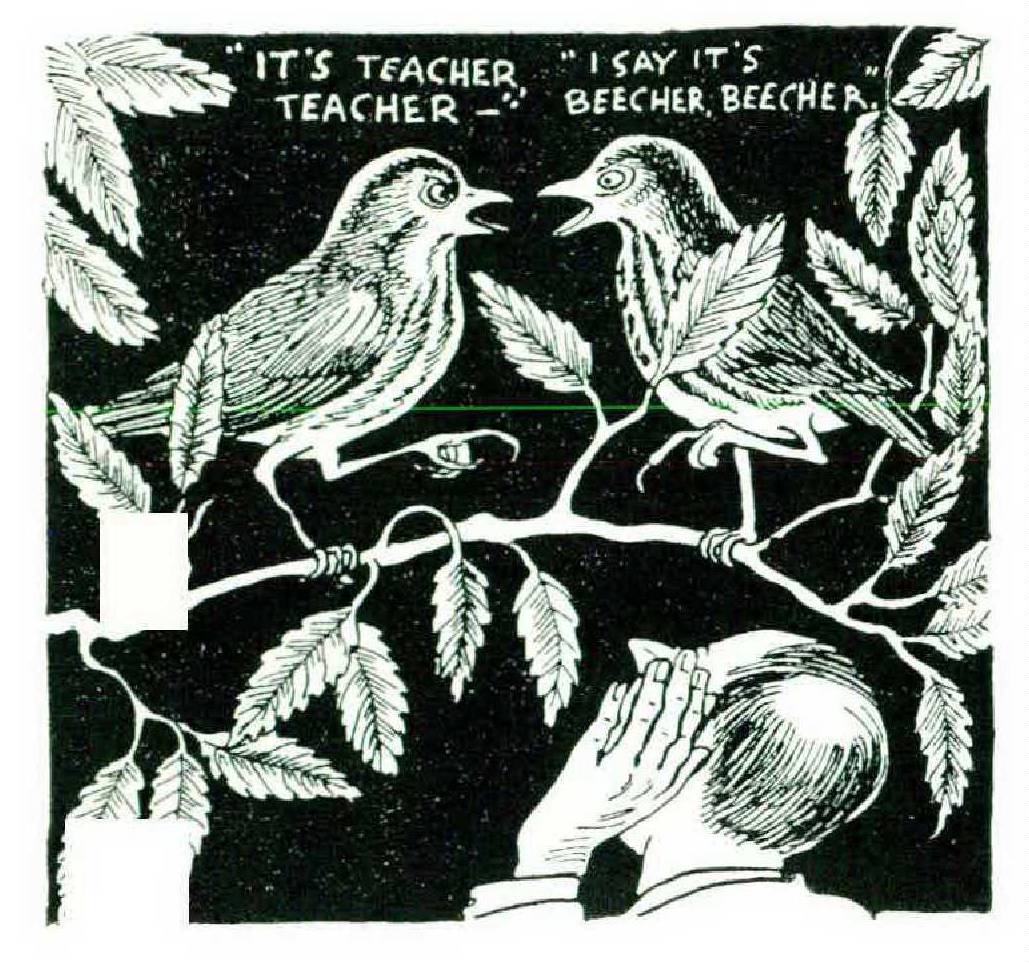
The cry of the Ovenbird and what they do with it will illustrate what I mean. One of my books described it as “teacher, teacher, teacher,”while another insisted that it is “Beecher, Beecher, Beecher.” The discrepancy seems innocent enough until we examine these two authorities a little further. Then we discover that the one who heard the Ovenbird cry “teacher” noted also that it was conspicuous for its “pale pinkish legs”; whereas the one who heard it call “Beecher" reports elsewhere that the song of the Chestnut-sided Warbler is “I wish to see Miss Beecher.” One does not have to be much of a psychologist to see what has happened here: this Miss Beccher was a teacher who distracted both these men in their schooldays and left one of them, at least, with a permanent traumatic fixation.
Such men are of course more to be pitied than censured. And perhaps there is no real harm in some of the others who indulge in the vain and petty practice of ascribing their own unbirdlike names to the helpless creatures they study. If Mr. Wilson and Mr. Harris want to pin their hopes of immortality on the tail of a sparrow, I suppose there is no great harm done to science. But there is a third group of ornithologists whose foibles make them downright unscientific, in my esteem. I am thinking of those who lose their objectivity and indulge in the most obvious kinds of favoritism and prejudice.
Can there be any other explanation of the statement in one of my bird books that the Scarlet Tanager “sounds like a Robin with a sore throat”? Is there any conceivable excuse for the universal conspiracy among the ornithologists against the Booby, the Noddy, the Coot, and the Widgeon, whose vocalizings are not even recorded in my books? Is there any reason why the honest amateur who pays good money for these volumes should himself be given the bird, too, along with the birds? If you want to recognize the White-eyed Vireo, says one of these men of science, listen for him to say, “See me, you hick!”
But of course it is the birds themselves who are the first, and worst offenders; after a very few weeks of bird-listening I decided that the sanest of men devoting himself to their twitterings and twirpings is in danger of becoming somewhat twittery and twirpy himself. If you ask me, a bird in the hush is where it belongs, and anyone who tries to figure out what it is saying will soon find himself listening up the wrong tree.
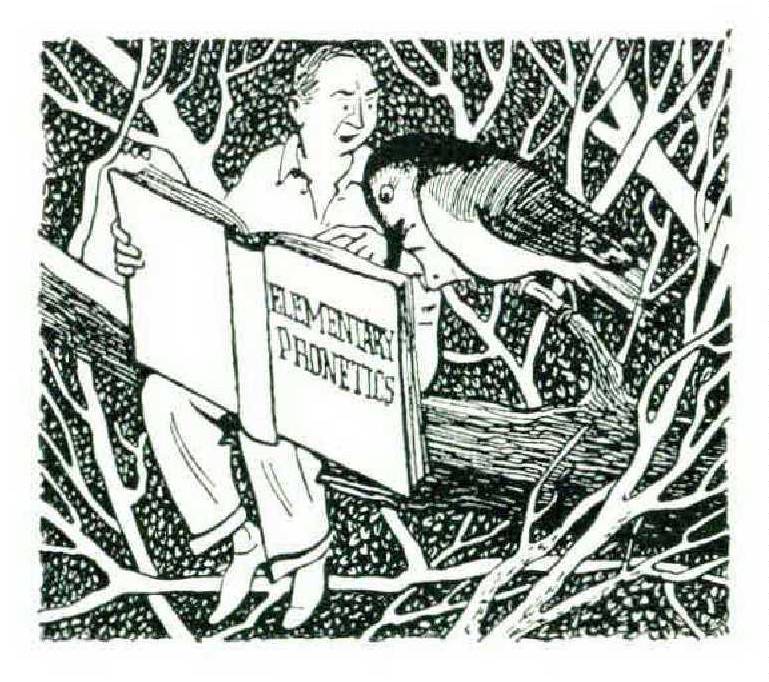
I must confess, however, that I did learn one thing of value from my brief experience with birds and bird books. Now, whenever one of my bird-loving friends suggests a bird-walk, I answer in the words of the Brown-headed Nut hatch, “Nya — nya!”