The Palio
CARL DE SUZEinterrupts his radio and television broadcasts each pear with travel overseas. Here is an item from his most recent trip to Italy.
by CARL DE SUZE
THE Palio, a breakneck horse race round the Piazza of Siena, has taken place twice a year for some seven centuries. It is no Turf Classic; the race itself is merely part of a general festival; the winner is chosen beforehand, and both jockeys and horses are rank though enthusiastic amateurs. Nevertheless, July 2 and August 16 see the ancient walled city flooded with tourists, reporters, and newsreel cameramen. Half pageant, half uproarious party, the Palio is unmatched as a spectacle.
It all began in 1260, when the newly constituted Sienese republic looked around for a satisfying substitute for the intramural skirmishes which had hitherto entertained its sixty (now seventeen) contrade, or neighborhoods. Warfare, having been pronounced an unseemly sport, was replaced by boxing and tilting matches, with a palio, or banner, awarded to the winning contrada. These contests were followed in turn by bull hunts and buffalo races, under the brief Spanish rule of the seventeenth century. Thereafter the Palio took the form it has today: a bareback race through the streets of the town, though it is now confined to the central Piazza del Campo.
Each of the seventeen contrade is represented by one horse, but in each Palio the entries are limited to ten, these determined by lot. Thus the seven contrade left out run later in August against the three best runner-up horses from the July Palio. Not only the horse but the rider as well is chosen, and there is a no-substitution rule in case of injury or other misadventure. As most of the horses, bought from local farmers, are new alike to racing and to their particular jockeys, this rule often causes considerable anguish.
The excitement begins the day before the actual Palio, when an elimination race is run off. All the entries run again next day, but the rehearsal serves as an indication of form to the Palio segreto, which decides that night who shall be allowed to win. Representatives of each contrada meet in the Mangia Café (named for the prodigious campanile across the square), and dicker over their Chianti. Those fantini (jockeys) who have agreed to hold back bargain with those due to win, place, and show; the money is used by their contrade toward the purchase of better horses for next year.
Meanwhile, all the other Sienese march through the town, from bar to bar, with their contrade. Becoming flown with insolence and wine, they bellow forth the medieval Palio song. It has, by this time, acquired hundreds of unprintable verses, but the general purport is that
The tower of our opponent is like dirt and a disgrace to the city.
The clamor reaches such a pitch that Siena’s dark, listing old houses seem about to topple inward onto the rioting marchers. Venerable nags, heroes of former Palios, are part of the crowd. After years of celebrating, their palates are so finely developed that they can detect a bar at a thousand paces, and will not pass its doors until given a drink.
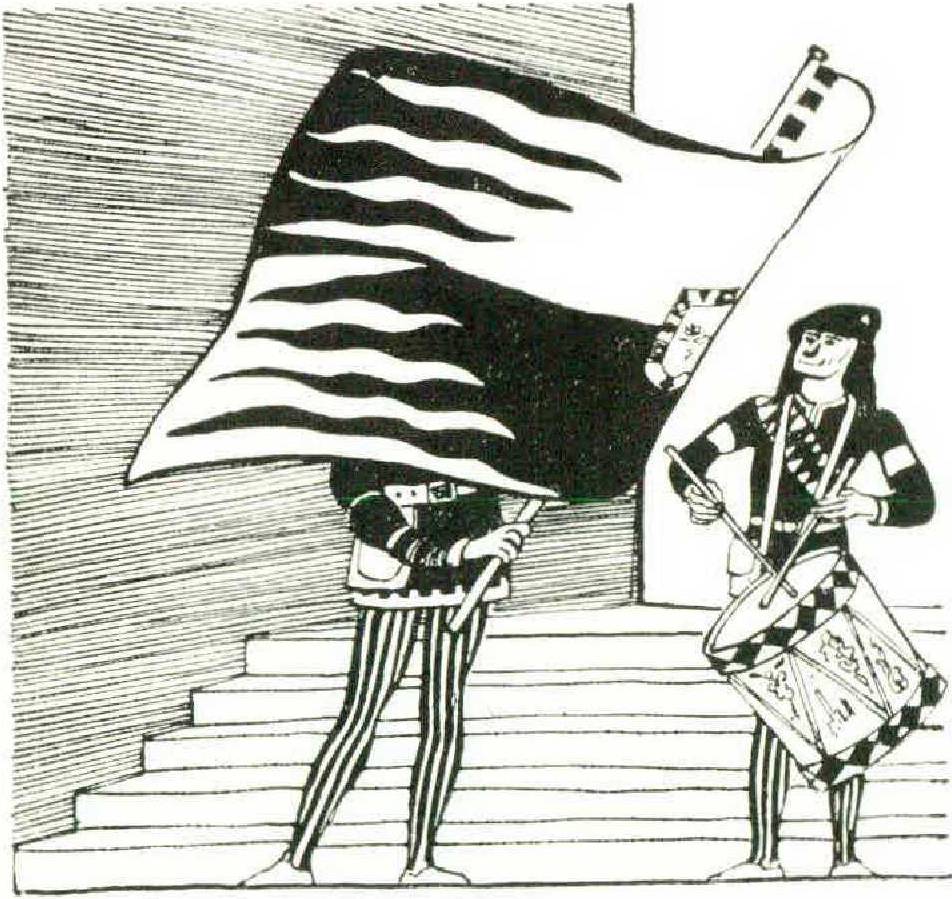
The next morning is spent in recov - ering from the preliminaries. At four in the afternoon the Palio begins officially with the Blessing of the Horses at a neighborhood church. Then the contrade form for their parade to the Duomo. The brilliant procession floods into the open, sunlit court like a spreading whirlpool. A clangor of trumpets and drums announces each contrada. The marchers — mace-bearers, knights, captains, pages, and others — are richly caparisoned in gilded armor, fantastic headdresses, and the flowing silks of the High Renaissance. Alfieri, or standard-bearers, with pennants and gonfalons strut by the cheering crowds. As each contrada reaches the Duomo steps, there is a great ruffle of drums, and there, before the glittering, flamboyant façade, the alfieri perform their renowned Gioco delle Bandiere.
The two men unfurl their great flags, blazoned with the ensign of the contrada — for Valdimontone, for instance, a white ram on an orange field. With extraordinary dash and elegance, they weave their banners under their legs and around their necks and waists. The strain of the writhing silk is so great that it has been known to snap the thick poles. The alfieri crouch in unison, and the silk describes slow serpentines above their backs; a somersault, and they are erect, spinning the banners in pinwheels so swift that the colors blur. Fluid and symmetrical, their performance has the hypnotic quality of a ritual dance, and it culminates in a superb salute.
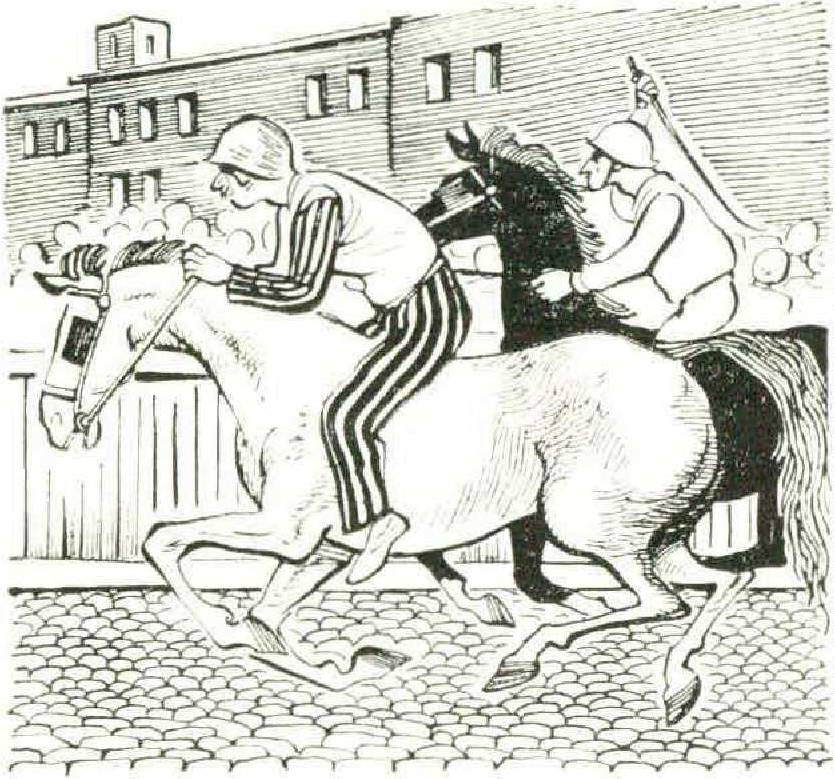
A banner is awarded to the most brilliant executant, and this honor is so highly prized that certain contrade support their alfieri, to ensure a yearlong dedication to the art. This point of view, like the Palio festival itself, is typical of Siena, a city which prides itself on being more Italian, even to the purity of its accent, than any other. The wild enthusiasm surrounding the Palio is vented to the fullest by the crowd. Each contrada, passing the stands, is greeted by violent cheers or the most venomous booing. Those unfortunates who have not won a Palio for thirty years or so are received with scornful fury. The parade takes about four hours; but, by eight o’clock, with the horses champing at the starting gate (two hemp lines) the excitement is unabated. The fantini, bareback on their sweating farmhorses, wear the archaic harlequin silks of their own contrade, and each carries a nerbo, a whip made of a dried tendon. It is used equally to encourage one’s mount and intimidate one’s opponent. All the fantini, consequently, wear steel helmets.
A cannon shot starts them off in a thundering scramble, for three laps of the track, bounded by two-story stands and enclosing an oval packed with screaming partisans. In that crazy charge, a fall would be fatal, so the fantini, aside from nerbo-flailing, devote themselves to sticking to their slippery mounts. As they come thudding and floundering into the stretch, an insane roar rises from the crowd. Even the smallest bambini, high on their fathers’ shoulders, shake their fists and howl imprecations.
The fact that the race was fixed has nothing to do with it. What you can’t bet on you can still shout about — all night long, if you like. The Palio festival comes to its climax in a mighty banquet, with public tables set out by the women of the winning contrada. The streets reek with wine, garlic, and smoking olive oil, while the torches flare down on a sea of yelling, reeling celebrants. Most Italian of all festivals, the Palio is still a spontaneous party, after 700 years.
The fortunate visitor may be witness to some pleasing disaster. The Palio of July, 1952, for instance, will go down in fame. On that splendid night, the fire department joined the party, being forced to run up the soaring Mangia tower, whose illuminated battlements hung like a fireballoon over all Siena. It was almost too much of a good thing: the torches were about to burn down the bell.