Colas on the Nile
CHARLES J. ROLO,who writes “Reader’s Choice” for the Atlantic Bookshelf, spends several months each year traveling in Europe. Here is his report on his recent sojourn in Egypt.
by CHARLES J. ROLO
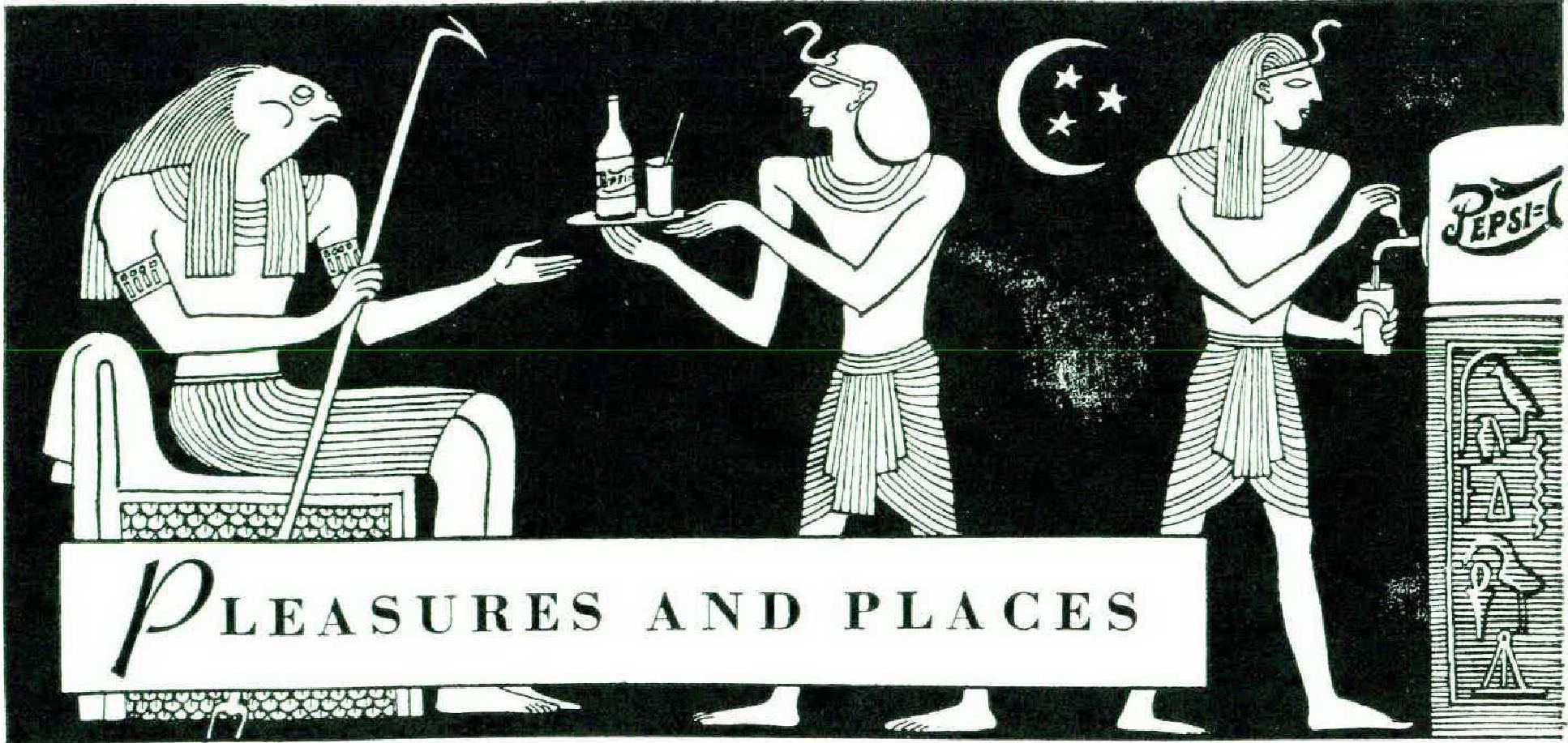
A MIGHTY voice can be heard crying, these days, throughout the land of Egypt, and the words it utters incongruously evoke the U.S.A. This new voice — now as familar a sound in the Valley of the Nile as the cry of the muezzin calling the faithful to prayer — is the voice of innumerable vendors calling on the thirsty to refresh themselves with ice-cold CocaCola or the rival product, which, since the Egyptians have no letter P, is known to them as “Bebsi.”
The population of Egypt, I discovered on a recent visit, has taken to Cola drinks in a big way since I was there just after the war. “ Bebsi ” first hit the Egyptian market in 1949, and today Cairo drinks more Pepsi-Cola than any other city in the world with the sole exception of New York.
Bottled on the spot, where labor costs are low, the Cola drinks sell in Egypt for a fraction less than in the United States. Aside from the fact that they are cheap, they have captured the masses not so much because of what is in the bottle as because of what the bottle is in: the coolers have put over the Colas in Egypt. Thousands of these coolers have been distributed, at cost price or less, to vendors who in the past had no effective means of keeping their drinks cold. Romantics and archaists may shudder at the thought of Cokes by the Nile and Pepsi billboards on the route to the Pyramids. But the Cola drinks have a priceless merit in a warm country where it’s risky to use ice, except in private homes and first-rate establishments — they are cold AND they are germfree.
Egypt’s tourist trade showed signs of picking up last season after a prolonged slump caused by the post-war political troubles of the Middle East. The war in Palestine, and later the Anglo-Egyptian clashes in the Canal Zone, were accompanied by a mounting fever of xenophobia which was deliberately fanned by certain political groups. But all responsible Egyptians were deeply shaken and shamed by the anti-Western orgy of mob violence which ravaged the heart of Cairo on January 26, 1952; and the present government has given reassuring signs that it will not countenance hooliganism vis-à-vis the foreign population.
The Naguib regime is extremely eager to encourage tourism, traditionally a major source of revenue to the country. When a cruise ship brought several hundred Americans to Egypt last March, Cairo and Alexandria were bedecked with streamers inscribed “Welcome U.S.S. Constitution,” and a new sign — “Welcome to Egypt” — greets you at the Cairo International Airport. To smooth the foreigner’s entry into Egypt, the Egyptian State Tourist Department has its own English-speaking “Courtesy Officers” at the principal ports and airfields; and the customs officials, who in the past were sometimes pretty boorish, have been treating visitors with touching amiability and with exemplary dispatch.
General Naguib himself is highly conscious that tourists are only slightly less necessary to Egypt than the waters of the Nile. Last spring, when a party of Americans was being conducted through Abdin Palace, the General unexpectedly appeared to greet them in person and was more than willing to autograph their postcards. Naguib again put in a personal appearance at a tea party given for visiting Americans at the Royal Rest House out by the Pyramids, and the visitors departed mightily impressed by his geniality. As one Cairo dragoman put it, “Mohammed Naguib, him liking tourists very much” — and this sentiment has been communicated to policemen, taxi drivers, and such, with agreeable results. Barring some acute political crisis, this winter’s travelers should find the Egyptians in a hospitable mood.
The riots of January ‘52 have left the center of Cairo looking as if it had been lightly blitzed. Of the seedy grandeur that was Shepheard’s Hotel, nothing is left but a pile of rubble screened off by hoardings, and the neighboring quarters are dotted with empty lots, similarly veiled. The main streets are decidedly cleaner than they used to be, and the police are trying to make beggars conduct their business elsewhere. These reforms have not, I hasten to add, progressed so far that the tourist is deprived of his eyeful of “picturesque” squalor even in the classiest section of town. And periodically whining pleas for baksheesh still fall upon the ear.
Cairo’s fleet of taxicabs, which in ‘45 was in a grandiose state of disrepair, has been fortified by a contingent of post-war models of various makes whose radios give forth, in counterpoint to the insistent tooting of the horn, the anguished wail of an Arab crooner intoning a love song. Transportation in Egypt has considerably improved. The express trains between the main cities have jacked up their average speed to a dizzy 35 m.p.h.; and on the Cairo-Alexandria run there are now, once a day, “refrigerated” (that is, air-conditioned) compartments. The Misr Airline, which has daily flights all over the country, has replaced its battered old crates with up-to-date Vickers Vikings. Its safety record is sufficiently good to make me choose air travel in Egypt, any day, in preference to the railways.
Before the war, and especially in the twenties, the winter season in Egypt was very fashionable among the milord class of traveler, who arrived with thirty pieces of baggage and a personal servant or two, and who usually stayed the whole season, making a leisurely trip to Luxor by Nile steamer. Most of today’s visitors from the West belong in a less exalted income bracket and they have a far more hurried time schedule. But the post-war changes in the international travel picture have their compensations as far as Egypt is concerned. For the four-engined airliner has brought Egypt within reach of Americans who could never go there by sea. It is now a 32-hour flight from New York to Cairo on one of TWA’s Constellations, and sleepers are available (at extra cost) crossing the Atlantic.
Another break for Egypt is that some of the Americans who have been flocking to Rome have discovered that the Pyramids are just five hours’ flying time from the Colosseum; and that, by stretching their outlay on transportation another 20 per cent or so, they can take in the Valley of the Nile. The best time to visit Egypt is between December and April, which makes it one of the few places whose tourist season falls within the months when the airlines arc charging “off-season” rates. The round trip from New York to Cairo in winter costs $772.80 (tourist rate), in summer $842.80. The first-class fare in winter is $1043.50.
The American dollar goes a bit further in Egypt than in the more expensive countries of Western Europe. Hotel accommodations in the first class and de luxe bracket range, in season, from $3.50 to $6.50 a day for a single room with bath, and from $6.75 to $9.75, American plan. The table d’hôte meals are strictly pricecontrolled, the ceiling in top-bracket places being $1.20 to $1.50 for a fourcourse lunch, and $1.50 to $2.10 for dinner. It costs more, of course, to order à la carte, but nowhere in Egypt will you encounter a murderously inflated check. Scotch whiskey, French wines — in fact, most alcoholic drinks — are slightly cheaper than in the United States.
By far the best hotel in Cairo is the Semiramis. It is not as central as the Metropole, but it is handsomely situated beside the Nile, at a point where the river majestically widens. The Mena House Hotel, overlooking the Pyramids, twenty minutes from town by car, is a good choice for the traveler who is staying some time in Egypt: it has a riding stable, tennis courts, a swimming pool, and a ninehole golf course. The tourist with a slim bank roll can save himself some money, and enjoy an extra helping of local color while doing so, by going to the Arabia, a onetime Cook’s Nile Steamer converted into a high-class pension and moored near the Gezira Sporting Club. In winter, there is a drastic shortage of hotel space in Egypt, and it’s imperative to make bookings well in advance.
Reports such as this one usually contain an alarming paragraph on the health hazards of the Orient, and certainly it’s the better part of wisdom to be extremely choosy about where and what you eat and drink. A smallpox vaccination is necessary and it is prudent to be immunized against typhoid, but there is no earthly need, as some travel experts prescribe, to subject yourself to the torture of shots against cholera, typhus, and other scourges —unless, peradventure, you are planning to do the field work for a sociological treatise on the slums of Cairo.
The cuisine in the top hotels and most reputable restaurants — the St. James, the Ermitage, and the Regent — can best be described as FrancoItalian with a Levantine accent. The accent appears in the form of various pilaffs (the most delicious is with quails), fried aubergines, a ragoût of green beans and okra, and a few other dishes, all more or less genteel as compared with the greasy, highly seasoned specialties of the Middle East. There are, however, several moderately hygienic establishments where you can sample pukka Oriental food pretty safely, provided, of course, your digestive system is robust.
Haassan El Hati has two well-known Arabic restaurants, where you might start off with a glass of zibib (an absinthe-type aperitif, extracted from dates) and Ta’amia, a fritter of crushed haricot beans, green coriander, onion, garlic, and bread; then try the admirable kebab or the kuftas (a kind of small hamburger, made of minced lamb, plus various seasonings). There is also a large choice of Oriental specialties at El Chimi and at the Parisiana. Here are a few more items which the adventurous gastronome might ask for at these places: Melokhia, a glutinous soup made of various green herbs, rabbit stock, and garlic, and accompanied by boiled rice with rabbit or chicken; Fool Medamis, brown beans cooked with a handful of red lentils for as long as twelve hours, then sprinkled with olive oil and topped with hard-boiled eggs; Tahina, a purée of sesame seeds, oil, and crushed garlic, which you scoop up with slices of unleavened bread. If, after this kind of fare, your thoughts should stray to the chaste precepts of Mr. Gayelord Hauser, you can always finish off your meal anywhere in Egypt with a bowl of yoghurt. One of the country’s greatest culinary treats, though it may offend the tenderhearted, is grilled figpeckers — tiny birds served on a bed of pilaff and eaten more or less whole.
As far as sightseeing in Cairo is concerned, there is a time-honored program for newcomers with three or four days at their disposal, and I see no reason not to follow it — the Pyramids and the Sphinx; the Museum of Egyptian Antiquities, which houses the Tut-Ankh-Amen collection; the Citadel; Memphis and the Tombs of Sakkarah; the Mosque and University of Al Ahzar, the oldest (tenth century) and most important center of Islamic learning; the other mosques, of which Sultan Hassan is perhaps the finest, and the Coptic churches. I have but one tip to proffer: if time gets pressing, don’t try to see all of the mosques, churches, and palaces; skip the secondary museums and other places prescribed by the guidebooks; but allow for a second visit to the Museum of Egyptian Antiquities. Its treasures — among them a group of early Egyptian paintings, extraordinarily modern in technique — are of more interest, artistically, than anything else in and around Cairo.
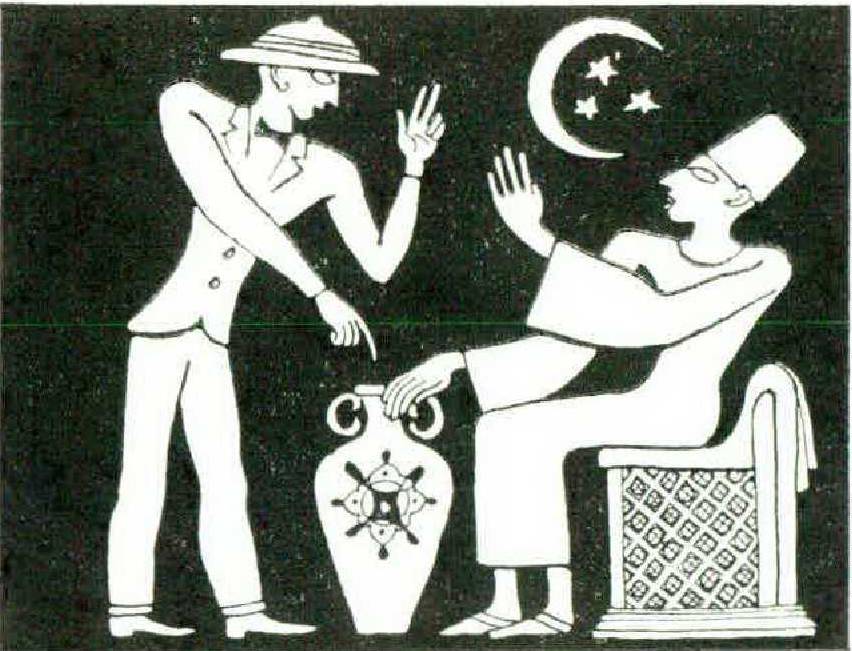
On my last visit to the Museum, I was seduced into accepting a guide whose spiel, though culturally unenlightening, was memorably comic. He recited away at unbelievable speed, pausing to draw breath only when it seemed that some sort of seizure was imminent; his erudition was boundless in all such footling matters as the number of rubies in a bracelet; and nothing could have been more entrancing than his English, which went somewhat as follows: —
“Dees jewels dey come from tomb of a queen. So what iss her name? Her name iss Heteberis [Hetepheres], and she iss de mudder of Cheops, and Cheops he is building de great Pyramid. . . . See dees necklace. Dees beads is made of a gold, made of a copper, made of a turquoise, and is fastening on de backside wid gold clip, 21 carat.”
The tourist visiting Egypt for the first time had probably better, unless he is exceptionally resourceful, resign himself to hiring a dragoman; and the best policy is to apply to one of the leading travel agencies. By hiring a good dragoman you will, if nothing else, keep out of the clutches of the dubious dragomen who assault the unescorted tourist in the street, and who are often in a league with the petty racketeers who flourish in the Middle East.
At this point, I should like to interject a word or two about the legend that the tourist is bound to be swindled in Cairo whichever way he turns. There are, to be sure, in the streets of Cairo, a host of wily entrepreneurs who are infinitely skilled at fleecing the gullible traveler. But anyone who has truck with these characters is, by definition, a sucker. For unaccountable reasons, even hardheaded Americans, as soon as they breathe the air of Egypt , are prone to imagine that they are being devilishly astute when they fall for the pitch of some street-corner shyster, who leads them to a “little shop” where they are offered “star sapphires” for a song and ”Chanel Numéro Cinq” for less than its wholesale price in Paris. Anyone who buys his goods and services from reputable sources, and counts his change when dealing with taxi drivers and such, will, I am sure, leave Egypt without having suffered appreciably from fraud.
Every visitor to Cairo is taken on a shopping expedition to the Khan el Khalili Bazaar and the adjoining Musky. The Bazaar is a long, very narrow street, dirty and malodorous, where a certain amount of the stuff displayed as characteristically Egyptian originates in Manchester, Prague, or Tokyo. But it is perfectly possible to get good value for your money provided that (a) you bargain resolutely, (b) you stick to a few local specialties such as inlaid silverware and brassware, leather and ivory goods, inlaid wooden trays and cigarette boxes, and silk brocade (not up to the Damascus product, but fine stuff). Anyone with really ambitious purchases in mind will find it safest to go to the well-known Dialdas, or to Geneshi Lall.
In the winter, Cairo has a season of opera and an extremely bustling night life, even though liquor is removed from the table at midnight. The notorious Egyptian danse du ventre is performed at the Casino Beba — a rowdy joint which seats a thousand customers— and, in less uninhibited style, at the Kit Kat. The Helmieh Palace is the Diamond Horseshoe of Cairo. The smart set does its dinner-dancing at the Semiramis, the Heliopolis Palace, or the Auberge des Pyramides, then goes on to the Scarabée, which is probably the toniest boîte in the Middle East.
No visitor to Egypt should, as the saying goes, fail to go to Luxor, with its awesome Valley of the Kings, its Temples of Karnak, Colossi of Memnon, and other celebrated pieces of masonry, which help you to think of history sub specie Professor Toynbee, and remind you that the Parthenon, say, is practically art nouveau. From Cairo to Luxor (Winter Palace Hotel) is an overnight journey by train, and roughly three hours by the Misr Airline; the Nile steamers are not yet back in business. Assouan (Cataract Hotel), with its mighty Nile Dam and fine scenery, is 125 miles up the river from Luxor, and between them at Edfu and Kom Ombo there are two of the most perfectly preserved temples in Egypt.
An admirable way to see something of the Egyptian landscape, the villages and the life of the fellaheen, is to drive from Cairo to Alexandria via the old route which skirts the Nile Canal. (The return journey can be made on the vastly superior road through the desert.) Whichever way you look, there is a perfectly flat plain, carved up into rectangular patches bounded by irrigation ditches. The countryside is sparsely dotted with mud houses, a cluster of palm trees, a row of poplars or casuarinas. The peasants are tilling the soil in much the same way as their forefathers did a millennium ago. And on the Canal, when there is no breeze to power their sails, you see cottonladen dahabiehs being tugged along by a thick rope wound around the bodies of six or eight sweating peasants.
A day or two in Alexandria is a refreshing respite from Cairo sightseeing. The town is cooler, cleaner, and less raucous than the capital, and immeasurably closer to the West. The Cecil, an excellent hotel, is the best place to stay in winter; the San Stefano, Beau Rivage, and Méditerranée, all beside the beaches, are agreeable in summer.
Ambitious tourists, who want to make the most of their investment in transport to the Eastern Mediterranean, can conveniently fit Egypt into several larger programs of travel. You can fly on to Athens by TWA, returning via Rome, Madrid, and Lisbon, or you can visit the Christian Holy Places in Jordan (it’s a short flight to Kolundiu, airport for the Arab half of Jerusalem); then travel by road to Damascus and Beirut, where there are Pan American flights through Istanbul to the U.S.A.