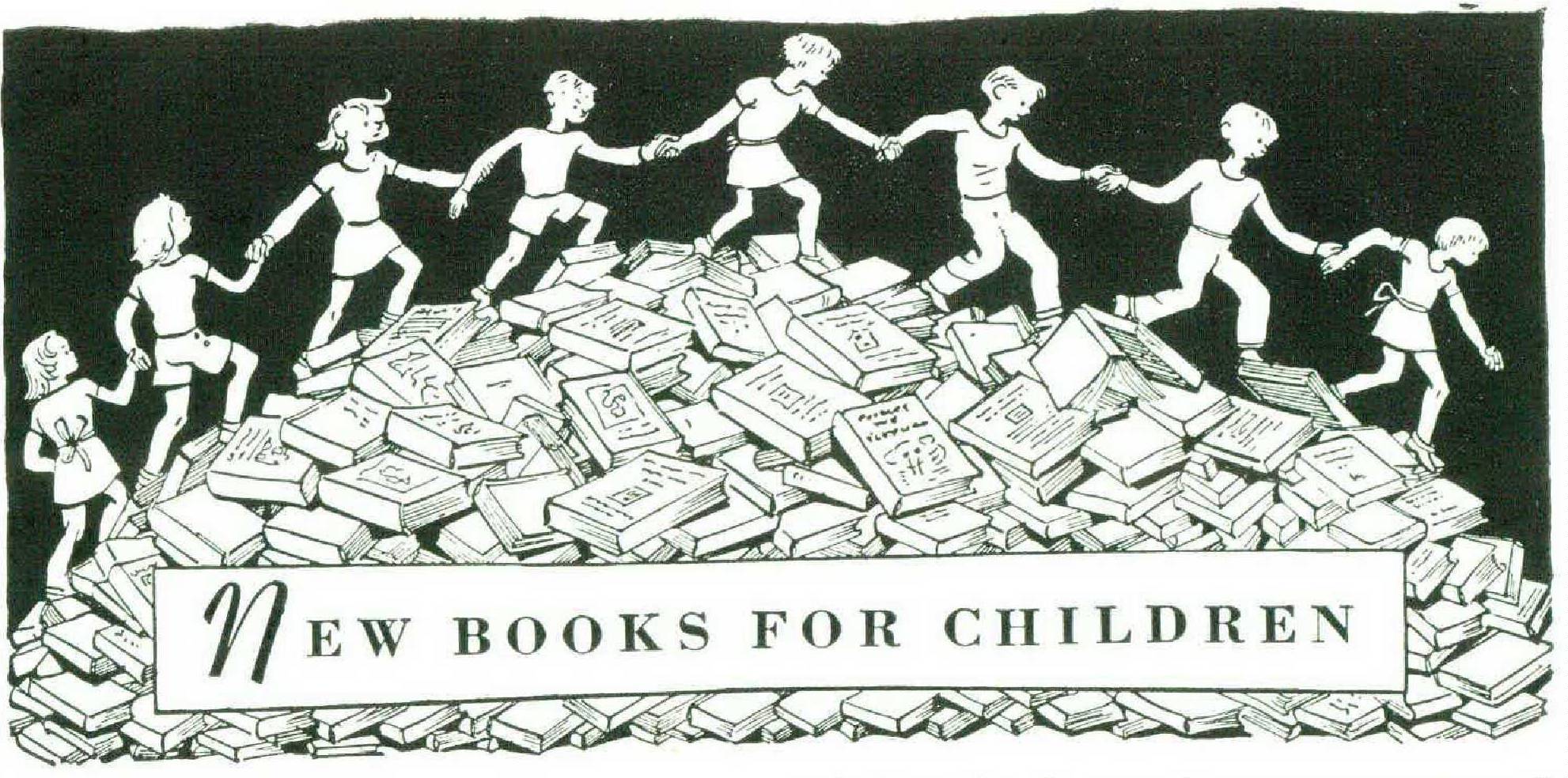
New Books for Children
MARGARET FORD TVIERAN was Children’s Page Editor of the Boston Herald for twenty-three years. She is the author of a juvenile, David and the Magic Powder, and at present is working with her husband, John Kieran, on a young people’s Life of Audubon.
MARGARET FORD KIERAN
I CANNOT understand why going over hundreds of children s books each year puts me into such a state when I arrive at the point of recommending a few to you. After all, mine is just one person’s opinion and you can ignore the selections and make your own ii you are so inclined.
But would it be the wise thing to do?
Think of all the wear and tear you avoid by having a little memo pad by you as you look over this list. You can sit quietly at home feeling properly sorry for people who are herded in bookshops where the hot breath of Christmas shoppers is always on their necks.
Here, then, are my 1953 choices, and I pass them on for Christmas sampling.
Christmas sampling? Much of my sampling was done in Gloucester, Massachusetts, this past summer — where, incidentally, I had no young readers to help me as in other years at Nantucket. Gloucester is a place for sailing and picnics in the pines; a place for diving into sun-warmed quarries after clamming; it didn’t seem to be the right place to corral an associate reviewer, age thirteen.
“Oh groans! Can’t I read it tomorrow instead? “ was what one of my intended always asked. So I had a go at the books alone, and by late fall, after I had scrutinized several hundred, I found it helpful to divide and appraise the new juveniles in selections for the Little, for the Middle-sized, and for the Big age groups.
There was a time when publishers tried to back one into a corner and say that such a book was for boys and girls of a certain age. But with a growing realization that many children cannot be easily pigeonholed, some publishers have even gone so far as to come right out with a declaration that their book is “for all ages.” Walt Kelly’s Pogo, published in book form by Simon & Schuster, unquestionably has that irresistible ageless appeal. Mr. Revere and I is another example. In a general way, however, it is helpful to have at least this Little, Middle-sized, and Big grouping.
FOR THE MOPPETS
I’ll start off first with the moppets’ picture books and give a loud “Huzza!” to Fiorina and the Wild Bird by Selina Chonz (Oxford University Press). Perhaps you remember A Bell for Ursli by the same author. If you do, it will not be necessary for me to whip up your enthusiasm for the story or for the beautifully fluid illustrations of Alois G. Carigiet. The setting here, as in the earlier book, is the Swiss Alps, and the lilting verses recount an adventure that has all the suspense of the poem known familiarly as “The Night Before Christmas.” Translating Fiorina and the Wild Bird from the German must have been a tantalizing task, but it has been well done by Anne and Ian Serraillier.
When a new book by Munro Leaf appears, it is not necessary to say much about it except that there is a new one. His latest, Reading Can, Be Fun (Lippincott), is right up to standard in concept and presentation. Through it one can feel a child’s excitement upon seeing letters form words, and words form stories. As the dust jacket indicates, it ought to answer, once and for all, that frightening question of young people today: “Why should I bother to read if I can listen to the radio and watch television?” Mr. Leaf tempts them subtly and leads them on with an introduction to Alice in Wonderland, Mary Poppins, Robin Hood, and other characters whom they will surely grow to love. Please star this on your memo list.
For a younger child there is Little Frightened Tiger by Golden MacDonald and Leonard Weisgard (Doubleday). Here a salutary lesson is taught, I think, by showing that fear isn’t too important, because everyone is afraid of something. Elephants are supposed to be afraid of mice, and mice (they do say) are afraid of their own shadows. So, if you have timid youngsters in the house, though goodness knows they seem to be a dying race what with space rockets a dime a dozen — but if you do happen to have some that cling to Mummy too much, this is for you. As a matter of fact almost any boy or girl under five would be amused by it, and if it fills a deeper need, so much the better.
Have you become acquainted with the series of “First” books that Franklin Watts publishes? They are fine introductions to such things as automobiles, baseball, bees, plants, and indeed to almost any subject about which a small child asks questions. Plenty of illustrations and good-sized type are other reasons for endorsing them.
Television is the agent responsible for another new series — the Ding Dong School books which are based on stories told by Dr. Frances Horwich, the “Miss Frances” of the NBC-TV show, “Ding Dong School.”They resemble somewhat in text and format the Little Golden books and are bound to attract attention.
The Golden books this year, by the way, especially the new Giant ones, are sure to be popular. One of the favorites will be Elizabeth Coatsworth’sDog Stories, beautifully illustrated by Feodor Rojankovsky. (Rand McNally publishes the Ding Dong, Simon & Schuster the Golden.)
Now we come to a slim little picture book by Ruth Krauss illustrated by Maurice Sendak (Harper). A Very Special House it is called. If you recall A Hole Is to Dig, which they did last year, you will get ready automatically for chuckles and cheers. Miss Krauss really penetrates a child’s mind. She knows he wants wild animals and she knows he wants them jumping over all the furniture — which is pretty well messed up by cracker crumbs anyway. It’s a lighthearted book and I loved it, but I have a strong feeling it will win the approval of fond uncles and aunts more than of parents. It’s not quite orthodox, as this excerpt shows.
The child says: ”I’m bringing home a giant and a little dead mouse. . . . Everywhere is music and the giant spilled his drinking and it went all over the floor . . . and everybody’s yelling for MORE MORE MORE!”
You can see it is no handbook for deportment, but in the blowing-offsteam department it deserves an award — and, as I say, I loved it.
FOR THE MIDDLE-SIZED
Now for boys and girls a little older I heartily recommend The Journey of Josiah Talltatters by Josephine Balfour Payne and Joan Balfour Payne (Ariel). The gray and sepia illustrations are very fine. The setting (Mississippi in the early 1800s) is background for the saga of one gentle clergyman who journeys with his nephew from Philadelphia to Natchez in order to build a church in that Mississippi settlement. The adventures that befall them on the way, the funny additions to the caravan, and most of all the old-fashioned fable style, put it way above the average juvenile in my opinion.
Then a beautifully told story is The Boy Jesus by Pelagie Doane (Oxford University Press). The Christ Child and His Family are portrayed in a familiar way which, nevertheless, achieves a nice feeling of reverence in this familiarity. It seems to me that young people of any creed would be richer for reading it. Did I say that the author was also the illustrator?
Mama Hattie’s Girl by Lois Lenski (Lippincott) I hail as an outstanding book of the season, and I predict that it will be read with relish by your children and their children. This story of little Lula Belle who lives with her Negro grandmother in the South is a warm and rich portrayal of not only one child or one family, but of an entire social question. I cannot imagine that any other juvenile I read this year will linger as vividly in my mind.
One always has a good solid feeling about asking for a Lois Lenski book, just as one does when picking up a new story by Ruth Holberg. This year I was charmed by Mrs. Holberg’s Tam Morgan (Doubleday). She has a facile and engaging way of making a child of the past seem contemporary. Her young readers always take more interest in history after putting down one of her tales — an added attraction for parents.
In a rollicking vein William Morrow has published another by Beverly Cleary. Remember her Henry and Beezus? Well, Otis Spofford is the new one and it has just as much small-boy deviltry and nonsense as the first. Probably won’t be endorsed by P.T.A. groups, but it certainly has enough of a Peck’s Bad Boy quality to make children between eight and twelve chuckle in secret, sympathetic glee.
Then it seems to me that a gold star for the most unusual juvenile should go to The Borrowers by Mary Norton (Harcourt, Brace). In the first place the idea is distinctive. She gives you little people living below the floor of a house, supporting themselves by “borrowing” all kinds of things. A pillbox made a fine table, for example, an old pâté de foie gras jar a bathtub; matchboxes were chests of drawers, and a postage stamp of Queen Victoria hung as a living-room portrait. These people aren’t fairies, you understand; or gnomes or elves or leprechauns. They are just little people about as high as a pencil.
The book is a specialized sort of thing in style as well as in theme. While some children might be delighted by it, others might think it silly. In other words, it has an Alice in Wonderland quality that puts it in a class by itself. I think you’d better examine this yourself before you take my endorsement, even though it won the Carnegie Medal in England as the outstanding children’s book of 1952.
With unqualified approval, however, I give you Mr. Revere and I, set down and illustrated by Robert Lawson (Little, Brown). Here is the story of Paul Revere and his times as told by his rather snobbish horse. If the device doesn’t attract you offhand, it must be because you don’t know how adroitly Mr. Lawson used the same method in Ben and Me. This latest (I think grownups will enjoy it as much as children) is easily one of my 1953 favorites.
All About the Sea by Ferdinand C. Lane (Random House) will serve as a fine introduction to that “All About” series which is interesting the average wide-awake young person between nine and twelve or thereabouts. Though the books contain much information and are presented with clear, attractive illustrations, they do not claim to be an end in themselves. Rather they serve as a springboard to more advanced books on the same subjects. If you give a child All About the Sea, for instance, you won’t be a bit surprised to learn, a few years from now, that he’s marched down to the bookstore himself for Rachel Carson’s The Sea Around Us.
And speaking of introductions, there is Nature Notebook by Robert Candy which Houghton Mifflin produced this year. The idea is an appealing one — a day in the open with a father and son — and by and large the result is all that the nonscientific layman could desire. Sketches by the author are very fine.
FOR THOSE OLDER
Now to the books for older boys and girls.
In a Mirror by Mary Slolz (Harper) is as penetrative and analytical as anything she has ever done. But is it a teen-age book? I confess I bogged down for a minute while I went through it because, as a streamof-consciousness journal of a presentday college girl, it would surely have Henry James looking to his laurels.
It is extremely well done, once you accept the heroine as a product of the “majoring in psychology” group. Smoothly written and as fascinating as certain psychiatric case histories can be, I nevertheless would not recommend it except to those teenagers of your acquaintance whose emotional balance is well established. They could handle it and would thoroughly enjoy it, no doubt, but for the more immature I think it is too introspective and somehow disturbing.
There always has to be at least one good animal story for the older group, and who can supply this need like Walter Farley?The Black Stallion Revolts (Random House) is this year’s product from his pen. Up to the usual standard. That is all that is required.
And cheers for a newcomer in this field too. Howl at the Moon by Robert Hogan (Houghton Mifflin) is a very, very exciting story. The young hero’s attachment to a dog and his determination to save him from being killed by his father pack suspense into the entire yarn.
For mystery fans try The Signal Net by Kenneth Andler (Ariel). In the thickening-plot department here, the reader is introduced to work done by the United States Coast and Geodetic Survey. And a lucky thing the two boys in the tale understood this work, because it results in their using one of the most original devices for a rescue signal I’ve yet encountered.
If you think that the 1953 crop of adventure and mystery stories is going to be limited to what happens on Earth, you just haven’t even caught up with 1951 thrillers. This year the books on space scientists are reaching a state approaching frenzy. Vandals of the Void by Jack Vance (Winston), for example, doesn’t take off from Earth at all. Venus is the starting point here, and there’s a murder mystery along with the talk of hydroponic tanks, cosmic ray research, and radioactive dusts.
In reading this I experienced a sensation somewhat like the one I felt when watching the famous circus family, “The Balancing Wallenders.” Each year they added some new gyration of incredible suspense on the high wires. Make their act interplanetary and you have an idea of what science fiction has reached these days.
As a companion volume to Vandals of the Void you should look at Rockets Beyond the Earth by Martin Caiden (McBride). No fiction this, it is based on scientific experiments conducted by the United States government as well as by civilian engineers.
For teen-agers Joan of Are by Nancy Wilson Ross and Mary, Queen of Scots by Emily Hahn (Random House) are two of the World Landmark series that merit your attention. Another is How Do I Love Thee? a life of Elizabeth Barrett Browning by Helen E. Waite (Macrae-Smith). Then in the true life adventures of famous men and women there is also the fine Signature Books series (Grosset & Dunlap).
For an all-round thing that would make a fine Christmas gift there is Pets by Frances N. Chrystie (Little, Brown). The publisher’s blurb in no way overstates its case when it says: “A complete handbook on the care, understanding and appreciation of all kinds of animal pets.” It is a wonderful book for any age, well indexed, and endorsed by a number of authorities in the field.
There you are, then, with Little, Middle-sized, and Big books for all ages. Look them over and see which will make life merrier as you gather around the Christmas tree.