Pity the Chairman
N. BRYLLION FAGIN is an associate professor of English at the Johns Hopkins University and director of its theater, lie is the author of several hooks, the latest being The Histrionic Mr. Foe.
by N. BRYLLION FAGIN
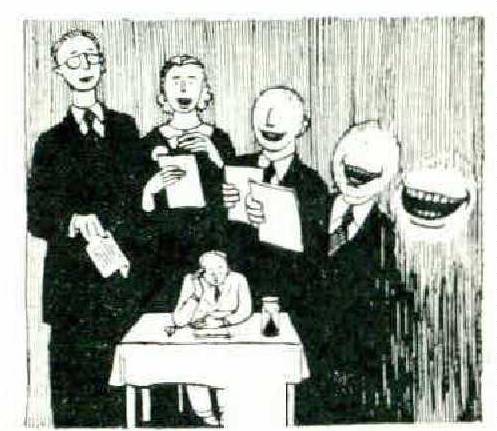
UNTIL a short while ago I attended conferences and conventions only as a delegate or visitor, and I often came away with unkind feelings toward chairmen or presiding officers. It seemed to me that they were a particularly smug and insensitive breed, sitting above everyone else, secure in power, smiling with diplomatic condescension.
And then came the dawn — when I was asked to chair a regional one-day conference; and swayed by reasons of expediency, loyalty, moral obligation, and pride I assumed the burden of the honor. Immediately I found myself turning into a diplomat, resorting to a benign smile for protective coloration and hiding my perplexity and trepidation by assuming an air of selfconfidence which shielded but did not warm me.
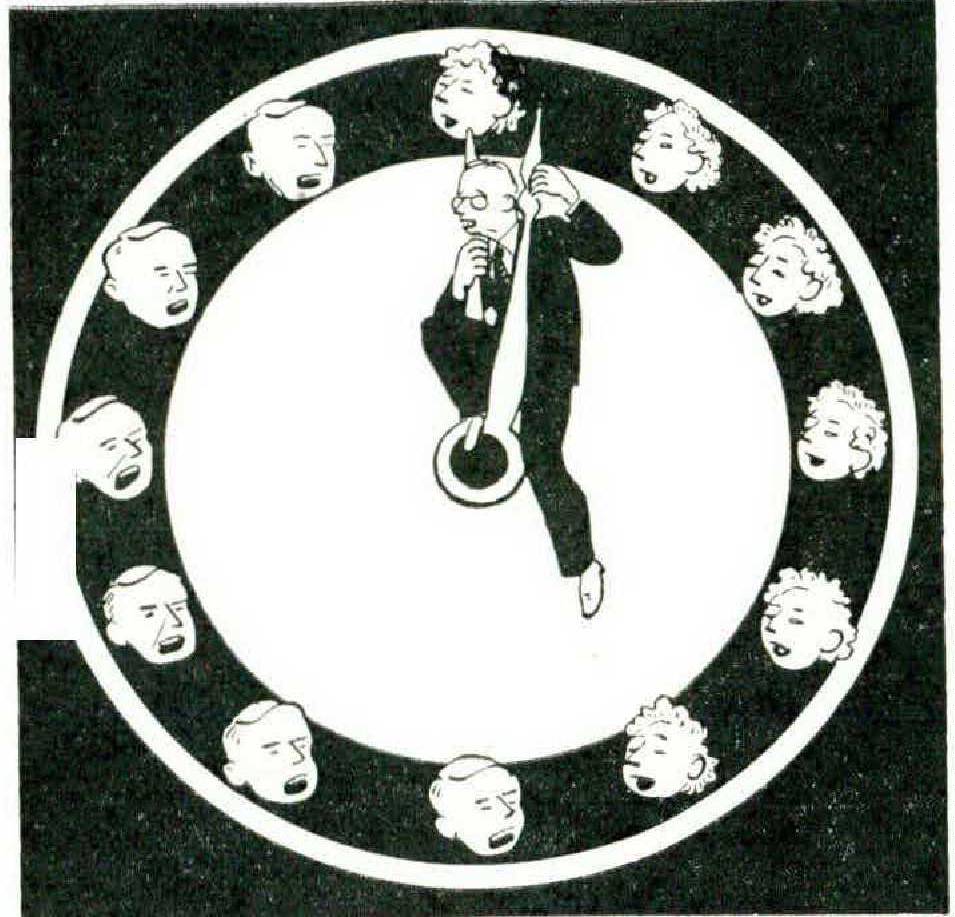
The program called for a Morning Session, a Luncheon Session, and an Afternoon Session. The Morning Session was to begin promptly at ten o’clock with some words of greeting by the president of the small college which played host to the conference. We waited twenty minutes before a lowly dean appeared with apologies from the president, who regrettably was unable to be with us. I introduced the dean with all the tact and eloquence at my command. And the man repaid me and the conference handsomely; he spoke for twentyfive minutes. The time allotted on the program to the greetings of the president was five minutes. We were thus forty-five minutes behind schedule when I introduced the principal speaker of the Morning Session, an important lady from an important educational institution. She had sat next to me on the podium during the dean’s “remarks,”and I had managed to whisper to her that, we were almost three quarters of an hour behind time, and she had charmingly reassured me that her talk would be brief. Unfortunately she had no prepared speech, only a package of three by five cards, and she proceeded to improvise to her heart’s content—and to my consternation and chagrin. To this day I don’t know what the lady said. But when she finally stopped talking I stood up and led the applause.
It was now 11.45; and before we could adjourn to lunch, at which a very famous literary figure — the pièce de résistance of the whole conference— was to enlighten and entertain us, two more items on the program faced me. One was a fifteenminute talk by one of my own colleagues; the other was a panel discussion in which six delegates, each representing a regional institution, were to participate. It was impossible to do anything about the second item, but something, I thought, could and should be done about the first.
“Ladies and gentlemen,” I announced. “I know that you are as eager as I am to hear the rest of the program of this extraordinary Morning Session. I also know that we are running considerably behind time and are in danger of incurring the enmity of the college chef if we are late for the excellent lunch he has prepared for us. I therefore take it upon myself to shift Dr. X’s talk to the Afternoon Session and to proceed immediately with the panel discussion. I am sure Dr. X will agree with me that an important talk such as his should receive the attention it deserves, which it won’t so near the lunch hour.”
I thought that I was being diplomatic and clever. Evidently I was neither. My colleague seemed to acquiesce at the time, but he has hardly spoken to me ever since — for, of course, I was not able to find a spot for him on the afternoon program.
And my words had the further effect of alarming my six panel participants— four males and two females. The first gentleman read every blessed word in his prepared manuscript and consumed fifteen minutes; the second speaker, a lady, edited her manuscript publicly, commenting, shading, disgressing, and “concluding” several times without coming to a full stop. I sent a frantic note to the third speaker and received a smiling promise of brevity, but once he got up he acted as though he were saying to me: “I have the floor at last and I am going to have my say, every bit of it; everyone else has had all the time he wanted and I am as good as everyone else, if not better. This is my moment of glory and I am going to live up to it, even if thereby I annoy some people.”
And he evidently did annoy a considerable number of people, for they began walking out on him. The last speaker had a mere token of an audience, which, of course, included the tired and wilted chairman. I guessed that these intrepid listeners were merely waiting their turn to become questioners, arguers, and commentators in the general discussion, and I was right. No sooner had I thanked my speakers than people began popping up, eyes blazing, hands upraised, demanding to be heard.
By then, however, I was not only tired but also desperate. The idea of more talk was intolerable to me. “I know,” I said weakly, “that you all have interesting things to say. Discussion from the floor is always stimulating and profitable. But lunch is waiting for us; it is getting cold; let’s go to it.” I could not help feeling that my suggestion was received with hostility.
The rest of the conference is not clearly registered in my mind. We ate chicken à la king—or was it tuna fish? — and a brick of ice cream with a green cookie. The literary celebrity was very jolly and we all laughed a lot. I don’t remember when the Afternoon Session began but it was over by 6 P.M., when I was saying “Thank you” to many people who thought the conference had been wonderful. I said it cheerfully, although I was not sure what I meant by the phrase. Perhaps I meant: “Hooray, it’s over!” or “Glad you think so” or — more irreverently — “Nuts!”