French Film
DORIS OVERLAND has reviewed books and done miscellaneous writing as a free lance. A former Bostonian, she now works in Springfield, Mass.
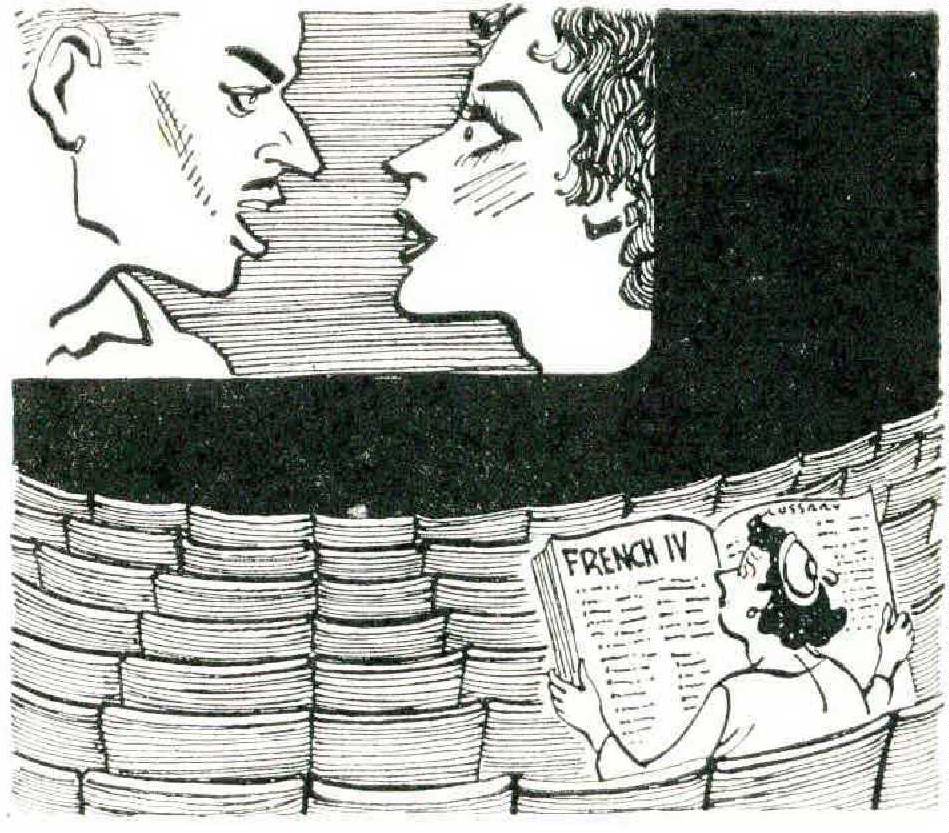
by DORIS OVERLAND
IT’S baffling not to know what they are saying when their noses are close to each other and their chins are set and their eyes are flashing. I can sometimes lose the thread of the whole plot that way. I think the French should speak a little more slowly when they get excited. This precision would be a good national characteristic to develop en colère, as it were, and then they would be sure of what they were saying themselves — and eventually it would be reflected in their drama, and I could understand it.
The French movie that I saw was about a man who went to prison for a crime which I don’t know whether he committed or not. Anyway, he got out when he was gray at the temples, and he immediately got mixed up with a lot of people whom he seemed to know very well from way back. Most of them were gray at the temples, too. He was very sweet to a charming young girl who was sick, and it turned out that she was his daughter. I knew that because he said, “C’est ma fille” — and I heard him plain as anything. I wish they would always speak like that. They could use shorter sentences, too. It makes better dialogue.
Nothing annoys me so much as to hear one character say to another, “Je pense que—” and then lapse into sheer gibberish. I want to know what he or she is thinking. I know perfectly well what “ Je pense que —” means. Another annoying thing is to hear one character pause and say quietly and clearly, “Cependant”— and then, just as I am all relaxed and ready to hear a slow, considered statement, have him add three or four blurred French words that I cannot possibly understand, because I can’t even distinguish the sounds. Sometimes a character will say “Cependant” and not say anything else at all. That is very disappointing, but it is to be preferred to the garbled mess that sometimes follows “Cependant.”
The movie was most interesting when the daughter of the man who got out of prison met a young man in a cemetery. He grasped her hand and pressed it to his breast and cried, “Je vous aime!“ She demurred haltingly that he shouldn’t. I approve of halting dialogue in French — just a simple word here and there. It conveys the story just as well as a lot of pretentious orating about one’s feelings. I catch up with the whole plot sometimes when one character gets out of breath and cannot say very much or think of long words.
I really got excited when the young man asked the girl to marry him. And when she demurred again, he cried, “Is it that you have no confidence in me?” The French word for confidence is “confiance.”She told him no, it was not that. And then she went a little too fast, and I caught only one word. It was “fidèle.” I realized then that she promised to remain “faithful” to someone who lay buried in the cemetery. Quel sentiment!
At another point in the plot there was a very interesting bit of dialogue. Two distinguished elderly men sat at a chess table and talked at length about something highly important. I strained both ears in vain, and it seemed that I should catch a few significant words, because there was a sonorous precision about their enunciation. I don’t understand how some French actors can sound so clear and yet not say anything. In this case I think it was the beards. This cinema was a gay-nineties period piece, and the elderly characters wore drooping beards. Beards do something confusing to the sound of a French voice speaking French. I am sure of it.
But suddenly one of these elderly characters said something clearly. It was “ Votre discrétion fortifie man sentiment.” That was a brilliant line — typical sparkling French — a veritable bon mot. It would have been nice to know just why the one’s discretion fortified the other’s sentiment.
All in all, it was a good picture, and I enjoyed it very much. Cependant —