Plaster
RIXFORD KNIGHT, from his farm at Jamaica, Vermonl, has supplied many light subjects for Accent on Liring.
by RIXFORD KNIGHT
IT IS inevitable that people who buy fine old country homes with one hundred and fifty acres of land, a picturesque barn, an all-year brook, and a wonderful view, all for “what it would take to put up the barn alone,”should become engrossed in the subject of plaster. There will BE other things too that demand attentionthings like leaky roofs, crumbly cellars, and the orneriness of the road commissioner—but the thing that will never fail them is plaster. This is especially true when the plaster is not supported by enough layers of wallpaper.
People who are new to rural interior decoration do not take into account the symbiotic relationship between plaster and wallpaper. Therefore they get a good deal of fun peeling off layer after layer of paper and exclaiming over the artistic tastes of the people who lived there before. But theirs is the humor of ignorance, and it is going to be paid for. Old-timers knew better—whenever they put new paper on they were careful to take off no more of the old than they absolutely had to. Thus cases have been reported of houses having fifteen layers of wallpaper, and the record is held by a fine old home in northern Vermont, which was supported by twenty-one layers of wallpaper. In cases like that it is sacrilege to peel off the paper. Worse. It is foolhardy .
There is only one time when old paper should be disturbed in old homes. This is right after a change in ownership. Blaster and paper art* very sensitive to changes in ownership. They will hang on indefinitely so long as I he old owner and his dressers and pictures and mirrors are there, but when these go they become dejected at once and some sort of patching job has to be done.
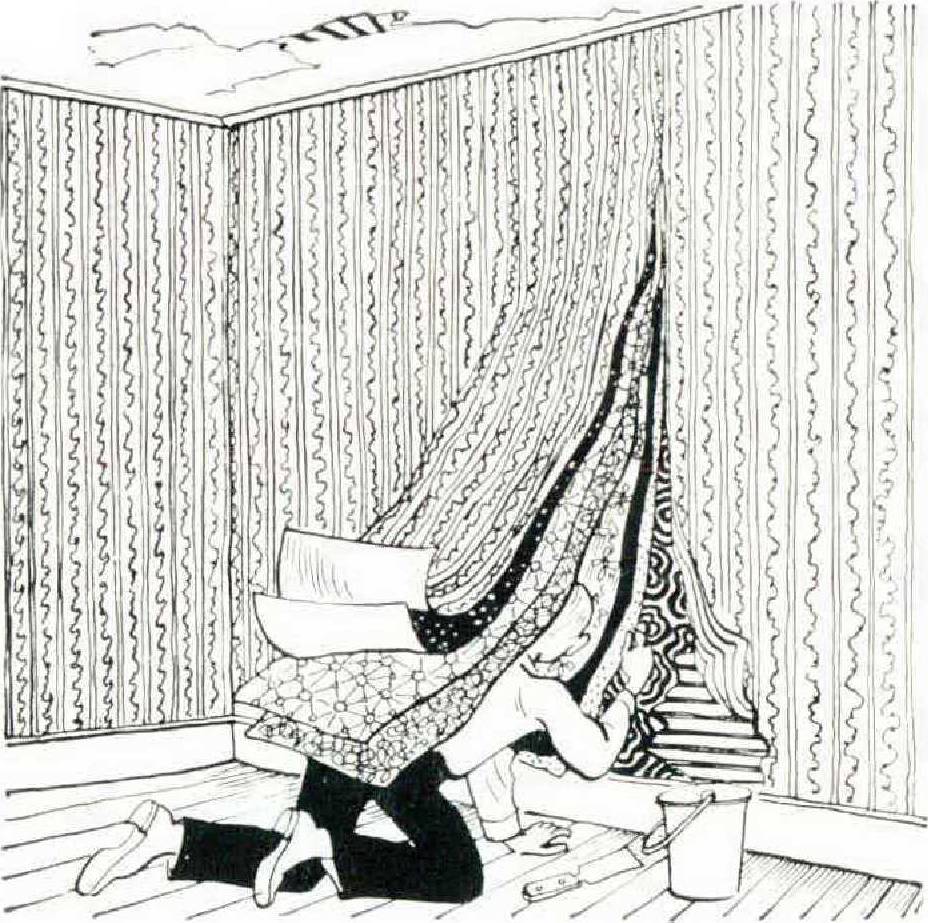
Unfortunately most people like to remove paper better than plaster. There is something about peeling things, whether old skin from sunburn or old paper from walls, that engenders a sense of accomplishment. Therefore, when peeling off wallpaper, people can’t stop when they should. This upsets the balance between paper and plaster, and once that is done it can’t be regained till the whole room is denuded down to the lathing. To avoid this, never tear off any paper that can be pushed back in place and held with a tack. If it is too far gone for that, demark a limited area with a stout knife and remove paper and plaster together. Strive for rectangles and squares when doing this. Peninsular patterns do not fit well with the pieces of wallboard or orange crate.
An especially troublesome problem is how to deal with plastered ceilings. Ceilings differ from walls in that bumps knock the plaster away from the lathing instead of towards it. This throws extra burden on the ceiling paper, and once that starts going, the only solution is a whole new ceiling. As it is easier to put on four now walls than one ceiling, this is to be avoided if any way possible. Therefore, when treating plastered ceilings, the first thing to do is find out if they won’t perhaps do without treating at all. A good rule-of-thumb method is to hit the ceiling with a fly swatter as hard as would be necessary to kill a small fly. If the ceiling stays up, let it stay — and spray it with DDT. If it falls it is wisest to sell the place; but since no one is ever that wise, here are alternatives.
Most of the paper and plaster can be got off an old ceiling with a stout stick, a pair of goggles, and a respirator. For the recalcitrant hunks protruding between the laths and locked above them you will need in addition a stepladder, a hammer and chisel, a screwdriver, and a two-week vacation. When the plaster is all of the ceiling you can then get it off the floor with the same equipment plus a wheelbarrow, a snowshovel, a broom, a vacuum cleaner, a mop, a sander, and a gallon of paint. Now we are ready to think about the new ceiling.
In the long run the most satisfaction will be had, and the nicest effect obtained, by hiring a man to come in and put on new plaster. But as there aren’t such men where fine old homes can be had for the price of the barn alone, the next best thing is those fabricated sheets of material the trade names of which end in asote, esote, isote, osote, or usote. A wide range of sizes and qualities of these is offered but as none of them looks as good as plaster and can’t be made to, you may as well get the size as near the size of the ceiling as they come and minimize the1 number of fittings. Set up stepladder. Crawl under sheet and balance on top of head. Rise slowly. Squat again carefully to retrieve spilled nails. Ascend ladder. Attach sheet to ceiling. The blows of the hammer, whacking nails into the laths, will dislodge hunks of plaster still nestling above the laths and these, caught between laths and sheet, will make the sheet look lumpy and cause one to wonder what good il did to remove the plaster at all. It did no good. It would have been better to have left il on. Which brings us to the second alternative.
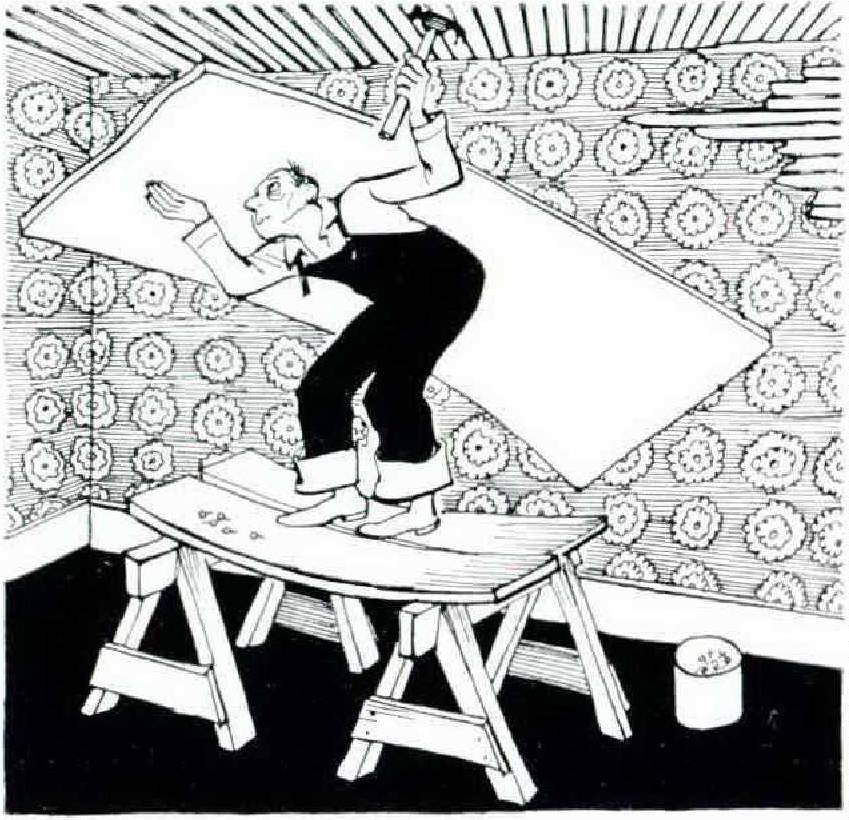
When applying fabricated sheets directly over old plaster it is si ill bad to use nails, because the hammering will bring down the plaster even better than the stout stick did. The answer, of course, is screws. Put the first screw near the center of sheet, to relieve weight on head and work from there out. Practice will probably help, but as no one who ever tried screwing fabricated sheets to a ceiling over old plaster ever tries it again, no one ever has practice.
People having mechanical genius and an unholy urge to put it to use sometimes get the idea that because the lath is put on the ceiling to hold the plaster, and the plaster to hide the lath, it should be possible to do away with both plaster and lath and nail the sheets right to the joists. Indeed it is possible. Since in fine old homes the laths always extend under the partitions into adjoining rooms, the safest way to remove them is to start anywhere on the edge and saw around.
As soon as the lath and plaster are off the ceiling and on the floor it will be noticed that all the joists that held up the lath are crooked and that no two crook the same way. Fabricated sheets nailed to these crooked joists would look like a storm on the Baltic, and if not nailed to all would sag where they weren’t; so furring strips will have to be fitted and the joists evened up. To do this, get a long straight stick and hold it crosswise of the joists. Then peer between stick and joists and estimate, if so much is planed off which joists, how much furring will have to he added to which of the others to make a nice even job. This has been done, but results suggest it would be better to take out the old warped crooked joists and put in machine-sawed new ones. This means taking up the floors of the rooms upstairs. But in these fine old homes big families were raised, and to make enough bedrooms, partitions were stuck in every which way; so to get at the floor boards you will have to remove the partitions. Having the ceilings and floors and partitions out like that may let the outside walls bulge, and that might let the roof sag, but handling those things is outside the subject of the present article; so I can’t help much there except to suggest giving up the house and moving into the barn. It was the barn that was paid for anyhow.